In today’s complex enterprise networks, visibility is
critical for maintaining security, compliance, and operational efficiency.
Logging and monitoring are foundational components of any robust security
strategy, providing actionable insights into network activity, user behavior,
and potential threats. Fortinet NSE 8 professionals must master advanced
logging and monitoring techniques to protect modern networks effectively.
For Fortinet NSE 8 Course engineers, understanding how to implement
comprehensive logging and monitoring solutions is crucial. Properly configured
systems allow organizations to detect anomalies in real time, ensure regulatory
compliance, and improve overall incident response capabilities.
Understanding Logging and Monitoring in Fortinet NSE 8
Logging involves the systematic recording of network events,
security alerts, and administrative actions. Monitoring is the ongoing analysis
of these logs to detect patterns, identify anomalies, and trigger alerts for
potential security incidents. Together, these practices enable enterprises to
maintain situational awareness, enforce policies, and respond proactively to
threats.
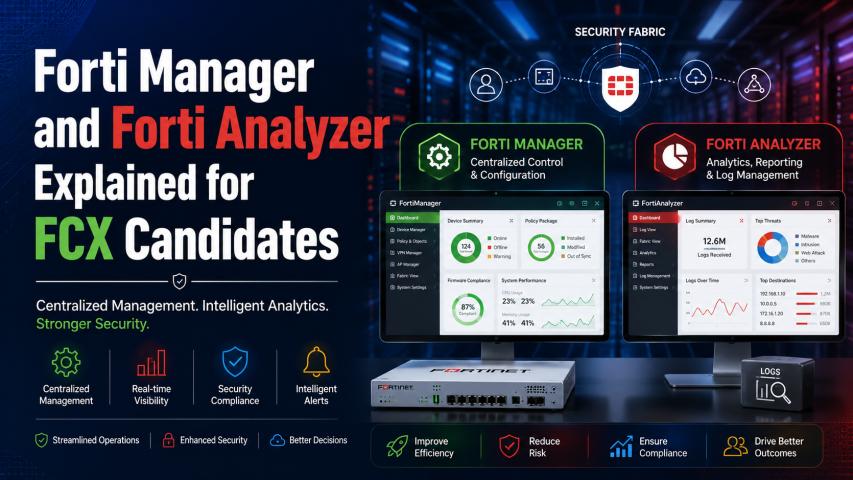
Fortinet NSE 8 firewalls, combined with FortiAnalyzer and
FortiSIEM, provide an end-to-end solution for enterprise logging and
monitoring. Key features include:
- Centralized
log aggregation: Collect logs from multiple devices and security
solutions in a single platform.
- Real-time
alerting: Detect suspicious activities as they occur to minimize dwell
time.
- Advanced
correlation: Analyze patterns across multiple data sources for
comprehensive threat detection.
- Compliance
reporting: Generate reports aligned with regulatory standards like PCI
DSS, GDPR, and ISO 27001.
Best Practices for Advanced Logging
To maximize the effectiveness of logging in Fortinet NSE 8
environments, organizations should follow these best practices:
1. Centralize Logs for Enterprise Visibility
Centralized logging consolidates data from FortiGate
firewalls, switches, access points, and endpoints. This approach provides a
holistic view of network activity, simplifies analysis, and reduces the risk of
missing critical events.
2. Enable Granular Logging
Configure detailed logging for critical events such as
administrative changes, VPN connections, firewall policy hits, and intrusion
prevention alerts. Granular logs provide the context necessary for forensic
investigations and threat analysis.
3. Use Log Retention Policies
Define log retention policies based on regulatory
requirements and organizational needs. Retaining logs for an appropriate
duration ensures compliance while optimizing storage costs.
4. Secure Log Transmission and Storage
Encrypt log data in transit and at rest to prevent
unauthorized access. Fortinet NSE 8 solutions support secure log forwarding to
FortiAnalyzer or SIEM platforms for centralized protection.
5. Regularly Review Logging Configurations
Periodically audit logging settings to ensure critical
events are captured and irrelevant logs are filtered. This practice reduces
noise, improves analysis efficiency, and optimizes system performance.
Best Practices for Advanced Monitoring
Effective monitoring complements logging by providing
actionable insights and facilitating rapid incident response. Key strategies
include:
1. Real-Time Threat Detection
Leverage FortiSIEM to correlate logs and generate real-time
alerts for anomalies such as unusual login patterns, unexpected traffic spikes,
or repeated policy violations.
2. Dashboards and Visualization
Implement custom dashboards to visualize network
performance, security incidents, and compliance metrics. Visual representation
of logs helps security teams identify trends and focus on high-priority issues.
3. Automated Incident Response
Integrate monitoring systems with automation tools to
trigger predefined actions when specific conditions are met. For example,
automatically blocking suspicious IP addresses reduces manual response time and
limits exposure.
4. Behavioral Analytics
Apply behavioral analytics to establish baselines for normal
network activity. Deviations from these baselines can indicate insider threats,
compromised accounts, or lateral movement.
5. Continuous Improvement
Regularly review alerts, dashboards, and reports to refine
detection rules, update thresholds, and enhance monitoring efficiency.
Continuous improvement ensures the system adapts to evolving threats.
Why Fortinet NSE 8 Professionals Should Focus on Logging
and Monitoring
For Fortinet NSE 8 engineers, advanced logging and
monitoring skills are essential for building resilient security
infrastructures. Organizations increasingly rely on real-time insights to
detect and respond to sophisticated threats. By mastering these practices, NSE
8 professionals can:
- Ensure
comprehensive visibility across enterprise networks.
- Reduce
mean time to detection (MTTD) and mean time to response (MTTR).
- Maintain
compliance with regulatory frameworks and audit requirements.
- Support
proactive security operations and threat hunting initiatives.
Conclusion
Implementing advanced logging and monitoring best practices
with Fortinet NSE 8 Certification is critical for maintaining security, compliance, and
operational efficiency in enterprise networks. For Fortinet NSE 8
professionals, mastering centralized logging, real-time monitoring, and
automated response enables organizations to detect anomalies, respond to
threats proactively, and ensure regulatory adherence. By following these best
practices, enterprises can achieve a resilient security posture and safeguard
critical assets against evolving cyber threats.