
Introduction
Computer vision is a branch of artificial intelligence that enables machines to read and comprehend visual data of the world. The cameras are taking pictures and videos on a minute-by-minute basis. Raw visual data do not however mean much before a system is able to analyze it. It is at this point that the essence computer vision techniques come in.
Most of the contemporary computer vision systems are based on object detection, recognition, and tracking. The technologies can assist machines with recognition of objects in images, interpretation of the objects, and their tracking throughout frames of a video. These ideas are important in numerous real-world applications; this is true in such cases as autonomous cars and security systems.
Object Detection and Comprehension.
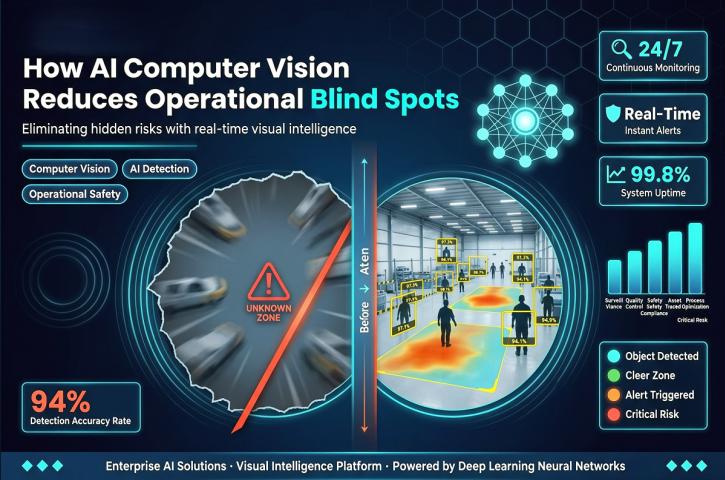
Object detection is a process that aims at determining the existence and the position of objects within a frame of an image or a video. The visual data are scanned and the places where objects are identified highlighted by the system. The bounding boxes are placed in these areas frequently.
As an illustration, in traffic surveillance, object detection can be used to figure out cars, buses, pedestrians, and bicycles on the road. The algorithm analyses visual features like shape, color and texture. Judging by these characteristics, it has the ability to decide where various objects can be found.
Current object detection networks are based on deep learning methods. Convolutional neural networks are trained on large volumes of labeled images. This assists the system to be informed as to the appearance of the different objects in different angles and lighting scenarios.
Recognition and Classification of Objects.
Once an object is detected, it is followed by recognition. Object recognition finds out what exactly the object detected is. It gives each identified item a label.
As an example, a vision system can identify multiple objects in a street picture. Identification enables the system to identify them as a car, traffic signal, pedestrian or a bicycle. This action provides significance to the objects that have been identified.
Recognition models are trained with thousands of labeled pictures. There are objects in each image, which are labeled by certain categories. The model learns to correlate the visual patterns to the appropriate labels during the training process.
Complex scenes can be comprehended by machines in this process. A security system will be capable of identifying an individual entering a restricted zone. A retail store system will be able to recognize the products displayed in shelves.
Object Tracking Videoview Analysis.
Object tracking is concerned with tracking of object movement on consecutive video frames. Tracking systems monitor the path of an object as soon as it is detected and identified.
Tracking assists in tracking the identity of objects in motion. As an illustration, a security camera can identify multiple individuals in a corridor. Tracking algorithms give each individual a distinct ID and track him over frames.
Video analytics has extensive application in this technology. On field sports analysis systems are used to monitor players. The traffic management systems track the movement of cars to determine the flow of traffic.
They have tracking techniques that are usually based on similarities and motion estimates. Objects in adjacent frames are compared by the system and the manner in which they change with time is determined.
Real-World Applications
Many of the contemporary technologies are supported in object detection, recognition, and tracking. These systems help autonomous vehicles to detect road signs, vehicles, and pedestrians. This assists the vehicle to make good judgments in driving.
Computer vision is applied in the healthcare systems to interpret medical images. The tools can help physicians to identify abnormal scans. When it comes to retail, there is the usage of vision systems in observing customer behavior and product placement.
These technologies are also very crucial in security and surveillance systems. Users can forecast suspicious motion and view abnormality in real time through cameras.
Conclusion
To summarize it, object detection, recognition and tracking are key elements of computer vision. They allow machines to recognize objects, interpret visual scenes and trace movement through time. Such technologies keep evolving as the technology advances to artificial intelligence and deep learning. With the advancement of research, computer vision systems will be more precise, efficient and able to solve complex problems in the real world.