Choosing the right mutual fund can feel overwhelming with thousands of options available in the Indian market. Returns are often the first thing investors look at, but simply picking the fund with the highest recent gains can be a costly mistake. Smart investing requires a deeper understanding of how to properly evaluate and compare fund performance.
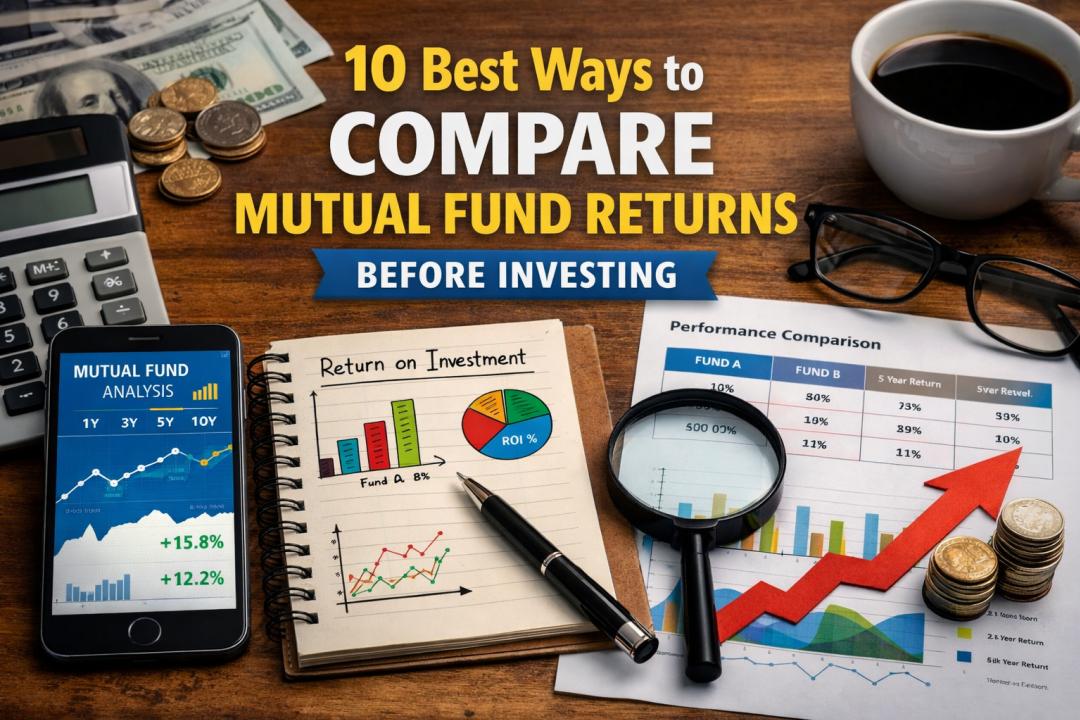
Learning how to compare mutual fund returns effectively is crucial for making informed investment decisions. The right comparison approach helps you identify funds that deliver consistent performance rather than just short-term winners. In this comprehensive guide, we'll explore ten proven methods that experienced investors use to evaluate mutual fund returns before committing their hard-earned money.
1. Analyze Long-Term Performance, Not Just Recent Returns
The biggest mistake investors make is choosing funds based solely on the past year's performance. A fund that topped the charts last year might be a mediocre performer over longer periods. Always examine at least three to five years of historical data to understand how a fund performs across different market conditions.
When you compare mutual fund returns over extended timeframes, you get insights into consistency and the fund manager's ability to navigate various market cycles including bull runs, corrections, and sideways movements. This long-term view reveals the true quality of a fund.
2. Compare Within the Same Category
Comparing a large cap fund with a small cap fund is meaningless because they operate in entirely different market segments with distinct risk-return profiles. Small cap funds naturally exhibit higher volatility and return potential, while large cap funds offer stability.
Always compare funds within identical categories. Match large cap with large cap, mid cap with mid cap, and debt funds with similar debt funds. This apples-to-apples comparison gives you accurate insights into which fund truly excels in its specific investment universe.
3. Check Benchmark Performance
Every mutual fund has a designated benchmark index that represents its investment universe. For example, a large cap fund might use the Nifty 50 as its benchmark. A fund's real value lies in its ability to consistently beat this benchmark.
When evaluating returns, see how much the fund has outperformed or underperformed its benchmark over different periods. A fund that consistently beats its benchmark by a reasonable margin demonstrates superior fund management and stock selection skills.
4. Use Rolling Returns Instead of Point-to-Point Returns
Point-to-point returns can be misleading because they depend heavily on start and end dates. A fund might show excellent 3-year returns if measured from a market bottom, but poor returns if measured from a market peak.
Rolling returns solve this problem by calculating returns across multiple overlapping periods. For instance, calculating 3-year returns starting from every month over the past 10 years gives you hundreds of data points, revealing how consistently a fund performs regardless of entry timing.
5. Evaluate Risk-Adjusted Returns
High returns mean little if they come with excessive risk. Two funds might both deliver 15% annual returns, but if one achieves this with half the volatility of the other, it's clearly the better choice for most investors.
Metrics like the Sharpe ratio measure return per unit of risk taken. A higher Sharpe ratio indicates better risk-adjusted performance. Similarly, the Sortino ratio focuses specifically on downside risk. Platforms like Quant Trade provide these advanced metrics, making it easy to compare mutual fund returns on a risk-adjusted basis.
6. Examine Performance During Market Downturns
How a fund performs when markets crash reveals its true character. Some funds fall harder than their benchmarks during bear markets, while quality funds demonstrate resilience by limiting losses.
Check how much a fund fell during the 2020 COVID crash, the 2018 correction, or earlier downturns. Funds that protect capital during bad times while participating well in good times offer the best long-term wealth creation potential.
7. Compare Expense Ratios
Expense ratios directly impact your net returns. If two similar funds deliver comparable gross returns but one charges 1% while the other charges 2%, the lower-cost fund gives you 1% more in your pocket every single year.
Over long periods, this difference compounds significantly. Always factor in expense ratios when comparing returns. Lower expenses don't guarantee better performance, but among similar performers, the one with lower costs is the obvious winner.
8. Review Consistency Through Quartile Rankings
Quartile rankings show where a fund stands compared to its peers every year. A fund might deliver top quartile (top 25%) performance some years but bottom quartile other years, indicating inconsistency.
Look for funds that consistently rank in the top two quartiles across multiple years. Consistency matters more than occasional brilliance because it suggests sustainable investment processes rather than lucky bets that worked temporarily.
9. Calculate CAGR Across Multiple Time Periods
Compound Annual Growth Rate (CAGR) smooths out year-to-year volatility and shows the steady annual return that would produce the same final value. Calculate CAGR for 1-year, 3-year, 5-year, and 10-year periods.
A fund showing strong CAGR across all these timeframes demonstrates both short-term momentum and long-term reliability. Be wary of funds with great 1-year CAGR but poor 5-year numbers, as this suggests recent performance might not be sustainable.
10. Use Technology and Analytics Platforms
Manually gathering and analyzing all this data is time-consuming and prone to errors. Modern investment platforms simplify the entire process by providing comprehensive analytics in easy-to-understand formats.
Quant Trade offers powerful tools that let you filter, compare, and analyze mutual funds using multiple parameters simultaneously. You can view rolling returns, risk metrics, quartile rankings, and benchmark comparisons all in one place, making data-driven decisions straightforward even for beginner investors.
The platform's quantitative approach removes emotional bias from fund selection, helping you focus on objective performance metrics that truly matter for long-term wealth creation.
Understanding Tax-Adjusted Returns
Returns shown by funds are typically pre-tax figures. Depending on your tax bracket and the type of fund, your actual post-tax returns might differ significantly. Equity funds held over one year attract long-term capital gains tax, while debt funds follow different tax rules.
Factor in tax implications when comparing funds, especially if you're in a high tax bracket. Sometimes a slightly lower-return fund with better tax efficiency delivers superior post-tax wealth accumulation.
Start Making Smarter Investment Decisions Today
Stop relying on guesswork or recent performance alone when selecting mutual funds. Visit Quant Trade now to access comprehensive fund analysis tools that help you compare returns, evaluate risks, and identify top-performing funds based on solid quantitative research. Whether you're a beginner or experienced investor, our platform provides the insights you need to build a winning portfolio. Make data-driven investment choices with confidence. Explore Quant Trade today and transform your mutual fund investment strategy!