Introduction
When people think about cables these days, USB-C tends to dominate the conversation. It's compact, reversible, and increasingly universal. But walk into any home office, recording studio, or IT department, and you'll still find a familiar sight the trusty USB-A to B cable connecting devices that have been around for years. It's not flashy, but it's still doing its job in 2026, and more reliably than most people expect.
What Is a USB-A to B Cable?
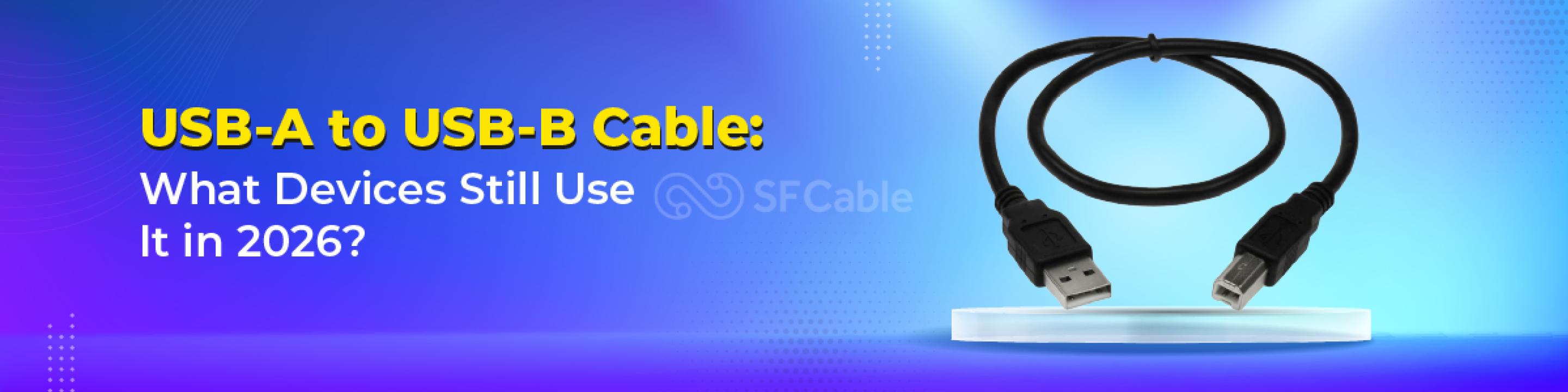
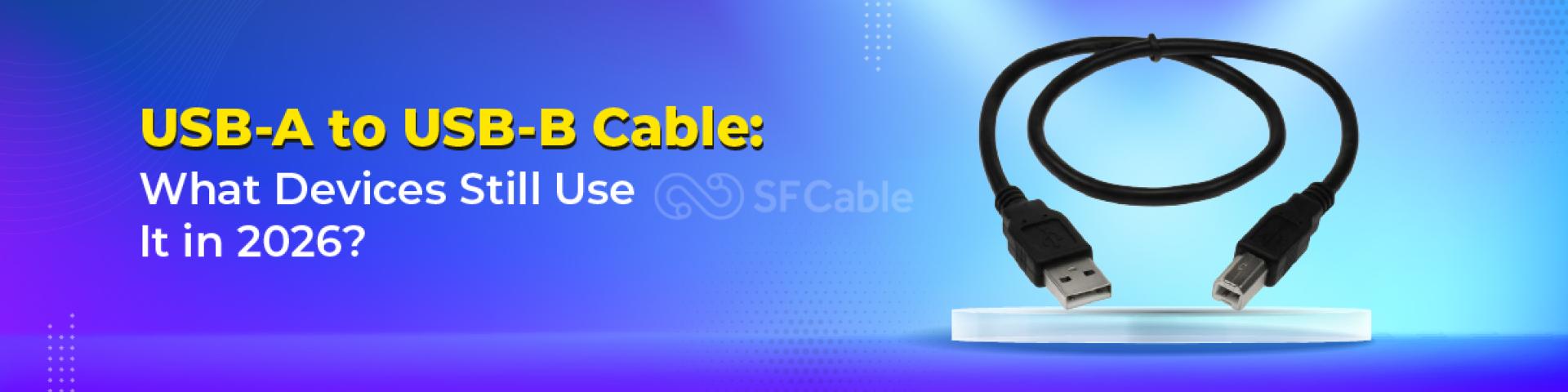
Before diving into which devices still use it, it helps to understand what this cable actually is. The USB-A to B cable is a connection cable featuring the standard rectangular USB-A connector on one end and the squarish, slightly trapezoidal USB-B connector on the other. The USB-A end plugs into your computer or power source, while the USB-B end plugs into the peripheral device. It's been a standard connection method since the early days of USB technology, and its durability and reliability have helped it survive well into the modern era.
Printers The Most Common Use Case
If you've ever set up a desktop printer, chances are you've used this cable. The vast majority of laser printers and inkjet printers from major brands like HP, Canon, Brother, and Epson still ship with or require a USB-A to B cable for direct computer-to-printer connections. Even as wireless printing has become common, many businesses and home users prefer a wired connection for its reliability and consistent performance. There are no dropped connections, no network configuration headaches just a direct, stable link between computer and printer.
Scanners and Multifunction Devices
Flatbed scanners and all-in-one printer-scanner-copier units frequently rely on this cable type as well. While high-end models have moved to USB-C or Wi-Fi, budget-friendly and mid-range scanners still widely use the USB-B port. For office environments where consistency and long-term reliability matter more than cutting-edge connectivity, these devices continue to serve their purpose well.
MIDI Keyboards and Audio Interfaces
The music production world has a deep and lasting relationship with the USB-A to B cable. MIDI keyboards, synthesizers, drum machines, and audio interfaces almost universally feature a USB-B port for connecting to computers. Brands like Focusrite, Roland, Yamaha, and Arturia have built entire product lines around this connection standard. Musicians rarely question it the cable works, latency is low, and there's no reason to change what isn't broken.
Arduino and Electronics Development Boards
Hobbyists and engineers working with Arduino boards, particularly the classic Arduino Uno and Mega, know the USB-A to B cable well. It's the standard connection for uploading sketches and powering the board via a computer. While newer Arduino models have shifted to USB-C, millions of legacy boards are still in active use, keeping demand for this cable type strong in the maker community.
External Hard Drive Enclosures
Some older external hard drive enclosures and docking stations still use USB-B ports, particularly those designed for traditional 3.5-inch drives. These devices were built to last, and many are still in use today for backup purposes or as secondary storage. If you have one of these units, you'll definitely need the right cable on hand.
Industrial and Specialized Equipment
Beyond consumer electronics, the USB-A to B cable remains standard in many industrial and specialized settings. Laboratory equipment, point-of-sale terminals, barcode scanners, and network switches frequently use USB-B ports for configuration and communication. These devices are built for long lifecycles, and manufacturers have little incentive to change port types mid-generation.
Why USB-B Hasn't Disappeared
It comes down to one simple truth: if something works well and there's no compelling reason to change it, it tends to stick around. The USB-A to B cable is robust, inexpensive, easy to replace, and universally available. For devices that sit in one place on a desk, in a rack, in a studio there's no real advantage to a reversible connector or a smaller port. The USB-B port is actually larger and more durable in many ways, making it well-suited for devices that are frequently connected and disconnected in busy environments.
Buying the Right Cable
When shopping for a USB-A to B cable in 2026, look for cables that support the USB 2.0 standard at minimum, though USB 3.0 versions (which feature a different, blue-colored USB-B port) are available for higher-speed data transfer needs. For most everyday uses like printing or MIDI, USB 2.0 is perfectly sufficient. Cable length, shielding quality, and connector build quality are the factors that matter most for long-term reliability.
Conclusion
Despite living in an era dominated by USB-C and wireless connectivity, the USB-A to B cable remains a practical and widely used connection standard in 2026. From printers and scanners to MIDI keyboards and Arduino boards, it continues to serve a broad range of devices reliably. If you work with any of these devices, keeping a good-quality USB-A to B cable in your toolkit is still very much worth it.
Original Article:- Click Here