Market Overview:
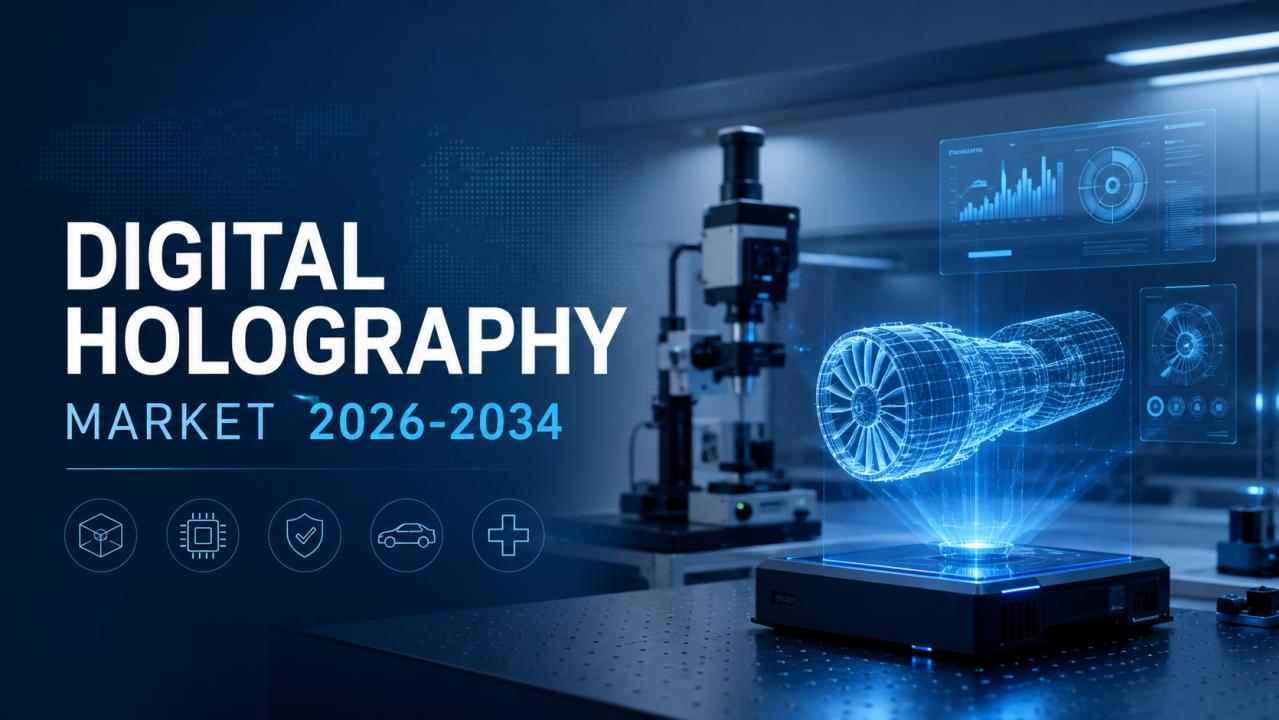
According to IMARC Group's latest research publication, "Digital Holography Market: Global Industry Trends, Share, Size, Growth, Opportunity and Forecast 2026-2034", the global digital holography market size reached USD 6.0 Billion in 2025. Looking forward, IMARC Group expects the market to reach USD 21.0 Billion by 2034, exhibiting a growth rate (CAGR) of 14.88% during 2026-2034.
This detailed analysis primarily encompasses industry size, business trends, market share, key growth factors, and regional forecasts. The report offers a comprehensive overview and integrates research findings, market assessments, and data from different sources. It also includes pivotal market dynamics like drivers and challenges, while also highlighting growth opportunities, financial insights, technological improvements, emerging trends, and innovations. Besides this, the report provides regional market evaluation, along with a competitive landscape analysis.
How AI is Reshaping the Future of the Digital Holography Market
- AI-powered reconstruction algorithms are significantly accelerating holographic image processing, enabling real-time 3D visualization from raw interference data, with processing speeds improving by up to 40% compared to conventional computational methods.
- Government programs such as the U.S. Defense Advanced Research Projects Agency (DARPA) are funding holographic battlefield visualization systems, integrating AI-driven digital holography into defense planning tools for enhanced situational awareness and target identification.
- Companies like HYPERVSN launched an AI-powered holographic platform in 2025 that allows brands to create hyper-realistic 3D advertising content capable of reacting dynamically to audience presence and behavior, merging machine learning with volumetric display technology.
- AI integration with digital holographic microscopy is accelerating drug discovery and cell therapy research, with platforms automating cell morphology analysis and cycle-kinetic tracking, reducing trial design timelines and improving diagnostic precision across oncology and regenerative medicine.
- Machine learning models embedded in holographic quality control systems are enabling real-time defect identification in aerospace and electronics manufacturing, with automated inspection reducing error rates and delivering large financial savings to manufacturers across precision production environments.
Key Trends in the Digital Holography Market
- Growing Adoption in Medical Imaging and Diagnostics: Digital holography is transforming healthcare by enabling non-invasive, high-resolution 3D visualization of tissues and organs across ophthalmology, oncology, orthopedics, and neurology. The technology allows physicians to examine detailed volumetric representations without relying on contrast media or radiation. The ophthalmology sector alone recorded total investment of USD 6.3 billion in 2024, featuring 18 mergers and acquisitions, underscoring the rapid expansion of precision imaging across medical specialties. Digital holography is also being integrated into surgical navigation systems, enhancing outcomes in minimally invasive procedures.
- Innovation in Augmented Reality Display Technology: Digital holography is increasingly central to next-generation AR device development, enabling sharper virtual imagery without conventional backlighting systems. This results in lighter, more power-efficient AR hardware capable of delivering richer immersive experiences. In 2025, NVIDIA received a patent for backlight-free augmented reality digital holographic technology ahead of CES 2025, highlighting how holographic optics are eliminating legacy display components. With AR applications expanding across entertainment, gaming, education, and healthcare, demand for advanced holographic display solutions continues to accelerate.
- Rising Demand for Anti-Counterfeiting and Security Solutions: Governments and corporations are embracing digital holography to protect currencies, identity documents, and branded packaging against fraud. The technology's ability to produce complex, three-dimensional holograms that are extremely difficult to replicate makes it a preferred choice for high-security applications. In 2024, Japan launched new banknotes featuring holographic 3D images of notable historical figures, representing the first paper currency in the world to incorporate this advanced holographic security technology, setting a new global benchmark for currency protection.
- Expansion of Holographic Displays in Retail and Advertising: Immersive 3D holographic displays are reshaping how brands engage consumers in physical retail environments. Digital holographic display applications accounted for 45.2% of total market revenue, serving flagship retail windows, medical theatres, and defense planning facilities. Brands such as Louis Vuitton reported 30% foot-traffic increases when volumetric holographic showcases were deployed in Shanghai malls. In January 2025, Proto Hologram partnered with Hologram Media Network to launch the world's first 3D holographic advertising network across 30 Simon Malls in the United States, deploying Proto Luma devices displaying engaging 3D content across key locations.
- Integration into Automotive Head-Up Display Systems: Holographic windshield displays are emerging as a major growth frontier, with automotive OEMs integrating full-windshield AR holographic overlays to project navigation cues, safety alerts, and driving data across multiple viewing zones. In October 2024, South Korea's Hyundai Mobis teamed up with German optical company ZEISS to develop an advanced holographic windshield display projecting information across the entire windshield. Market projections indicate 7 million automotive holographic HUD units will ship by 2030, as premium manufacturers race to differentiate vehicles through immersive cockpit experiences.
Growth Factors in the Digital Holography Market
- Increasing Investments in Aerospace and Defense Applications: The aerospace and defense sector represents one of the most significant demand drivers for digital holography, requiring precise 3D measurement systems for radar, surveillance, satellite communications, and advanced navigation. As per the International Trade Administration, foreign direct investment in the U.S. aerospace sector exceeded USD 20 billion by the close of 2023. Defense agencies are procuring holographic sand-table visualization systems for battlefield planning, while aerospace manufacturers are using digital holography to inspect turbine engine components and eliminate compressor seal bond failures, yielding substantial cost savings.
- Software Dominance Driving Data Processing Advancements: Software accounts for 60.0% of the digital holography market share, underpinned by its critical role in reconstructing, visualizing, and interpreting complex 3D holographic data. Sophisticated algorithms process raw data captured from CCD cameras and laser hardware, generating intricate volumetric representations essential in medical diagnostics, materials science, and industrial inspection. Software solutions are increasingly incorporating AI and ML capabilities for automated image assessment, live monitoring, and real-time analytical feedback, making holographic platforms more intelligent, scalable, and accessible across diverse verticals.
- Government Schemes Supporting Healthcare Infrastructure Expansion: Government-backed investment in healthcare infrastructure across emerging markets is directly fueling demand for advanced imaging technologies including digital holography. The Dubai Healthcare City Authority reported that Dubai's healthcare sector expanded to 4,482 private healthcare facilities and 55,208 licensed professionals by 2022, with further growth projected at 3 to 6% in facilities and 10 to 15% in licensed experts. As new hospitals and diagnostic centers open across the Middle East, Africa, and Asia-Pacific, procurement of digital holographic imaging equipment is accelerating in tandem with broader healthcare modernization programs.
- Automotive Sector Investment Fueling Asia-Pacific Demand: The automotive industry's rapid shift toward autonomous vehicles, advanced driver assistance systems, and precision manufacturing is creating robust demand for digital holography across Asia-Pacific. According to the India Brand Equity Foundation, the automotive sector received total equity foreign direct investment of approximately USD 35.65 billion between April 2000 and December 2023. As electric vehicle and autonomous platform development accelerates, digital holography is playing an increasingly central role in component inspection, assembly verification, and quality control processes across manufacturing facilities in India, China, Japan, and South Korea.
- Growing Use in Industrial Quality Control and Metrology: Digital holography's ability to perform non-contact, high-resolution 3D measurement is making it indispensable in industrial inspection environments. The technology is being deployed to evaluate the geometric accuracy of complex mechanical components, identify surface defects, and validate manufacturing tolerances across electronics, pharmaceuticals, and precision engineering sectors. Industrial production in the EU grew by 8.5% in 2021 and continued expanding in 2022, with manufacturers increasingly adopting digital holography to meet strict quality compliance requirements and reduce production defects across automated high-throughput assembly lines.
Leading Companies Operating in the Global Digital Holography Industry:
- NKT Photonics A/S
- HoloTech Switzerland AG
- Geola Digital UAB
- EON Reality Inc.
- HOLOEYE Photonics AG
- Intelligent Imaging Innovations
- RealView Imaging Ltd.
- Lyncee TEC SA
- Ovizio Imaging Systems NV
- Phase Holographic Imaging AB
- Holoxica Limited
- 4D Technology Corporation
Digital Holography Market Report Segmentation:
Breakup By Technology Type:
- Gabor's (In-Line) Holography
- Off-Axis Holography
- Others
Gabor's (in-line) holography accounts for a significant share owing to its simplicity, cost-effectiveness, and widespread utility across material science, biology, and industrial quality control applications.
Breakup By Component Type:
- Hardware
- CCD Camera
- Laser
- Micro-display
- Beam Splitter
- Mirror
- Others
- Software
Software dominates the component segment with 60.0% market share, driven by the critical role of advanced algorithms in reconstructing and analyzing complex holographic data across medical, industrial, and scientific applications.
Breakup By Application:
- Digital Holographic Displays
- Digital Holographic Microscopy
- Holographic Television and Telepresence
- Others
Digital holographic displays lead the application segment due to their expanding adoption in entertainment, advertising, medical visualization, and scientific research, delivering immersive, glasses-free 3D experiences across industries.
Breakup By Vertical:
- Automotive
- Medical
- Aerospace and Defense
- Others
Medical accounts for the largest vertical share at 23.7% in 2025, driven by growing demand for precise, non-invasive 3D diagnostic imaging across ophthalmology, oncology, neurology, and surgical navigation applications.
Breakup By Region:
- North America (United States, Canada)
- Asia Pacific (China, Japan, India, South Korea, Australia, Indonesia, Others)
- Europe (Germany, France, United Kingdom, Italy, Spain, Russia, Others)
- Latin America (Brazil, Mexico, Others)
- Middle East and Africa
North America enjoys the leading position with over 33.7% market share, driven by advanced research infrastructure, strong government investment in aerospace and defense, widespread healthcare technology adoption, and the presence of leading holographic hardware and software companies.
Recent News and Developments in the Digital Holography Market
- April 2024: Swave Photonics developed the first 3D holographic display technology for small extended reality devices, introducing Holographic eXtended Reality with a pixel pitch of less than 300 nm, creating the smallest pixel in the world and ushering in a new generation of holographic display technologies.
- October 2024: South Korea's Hyundai Mobis partnered with German optical equipment company ZEISS to develop an advanced holographic windshield display capable of projecting driving information across the entire windshield, representing a significant evolution beyond conventional head-up display systems.
- December 2024: Eastman, Ceres Holographics, and Covestro signed a Memorandum of Understanding to co-develop holographic windshield displays, signaling a major cross-industry collaboration targeting next-generation automotive display platforms.
- January 2025: Hyundai Mobis debuted the world's first full-windshield holographic head-up display at CES 2025, featuring three simultaneous display zones projecting navigation, alerts, and content, with mass production targets set for 2027.
- January 2025: Proto Hologram partnered with Hologram Media Network to launch the world's first 3D holographic advertising network across 30 Simon Malls in the United States, deploying Proto Luma devices displaying engaging volumetric 3D content at flagship retail locations.
- February 2025: Ikonz Studios, an AI company specializing in hyper-realistic multilingual digital avatars and holographic technology, raised USD 5 million in strategic pre-Series A funding to accelerate integration of generative AI with real-time holographic interaction platforms.
Note: If you require specific details, data, or insights that are not currently included in the scope of this report, we are happy to accommodate your request. As part of our customization service, we will gather and provide the additional information you need, tailored to your specific requirements. Please let us know your exact needs, and we will ensure the report is updated accordingly to meet your expectations.
About Us:
IMARC Group is a global management consulting firm that helps the world's most ambitious changemakers to create a lasting impact. The company provides a comprehensive suite of market entry and expansion services. IMARC offerings include thorough market assessment, feasibility studies, company incorporation assistance, factory setup support, regulatory approvals and licensing navigation, branding, marketing and sales strategies, competitive landscape and benchmarking analyses, pricing and cost research, and procurement research.
Contact Us:
IMARC Group
134 N 4th St. Brooklyn, NY 11249, USA
Email: sales@imarcgroup.com
Tel No:(D) +91 120 433 0800
United States: +1-201971-6302