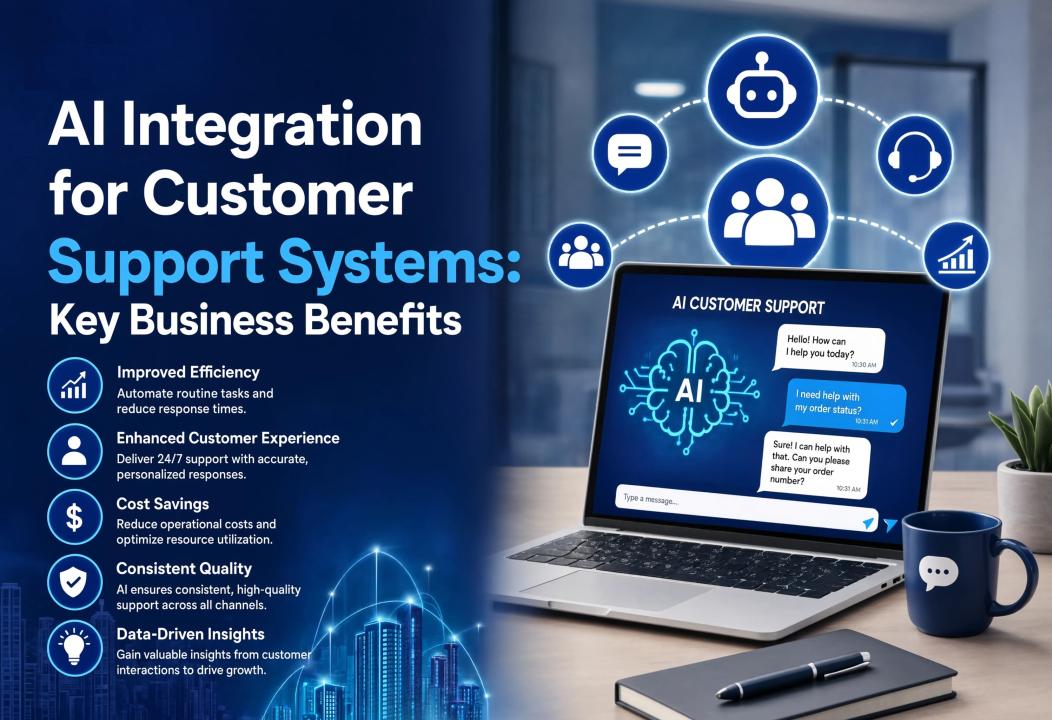
Customer support teams are under pressure to manage rising ticket volumes, multilingual conversations, and customer expectations that now demand instant responses. This is why businesses are investing in AI Integration Services to connect automation, analytics, chatbots, CRM systems, and generative AI tools into their support operations.
In 2026, AI integration is no longer limited to basic chatbots. Companies are using AI integration solutions to reduce response times, improve support quality, and lower operational costs without expanding large support teams.
Businesses working with an experienced AI Development Company are now integrating AI across help desks, live chat systems, knowledge bases, and customer data platforms to create more efficient support workflows.
Why AI Integration Matters in Customer Support
Customer support systems often operate across multiple tools such as CRM platforms, ticketing software, email systems, and messaging apps. Without integration, support agents spend significant time switching between systems and manually searching for information.
AI Integration Consulting helps businesses connect these systems so AI can process customer queries, suggest responses, analyze sentiment, and automate repetitive tasks.
Common AI integrations in support systems include:
- AI-powered chatbots
- Generative AI response suggestions
- Automated ticket routing
- Voice-to-text support analysis
- AI knowledge base search
- Predictive customer intent analysis
- Multilingual customer assistance
Companies adopting Artificial Intelligence Integration Services are focusing on faster service delivery and more accurate customer interactions.
Key Business Benefits of AI Integration Services
1. Faster Customer Response Times
One of the biggest reasons companies invest in AI integration solutions is response speed.
AI systems can instantly analyze customer queries and either:
- Resolve simple requests automatically
- Route tickets to the correct department
- Provide agents with suggested answers
This reduces waiting times and improves first-response metrics.
For example, AI-integrated support systems can identify billing issues, login problems, or refund requests within seconds and trigger predefined workflows.
2. Lower Support Costs
Hiring and scaling large customer support teams is expensive. Businesses are now using Generative AI Integration Services to handle repetitive support requests without increasing staffing costs.
AI can manage:
- FAQs
- Password resets
- Order tracking
- Appointment scheduling
- Basic troubleshooting
This allows human agents to focus on high-priority or complex customer cases.
According to 2026 industry trends, companies using AI-driven customer support systems are reporting lower ticket handling costs and improved agent productivity.
3. Better Agent Productivity
Support agents lose time searching for customer records, previous tickets, and internal documentation.
AI integration services connect support tools with CRM and internal knowledge systems so agents receive relevant information during live conversations.
This helps agents:
- Respond more accurately
- Reduce manual work
- Handle more tickets per shift
- Maintain conversation consistency
Businesses that Hire AI integration developers often prioritize workflow automation because it directly affects operational efficiency.
4. 24/7 Customer Support Availability
Customers expect support beyond traditional business hours.
AI-powered chat systems allow businesses to provide round-the-clock assistance without operating large overnight support teams.
Modern AI systems can:
- Handle multiple conversations simultaneously
- Support global time zones
- Escalate urgent issues automatically
- Continue conversations across channels
This is especially valuable for SaaS companies, eCommerce platforms, healthcare providers, and financial service businesses.
5. Smarter Customer Insights
AI systems analyze customer conversations at scale. Businesses can identify:
- Frequent complaints
- Product issues
- Customer sentiment trends
- Service bottlenecks
- Churn indicators
AI Integration Consulting services help companies convert support conversations into actionable business intelligence.
In 2026, predictive support analytics is becoming a major focus area for enterprises looking to reduce customer churn and improve retention.
6. Multilingual Support for Global Customers
Generative AI tools now support advanced multilingual conversations with contextual understanding.
Businesses using AI integration solutions can support customers across regions without building large multilingual teams.
AI systems can:
- Translate conversations in real time
- Detect regional language preferences
- Maintain contextual accuracy
- Support localized responses
This is particularly useful for global eCommerce and SaaS companies expanding into new markets.
2026 AI Trends Shaping Customer Support
Generative AI-Powered Agent Assistance
Generative AI is increasingly being used to assist support agents during live conversations by:
- Drafting replies
- Summarizing customer issues
- Suggesting next actions
- Generating ticket notes
AI Voice Support Systems
AI voice systems are improving call center efficiency with:
- Real-time transcription
- Sentiment analysis
- Intelligent call routing
- Automated quality monitoring
Predictive Customer Service
AI models now identify customers likely to escalate complaints or cancel services before issues become critical.
Unified AI Support Ecosystems
Businesses are moving toward centralized AI support environments where CRM, ticketing, analytics, and communication tools work together through AI integration services.
How to Choose the Right AI Integration Strategy
Before implementing AI in customer support systems, businesses should evaluate:
Existing Support Infrastructure
Review current CRM systems, help desk software, APIs, and customer communication channels.
Integration Compatibility
Not every AI platform works smoothly with existing systems. Compatibility planning is important before deployment.
Data Quality
AI systems depend on accurate customer and support data. Poor-quality data affects performance.
Security and Compliance
Customer support often involves sensitive customer information. Businesses must evaluate privacy requirements and compliance standards.
Scalability
AI systems should support future growth, additional channels, and increasing customer interactions.
Businesses looking for long-term AI adoption often work with specialized teams offering AI Integration Services and consulting support for architecture planning and deployment.
You can explore how modern AI Integration Services support customer service automation, workflow connectivity, and generative AI implementation across enterprise systems.
FAQ: AI Integration for Customer Support Systems
1. What are AI integration services?
AI Integration Services help businesses connect AI tools with existing software systems such as CRM platforms, help desk software, chat systems, and analytics tools.
2. How does AI improve customer support?
AI improves customer support by reducing response times, automating repetitive tasks, assisting support agents, and analyzing customer interactions for insights.
3. What industries benefit most from AI customer support integration?
Industries such as eCommerce, healthcare, SaaS, banking, logistics, and telecom are actively investing in AI integration solutions for customer support operations.
4. Is generative AI useful for customer support?
Yes. Generative AI helps create contextual responses, summarize conversations, assist support agents, and automate customer interactions.
5. Should businesses hire AI integration developers?
Businesses with complex workflows or enterprise systems often hire AI integration developers to build scalable integrations and custom AI workflows.
Final Thoughts
AI integration is becoming a core part of modern customer support strategy. Businesses are using AI integration solutions to reduce operational costs, improve customer experiences, and support growing service demands without depending entirely on manual processes.
As AI tools continue to mature in 2026, companies investing in structured AI integration consulting and scalable support automation are likely to gain stronger operational efficiency and faster customer response capabilities.