Search for a drone battery online and the results look nearly identical: similar Wh/kg claims, similar cycle-life numbers, similar promises of "premium NMC chemistry." What those listings rarely reveal is whether you're buying from an actual drone battery manufacturer or from a trading company relabeling someone else's cells — and that distinction is exactly where flight-time consistency, safety validation, and after-sales support tend to fall apart.
The Question That Actually Matters: Who Built the Cell?
A battery that's 100g lighter but carries 20% higher internal resistance will lose more flight time to Joule heating than it gains from being lighter. That kind of cell-to-cell inconsistency is nearly invisible on a datasheet, but it's the first thing to show up in the field — as unexplained flight-time variance across a fleet, or packs that perform fine in isolation but drift apart after a few dozen cycles.
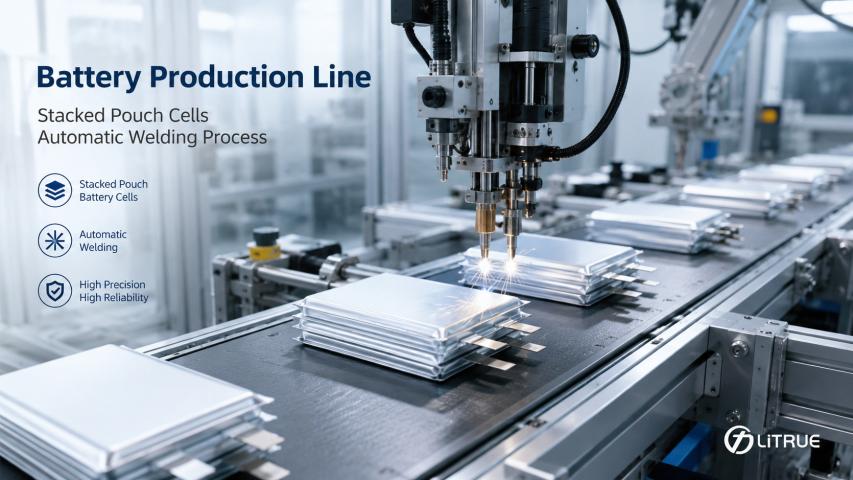
That's why the more useful question when evaluating a supplier isn't "what's your energy density," but "do you manufacture the cell yourself, on your own production line, or are you sourcing and repackaging?" LiTrue Power Technologies Co., Ltd. builds its UAV battery packs on a 1P14S configuration using Tier-1 Grade A cells, assembled on automated production lines specifically so that every cell in the string is voltage- and resistance-matched — the kind of consistency a relabeled, mixed-batch pack usually can't guarantee.
Certification Coverage Is a Manufacturing Signal, Not Paperwork
Safety certification is often treated as a compliance checkbox, but it's actually a proxy for how seriously a factory tests its own product. Every UAV pack LiTrue ships is tested against GB/T 38930-2020 — the design standard specific to drone battery packs — alongside GB/T 38058-2019 and GB 31241-2022, ensuring that "lightweight" or "high-discharge" never quietly becomes "under-tested." A supplier that can produce this documentation on request, batch by batch, is signaling something different than one that can only point to a generic UN38.3 stamp on a shared product line.
What the Right Drone Battery Manufacturer Actually Ships
The proof of this approach shows up in how LiTrue's UAV lineup is structured — not as one generic pack, but as purpose-built options matched to specific mission profiles:
- Weight-sensitive mapping and inspection: the 51.8V 20Ah lightweight drone battery (UAV-JP220M), at 6.8kg for 1.036kWh, engineered for aircraft where the battery itself is the payload limit.
- Heavy-lift agricultural spraying: the 51.8V 28Ah high-discharge NMC battery (UAV-JP328L), delivering 140A continuous / 280A peak discharge for aggressive motor demand under a full payload.
- Ultra-heavy-lift spraying platforms: the 66.6V 30Ah smart drone battery (UAV-JP330L), built on a voltage platform sized for thrust that standard-voltage packs can't sustain.
Each is IP65-rated, communicates over CAN bus directly with the flight controller for overcharge, over-discharge, and over-current protection, and is validated across a wide operating temperature range — details that only show up consistently across a product line when the same engineering team designed and tested every SKU. LiTrue's complete UAV range is available in the product catalog.