Autonomous mobile robots (AMRs) in logistics centers typically run 20+ hours per day, and the metric that quietly determines whether a fleet deployment succeeds isn't runtime — it's how fast a robot can top up during a shift change and get back on the floor. Fast-charge capability at 2C or higher is essential precisely because it lets robots recharge in the gaps between tasks rather than requiring dedicated downtime, and cycle life matters just as much: a warehouse robot can rack up 500+ charge cycles in a single year, which is a very different stress profile than a consumer device charged once a day.
The Math Nobody Runs Before Buying: Charge Time × Fleet Size
A capacity upgrade looks like the obvious lever for extending robot uptime, but it solves the wrong problem. More Ah means a longer run before the next charge, but it also means a longer charge afterward unless the charging rate scales with it — and in a facility running a 20+ robot fleet, even a modest increase in per-unit charge time compounds into meaningful lost throughput across a shift. The variable that actually protects fleet-wide uptime is charge rate, not capacity: a pack that can safely accept 2C or higher lets a robot use a 10-15 minute gap productively instead of sitting idle for an hour.
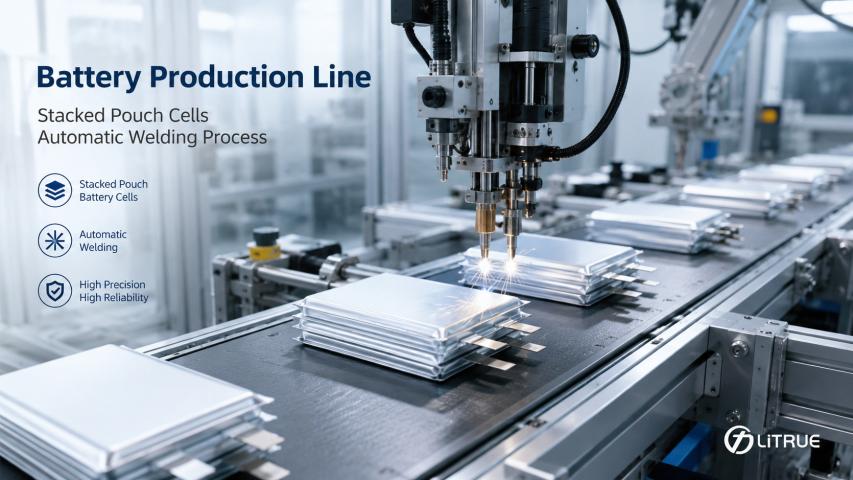
LiTrue Power Technologies Co., Ltd. applies the same fast-recharge engineering across its battery lineup that AMR and industrial robotics platforms depend on. The UAV-JP220M, for example, supports 40A fast charging with a 60A peak — a spec built for exactly this kind of fleet-uptime management, where turnaround time between missions matters as much as flight time itself. That same design philosophy — a BMS engineered to accept high charge current safely rather than throttle it defensively — carries over into LiTrue's industrial and robotics-oriented cell lines.
Fast Charging Only Works If the BMS Can Actually Manage It
Charging at 2C or higher isn't just a cell-chemistry question — it's a battery management question. Pushing high current into a pack without precise, real-time monitoring risks uneven cell aging and, in the worst case, thermal events. LiTrue's CAN-bus BMS architecture, used across its UAV and industrial packs, reports state of charge, cell voltage delta, and temperature in real time, which is what makes safe fast-charging possible in the first place rather than just theoretically supported on a spec sheet. This is also why cycle-life ratings matter more for robotics than for most consumer applications: a pack rated for 500+ cycles per year needs consistent cell-to-cell balance sustained across thousands of partial-charge events, not just a single deep discharge test in a lab.
Where This Applies Beyond Warehouse Robots
- AMRs and automated warehousing: fast partial-charge cycles during shift changes, sustained across 500+ cycles annually.
- AGVs on continuous production lines: opportunity charging in short breaks without pulling equipment out of rotation, an approach detailed further in LiTrue's 24V Lithium Battery: B2B Industrial Power Guide.
- Commercial drone fleets: rapid turnaround between missions, where the same fast-charge BMS logic protects flight schedule density rather than just single-flight endurance.
LiTrue's full range of high C-rate and fast-charging cell and pack options, spanning UAV, AGV, and industrial robotics applications, is available in the product catalog.