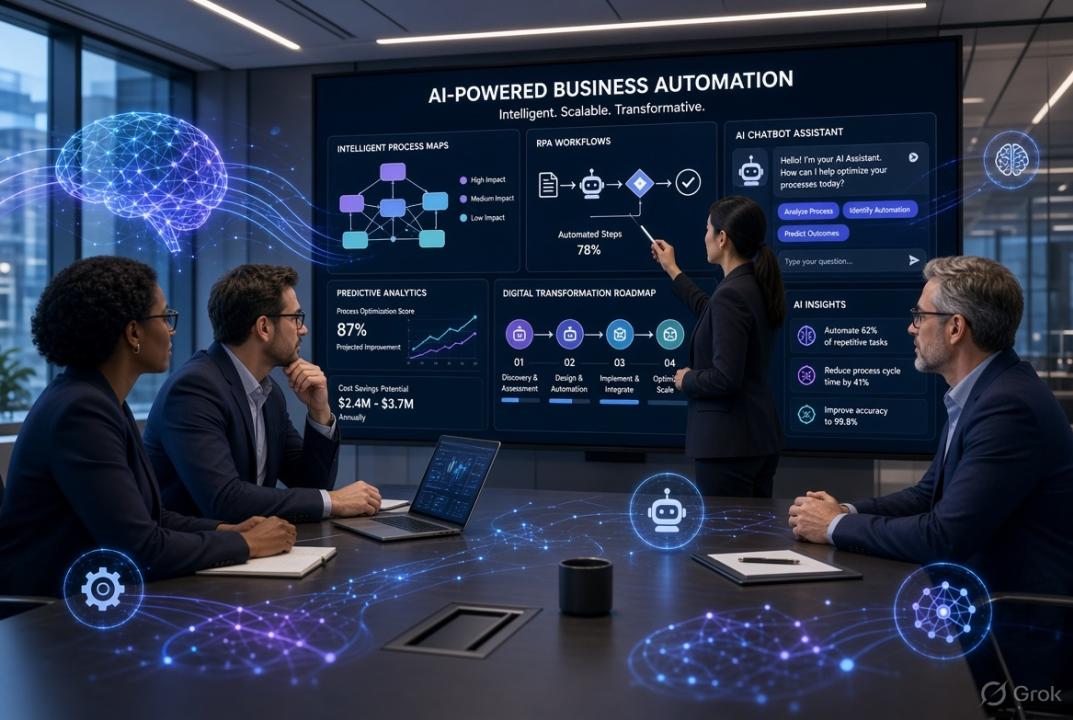
Business automation has been around for years, helping companies reduce repetitive work, streamline workflows, and improve productivity. But the introduction of artificial intelligence (AI) is changing what automation can actually accomplish.
Traditional automation typically follows predefined rules. If something happens, the system performs a specific action.
AI-powered automation is different. It can analyze information, recognize patterns, understand language, make recommendations, and in some cases take action based on changing circumstances.
This shift is transforming the role of the business automation consultant. Instead of simply identifying repetitive tasks and connecting software tools, modern automation consultants can help businesses design intelligent workflows that continuously improve how work gets done.
What Is AI-Powered Business Automation?
AI-powered business automation combines traditional workflow automation with artificial intelligence technologies.
Traditional automation might look like:
If a customer submits a form → create a CRM record → send an email.
AI-powered automation can go further:
A customer submits a form → AI analyzes the inquiry → identifies the customer's needs → categorizes the lead → determines its priority → updates the CRM → generates a personalized response → alerts the appropriate salesperson.
The difference is significant.
AI allows automated systems to handle situations that aren't always perfectly predictable.
The Changing Role of a Business Automation Consultant
The role of an automation consultant is evolving.
Previously, a consultant might focus primarily on mapping workflows, identifying repetitive tasks, and recommending automation tools.
Today, a business automation consultant may also evaluate:
- Where AI can add value
- Which business decisions can be partially automated
- How AI agents can interact with existing systems
- How employees should work alongside AI
- How data should move between platforms
- Where human approval is still necessary
- How to measure automation performance
The consultant's job is therefore becoming less about simply automating tasks and more about redesigning business processes around intelligent technology.
1. AI Can Automate More Complex Workflows
Traditional automation works best when processes are predictable.
For example:
New order received → update inventory → send confirmation → create invoice.
AI can help automate workflows where the information isn't always structured.
For example, an AI system could read an incoming customer email, understand what the customer needs, identify the relevant order, classify the request, and route it to the correct department.
This creates opportunities for business process automation consulting beyond simple rule-based workflows.
2. AI Improves Lead Management
Sales teams often receive leads from multiple sources.
Manually reviewing and categorizing these leads can take significant time.
AI can analyze information from forms, emails, CRM records, and previous interactions to help determine lead quality and intent.
A business automation consultant can design a workflow where:
- A lead enters the CRM.
- AI analyzes the available information.
- The lead is categorized.
- High-priority leads are routed to sales.
- Lower-priority leads enter a nurturing workflow.
- Relevant information is recorded automatically.
The sales team can then spend more time talking to qualified prospects instead of sorting through every inquiry manually.
3. AI Makes Customer Support More Intelligent
Customer service is another area where AI is having a major impact.
Chatbots and AI assistants can handle routine questions, summarize customer conversations, retrieve information, and route complex issues to human representatives.
The objective isn't necessarily to remove humans from customer service.
Instead, AI business automation can handle repetitive interactions while employees focus on situations requiring empathy, judgment, or specialized knowledge.
This can improve response times while reducing the workload on support teams.
4. AI Can Understand Unstructured Data
Businesses generate enormous amounts of information through emails, documents, contracts, invoices, messages, and customer conversations.
Traditional automation often struggles with unstructured information.
AI can analyze natural language and extract useful information from these sources.
For example, an AI-powered workflow could review an incoming document and identify:
- Customer name
- Contract value
- Important dates
- Payment terms
- Renewal information
- Required actions
The extracted information can then be transferred into the appropriate business system.
This creates significant opportunities for intelligent business automation solutions.
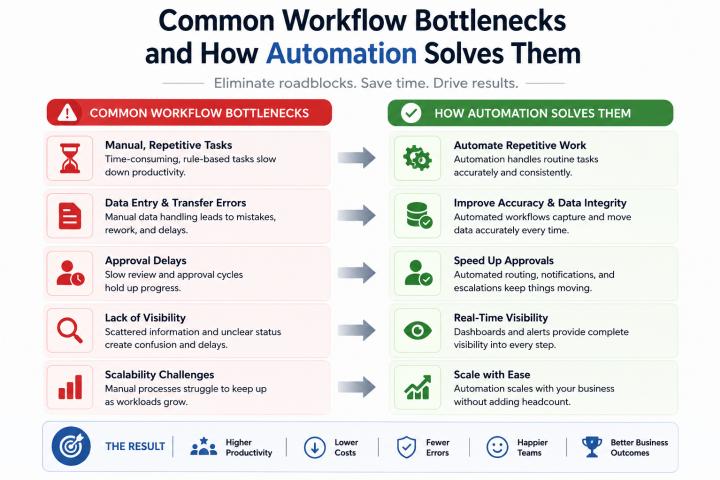
5. AI Helps Reduce Manual Data Entry
Manual data entry is repetitive, time-consuming, and vulnerable to errors.
AI-powered automation can extract information from emails, forms, documents, and other sources and transfer it into business applications.
For example:
Email → AI reads information → identifies customer details → updates CRM → creates task → notifies employee.
Instead of employees copying information between systems, the workflow handles much of the process automatically.
6. AI Enables More Personalized Marketing
Automation has already transformed email marketing, but AI can make these workflows more dynamic.
AI can analyze customer behavior and help determine:
- What content a customer may be interested in
- When they should receive a message
- Which product or service may be relevant
- Whether they are ready for a sales conversation
A business automation consultant can combine CRM data, marketing automation, and AI to create personalized customer journeys.
This allows businesses to move beyond generic automated campaigns.
7. AI Agents Are Expanding Automation Capabilities
One of the most interesting developments in business automation is the emergence of AI agents.
Unlike traditional automation, which generally performs predefined actions, AI agents can be designed to pursue a goal by selecting and executing multiple steps.
For example, an AI agent might receive a request to prepare a sales report.
It could potentially:
- Retrieve CRM information
- Analyze sales data
- Identify trends
- Create a summary
- Prepare a report
- Send it to the appropriate manager
Human oversight can still be incorporated where decisions have financial, legal, security, or customer-impact implications.
8. AI Helps Businesses Make Better Decisions
Automation isn't only about completing tasks faster.
AI can also help businesses interpret information.
For example, an AI-powered system could analyze sales data and identify declining performance in a particular customer segment.
A business automation consultant can incorporate these insights into automated reporting workflows so management receives relevant information without manually reviewing multiple dashboards.
The result is a more proactive approach to business management.
9. AI Can Connect Disconnected Business Systems
Most businesses use several software platforms.
CRM, accounting, marketing, project management, customer support, and communication tools may all contain valuable information.
When these systems don't communicate effectively, employees often become the connection between them.
AI-powered integrations can help reduce this dependency.
A business process automation consultant can evaluate how information moves between systems and determine where APIs, automation platforms, and AI can create a more connected workflow.
10. AI Changes the Way Businesses Think About Automation
Perhaps the biggest change is strategic.
Businesses no longer need to ask only:
"What repetitive task can we automate?"
They can also ask:
"What business process could work better if AI were involved?"
That is a much broader question.
It encourages businesses to redesign workflows rather than simply automate individual tasks.
A Practical AI Automation Roadmap
Businesses don't need to implement AI everywhere at once.
A practical approach is to start small.
Step 1: Map Current Processes
Identify repetitive, slow, expensive, or error-prone workflows.
Step 2: Prioritize Opportunities
Evaluate each process based on potential time savings, business impact, complexity, and risk.
Step 3: Identify AI Use Cases
Determine whether traditional automation, AI, or a combination of both is appropriate.
Step 4: Select the Right Technology
Choose tools based on existing systems, integration requirements, security, scalability, and business objectives.
Step 5: Start With a Pilot
Test one workflow before expanding automation across the organization.
Step 6: Keep Humans in the Loop
Not every decision should be fully automated. Establish approval points for sensitive or high-impact decisions.
Step 7: Measure Results
Track metrics such as:
- Time saved
- Processing speed
- Error reduction
- Employee productivity
- Customer response time
- Cost savings
- Conversion rates
Step 8: Improve Continuously
Use performance data and employee feedback to refine the workflow over time.
Will AI Replace Business Automation Consultants?
It's unlikely that AI will eliminate the need for automation consultants. Instead, it is likely to change what they do.
Businesses still need someone who understands their goals, processes, technology environment, risks, and employees.
Choosing what should be automated can be just as important as knowing how to automate it.
A skilled automation consultant can help ensure that AI is being applied where it creates genuine business value rather than simply adding another technology layer.
Final Thoughts
AI is transforming business automation from simple rule-based workflows into more intelligent and adaptive systems.
From lead qualification and customer service to document processing, reporting, data entry, and workflow management, AI can help businesses handle increasingly complex processes with less manual effort.
However, successful automation isn't about implementing as much AI as possible.
It's about identifying the right problems, selecting the right technology, designing practical workflows, and keeping people involved where human judgment matters.
That is where an experienced business automation consultant can make a real difference.
Ready to explore what AI could automate in your business? Contact a business automation consultant today to identify your highest-impact workflows, develop an AI automation strategy, and turn repetitive processes into smarter, scalable systems.