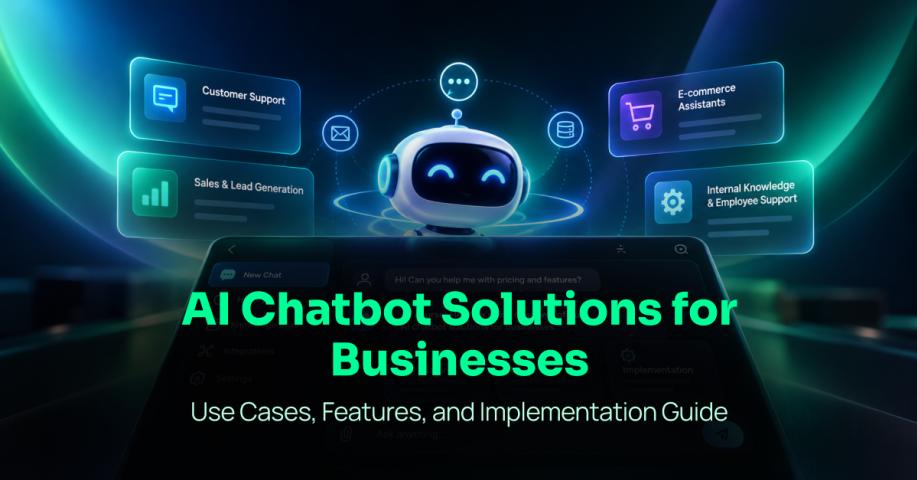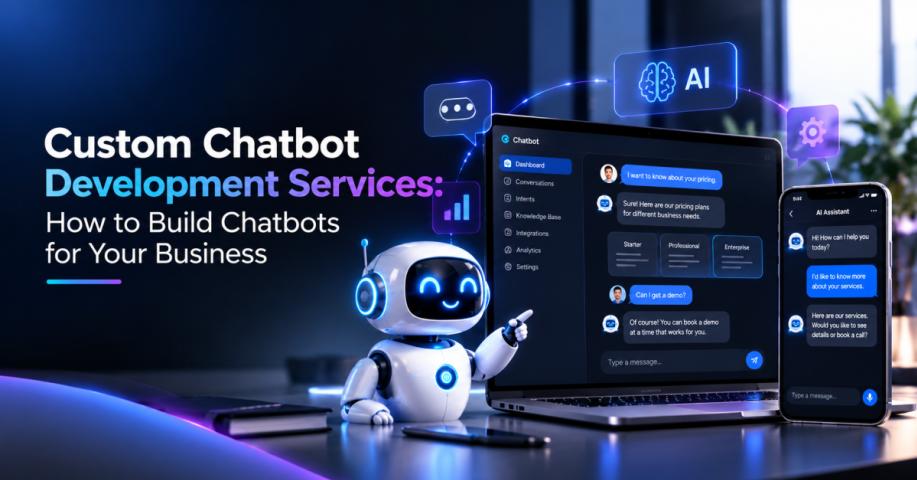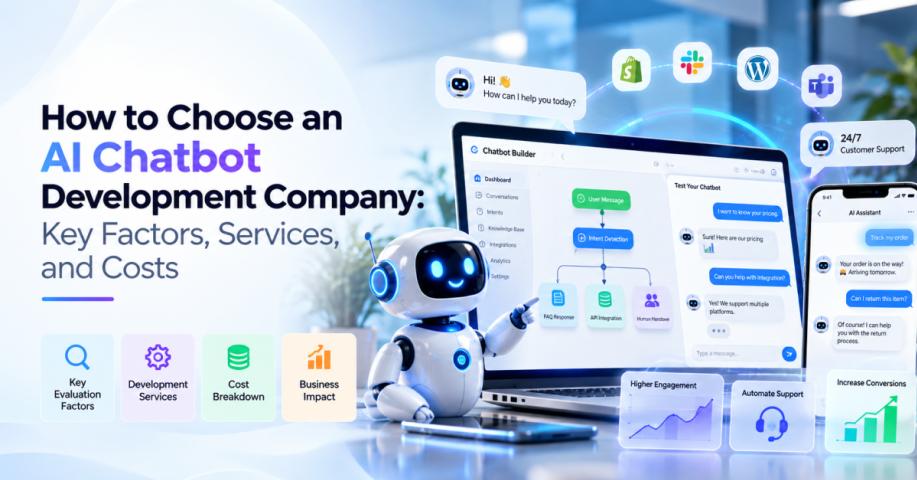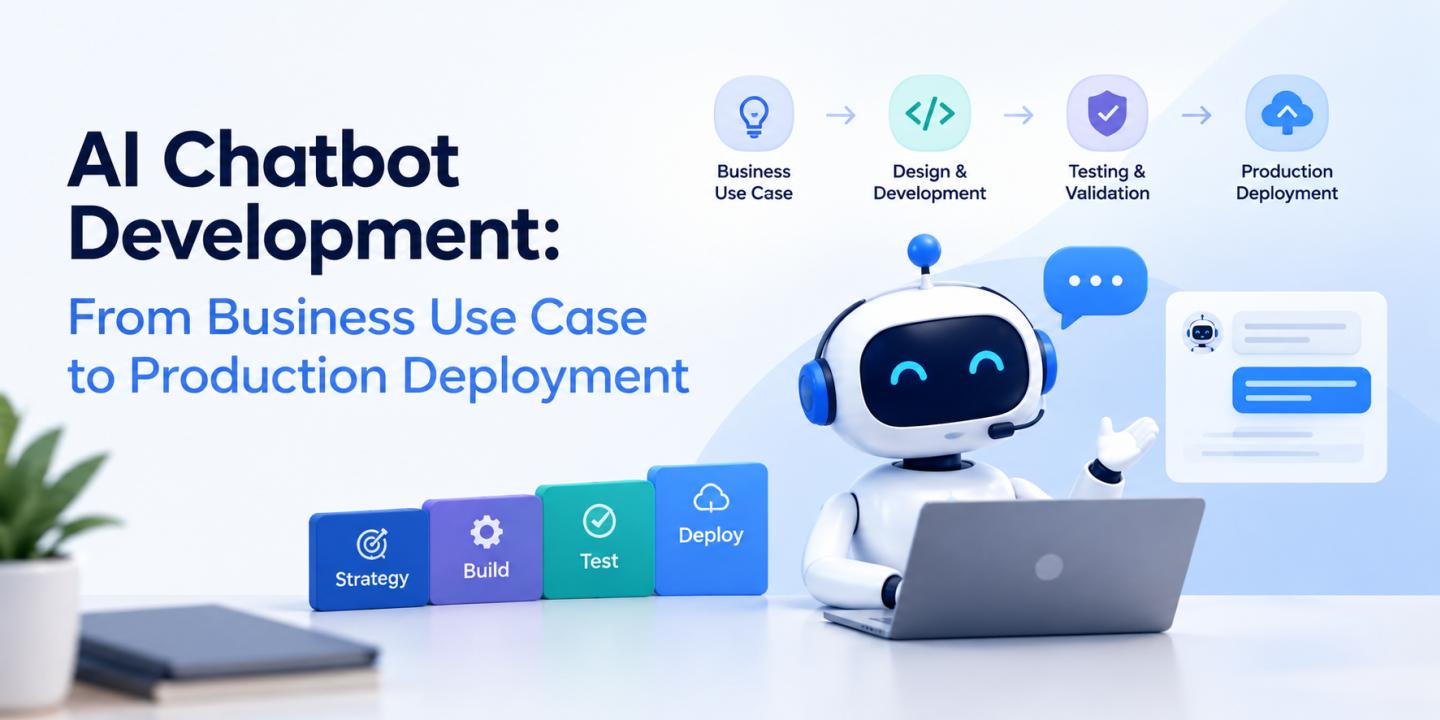
AI chatbots have moved beyond basic FAQ automation. Businesses now use them to support customers, qualify leads, assist employees, retrieve internal knowledge, schedule appointments, and connect users with business systems. But building a chatbot that works in a demo is very different from deploying one that reliably operates in production. Successful AI chatbot development starts with a clear business problem and continues through architecture, conversation design, AI model selection, knowledge integration, security, testing, deployment, and optimization. This is where AI chatbot solutions can help businesses turn conversational AI into a practical business capability.
1. Start With the Business Use Case
The first step in AI chatbot development is identifying what the chatbot needs to accomplish rather than immediately selecting an LLM or framework.
Common business objectives include:
- Reducing repetitive customer support requests
- Qualifying and routing sales leads
- Helping employees find internal information
- Automating appointment scheduling
- Providing product recommendations
- Answering questions using company documentation
- Supporting multiple languages
Businesses should also define what the chatbot should not handle. Identify target users, expected conversation volume, required data, connected systems, escalation requirements, and success metrics. This prevents teams from building an impressive chatbot that solves the wrong business problem.
2. Design the Right Chatbot Architecture
Once the use case is defined, design an architecture that can support production requirements. A typical enterprise chatbot includes the conversational interface, orchestration layer, AI/LLM layer, knowledge or retrieval layer, business logic, API integrations, security controls, and analytics.
A simple FAQ chatbot may only require an LLM connected to a controlled knowledge base. A customer-service chatbot may need CRM integration, authentication, retrieval, workflow automation, human handoff, and transaction APIs.
The architecture should therefore match the complexity of the intended workflow.
3. Design Conversation Flows
Conversation design determines how users interact with the chatbot. Start by mapping common user journeys and define the user intent, required information, expected response, follow-up questions, business rules, error conditions, escalation points, and completion criteria.
For example, an appointment-booking chatbot may need to identify the service, collect a preferred date, check availability through an API, confirm the selection, and provide appointment details.
A production chatbot should also handle incomplete inputs, topic changes, unexpected questions, and out-of-scope requests without creating a frustrating user experience.
4. Select the Right AI and LLM Strategy
AI model selection should be based on business requirements rather than popularity. During AI chatbot development, evaluate models based on:
- Response quality and reasoning
- Context-window requirements
- Latency
- Token and infrastructure costs
- Multilingual capabilities
- Data privacy
- Tool and function-calling support
- Deployment requirements
A smaller model may be sufficient for straightforward interactions, while complex workflows may require stronger reasoning capabilities. Keeping the model layer flexible also allows businesses to evaluate or replace models without rebuilding the complete chatbot architecture.
5. Connect Business Knowledge With RAG
An LLM's general knowledge is rarely enough for an enterprise chatbot. Businesses often need responses based on product documentation, internal policies, FAQs, service manuals, support information, databases, and business applications.
Retrieval-Augmented Generation (RAG) allows the system to retrieve relevant information from approved sources and provide that context to the model before generating a response.
However, adding RAG does not automatically guarantee accuracy. Teams must consider document processing, chunking, metadata, embeddings, retrieval quality, permissions, grounding, and evaluation. Knowledge sources should also be maintained continuously because outdated information can lead to inaccurate responses.
6. Integrate Business Systems
A chatbot becomes significantly more useful when it can securely interact with existing business systems. Common integrations include CRM platforms, ERP systems, e-commerce platforms, helpdesk software, appointment systems, databases, internal APIs, and communication platforms.
For example, a sales chatbot can retrieve customer information from a CRM and create a lead after qualifying a prospect. An e-commerce chatbot can retrieve product information, check inventory, and guide customers toward relevant products.
These integrations turn the chatbot from a question-answering interface into a business workflow layer. Each integration should have clearly defined permissions and actions.
7. Build Security and Access Controls
Security must be addressed before production deployment. A secure chatbot architecture should cover authentication, authorization, data encryption, API security, role-based access, sensitive-data handling, prompt-injection risks, output validation, audit logging, and data retention.
Access control is particularly important for enterprise knowledge assistants. Users may have different permissions for the same information. The retrieval layer and connected APIs should enforce authorization rather than relying on the LLM to determine what information a user can access.
8. Test With Realistic Scenarios
Traditional software testing alone is not enough for AI-powered conversational systems. Responses can vary based on context, retrieved information, model behavior, and conversation history.
Before deployment, create an evaluation dataset covering common questions, ambiguous requests, incomplete inputs, out-of-scope questions, sensitive-data scenarios, adversarial prompts, multi-turn conversations, integration failures, and human handoffs.
Measure accuracy, relevance, groundedness, task completion, safety, latency, cost, and successful tool execution. For RAG applications, evaluate both retrieval quality and the final generated response.
9. Prepare for Human Handoff
A production chatbot should know when not to answer. Human intervention may be required when the user requests a sensitive action, the chatbot lacks sufficient information, repeated attempts fail, a request falls outside its scope, or human approval is required.
The handoff should preserve relevant conversation context so users do not need to explain their issue again. This creates a hybrid support model where AI handles suitable interactions while people manage exceptions and higher-value cases.
10. Deploy in Controlled Stages
Production deployment should be gradual rather than a single switch. Start in a development environment with controlled datasets and mock APIs. Move to staging to test production-like infrastructure, security, integrations, and failure scenarios.
Next, release the chatbot to a limited user group or selected workflows. After validating performance, reliability, security, and business outcomes, expand to full production.
This staged approach reduces deployment risk and makes unexpected behavior easier to identify.
11. Monitor and Optimize After Deployment
Deployment is not the end of AI chatbot development. Production monitoring should cover both application performance and AI-specific quality signals.
Track response latency, error rates, API failures, conversation completion, escalation rates, user feedback, retrieval quality, response accuracy, token consumption, cost per interaction, and knowledge-source failures.
Production data can reveal issues that controlled testing misses. For example, frequent user rephrasing may indicate poor intent recognition or retrieval. High abandonment may indicate a confusing workflow. Accurate but expensive responses may require changes to model selection, prompts, caching, or retrieval configuration.
Regular evaluation is especially important after changing models, prompts, knowledge sources, integrations, or orchestration logic.
12. Consider AI Development Services for Complex Projects
As chatbot projects become more sophisticated, businesses may need expertise across AI architecture, LLM engineering, data integration, security, and production operations. An experienced AI development services provider can help businesses move from an initial use case to a production-ready architecture.
This becomes especially valuable when the chatbot must work with enterprise data, multiple APIs, complex workflows, private infrastructure, or strict security requirements.
13. When a Chatbot Should Evolve Into an AI Agent
Not every conversational workflow requires an agentic architecture. A chatbot is often sufficient for answering questions, retrieving information, or guiding users through predefined processes.
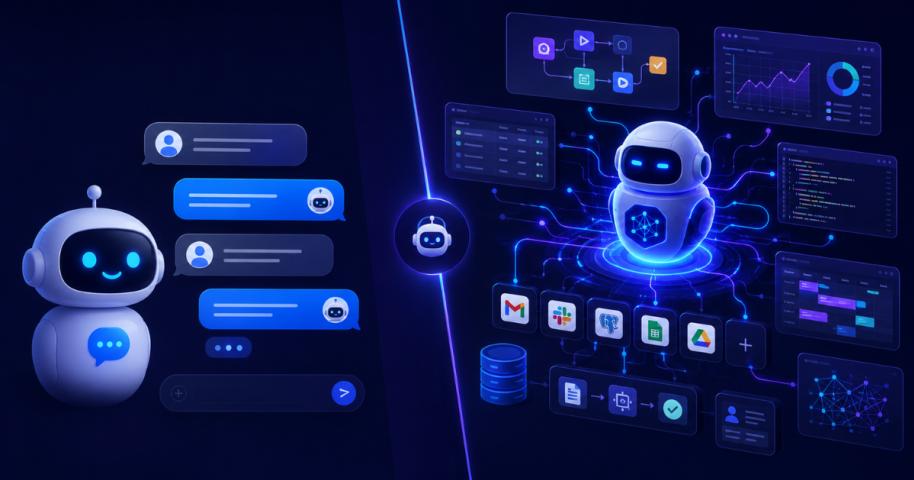
More complex workflows may require the system to reason through multiple steps, select tools, execute actions, and coordinate information across systems. For example, a support assistant could identify an issue, retrieve account information, check an order system, create a support ticket, and notify the appropriate team.
In such cases, Custom AI agent development can extend conversational AI into more autonomous workflows. The decision should be based on workflow complexity and business requirements rather than simply adopting agents because they are newer technology.
Key Considerations for Production-Ready AI Chatbot Development
Before moving a chatbot into production, businesses should clearly understand:
- What business problem does it solve?
- Who are the target users?
- What information does it require?
- Does it need RAG?
- Which systems must it integrate with?
- What actions can it perform?
- What permissions does it require?
- When should it hand off to a human?
- How will response quality be evaluated?
- Which security controls are required?
- How will production behavior be monitored?
- Which metrics will determine business success?
Conclusion
Successful AI chatbot development is more than connecting an LLM to a chat interface. It is a complete product and engineering process that begins with a specific business use case and continues through architecture, conversation design, knowledge integration, security, testing, deployment, and optimization.
The strongest implementations connect AI capabilities with measurable business processes. They use trusted knowledge, integrate securely with existing systems, evaluate realistic scenarios, and deploy in controlled stages.
After launch, continuous monitoring and optimization help businesses improve response quality, control costs, identify failures, and adapt to changing requirements. When these stages are treated as one connected lifecycle, businesses can move from a promising chatbot prototype to a production system that delivers measurable value.