AI adoption has shifted from experimentation to enterprise-wide transformation. CIOs are now expected to lead strategic investment decisions that influence operational efficiency, product innovation, and long-term competitiveness. As organizations expand their digital ecosystems, investing in large-scale AI Development Services has become a priority rather than an option. But high-value AI initiatives are complex, resource-intensive, and often misunderstood at the leadership level. Before committing budgets and timelines, CIOs need clarity on architecture, governance, ROI, and scalability.
This article outlines the essential considerations every technology leader should evaluate before partnering with an AI Development Company for mission-critical solutions. It highlights technical realities, organizational readiness, and measurable business outcomes that define successful enterprise AI adoption in 2025 and the years ahead.
1. AI is no longer an isolated project. It is a systems-level investment.
Enterprise AI is now integrated across workflows, analytics, cloud architectures, and product ecosystems. CIOs must treat AI as a company-wide capability rather than a single department initiative. Machine learning workloads, vector databases, multimodal models, and generative AI pipelines influence multiple layers of infrastructure.
Leadership needs a unified strategy that addresses:
• Data interoperability across business units
• High-performance computing requirements
• Cloud and on-prem orchestration choices
• API-first architectures to support future automation
• Lifecycle costs for training, fine-tuning, and versioning
Without a holistic strategy, organizations end up with fragmented POCs that fail to scale. Aligning stakeholders, security leads, and engineering functions early ensures sustainable adoption.
2. Data maturity determines the upper limit of AI performance.
No model outperforms the quality of its data. Enterprise AI efforts fail most often due to gaps in data readiness, not algorithmic limitations. CIOs must assess the organization’s data maturity before investing in Custom AI Development Services.
Key checks include:
• Data completeness across operational systems
• Governance models for accuracy, labeling, and lineage
• Reliability of data pipelines
• Compatibility with structured and unstructured formats
• Privacy readiness for user-generated and sensitive data
Modern architectures increasingly rely on vector embeddings, metadata enrichment, and unified data lakes. Enterprises with inconsistent data governance often experience inflated costs and poor model outcomes. A data audit or quality benchmarking exercise is essential before development begins. Industry research continues to emphasize that clean datasets can reduce AI operational costs by a significant margin.
3. Security and compliance frameworks cannot be an afterthought.
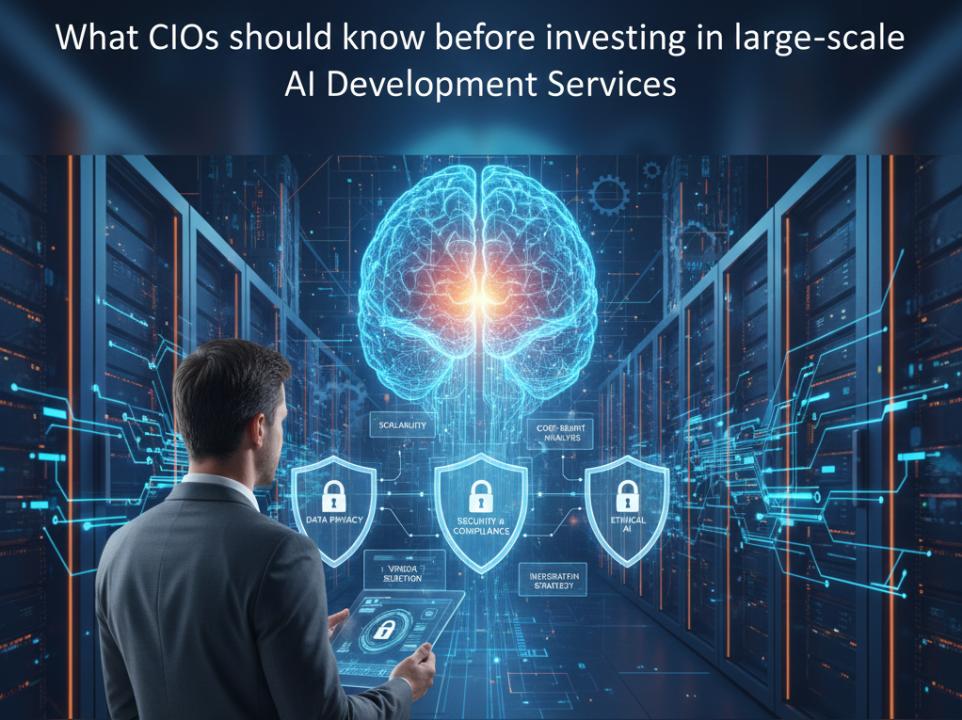
Every large-scale AI model interacts with internal data, user behavior, or proprietary systems. Security and compliance must therefore be embedded at every stage of development. Enterprise teams should work with providers who specialize in secure model training, controlled access policies, and cloud compliance standards.
CIOs should validate:
• Zero trust architecture compatibility
• Guardrails for prompt injection and data leakage
• Isolation for confidential workloads
• Adherence to global regulations such as GDPR, CCPA, and region-specific AI governance laws
• Continuous auditing and risk monitoring
The future of AI relies heavily on secure pipelines and transparent governance controls. Ignoring early compliance introduces financial risk and brand liability. Enterprises should evaluate whether the development partner has experience delivering secure and compliant AI systems at scale.
4. Model choice depends on long-term scalability, not hype.
The AI market is evolving rapidly. Although large foundation models get significant attention, not all enterprise use cases require them. In many scenarios, task-specific models offer faster training, lower compute costs, and higher accuracy.
CIOs should look beyond marketing narratives and evaluate:
• Whether open-source, proprietary, or hybrid models align with business demands
• Infrastructure requirements for inference speed
• Long-term licensing implications
• Maintenance and fine-tuning costs across the model lifecycle
• Integration complexity with existing workflows
The most strategic approach is selecting a model architecture that balances cost, accuracy, and enterprise governance. A provider skilled in Full-Stack AI Development can help teams design end-to-end systems that evolve with changing AI standards.
5. Talent alignment is a major determinant of AI success.
Even the most advanced AI solution requires strong internal alignment to succeed. Enterprise teams often underestimate the role of cross-functional talent. AI-first organizations typically integrate product managers, domain specialists, machine learning engineers, DevOps, and compliance experts within the same initiative.
CIOs should assess:
• Whether current engineering teams can maintain the deployed models
• Skill gaps in MLOps, model monitoring, and retraining workflows
• The organization’s ability to support iterative experimentation
• Change management readiness for AI-assisted operations
Investing in training or internal upskilling is often as important as investing in the platform itself. A development partner must also provide transparent documentation and handover processes that enable teams to maintain and scale the system after deployment.
6. ROI must be measured in operational and strategic terms.
AI investments do not produce results overnight. The return is realized through operational efficiency, workforce productivity, new revenue channels, and customer experience enhancements. CIOs must define success metrics early to justify long-term value.
Common ROI drivers include:
• Reduced manual workload across high-volume tasks
• Lower cost-to-serve through automated intelligence
• Real-time decision-making supported by predictive algorithms
• Revenue expansion from AI-enhanced products and services
• Faster delivery cycles through intelligent automation
Setting clear KPIs helps leadership measure outcomes and adjust implementation roadmaps. Enterprise studies indicate that organizations with defined AI governance and metrics achieve significantly higher ROI.
7. Vendor partnerships impact speed, quality, and sustainability.
Choosing the right AI partner is often the difference between a successful deployment and a costly redesign. CIOs should prioritize vendors with proven enterprise experience, strong research background, and transparent processes.
Evaluation criteria include:
• Portfolio of successful large-scale implementations
• Ability to integrate with cloud providers and legacy systems
• Technical expertise across machine learning, generative AI, and automation
• Flexible engagement models that support ongoing iteration
• Clear communication and documentation standards
Enterprises benefit from a partner that prioritizes outcomes over technology hype. A reliable AI provider will guide strategy, architecture, and execution while ensuring long-term scalability.
Conclusion
Enterprise AI adoption is entering a new era defined by accountability, integrated architectures, and measurable business impact. CIOs who approach AI as a strategic investment rather than a technology trend are better positioned to deliver sustainable value. Evaluating data maturity, security controls, talent readiness, model selection, and vendor expertise is essential before committing to large-scale AI development.
Building scalable AI capabilities requires collaboration across business and technology units, followed by careful planning and governance. Organizations that invest thoughtfully can create long-term competitive advantages and improve operational resilience with advanced AI solutions.