
Generative AI has shifted from innovation labs into boardroom discussions. Enterprises and well-funded startups now evaluate AI not as an experiment, but as infrastructure that influences cost efficiency, decision velocity, and product differentiation. The moment an organization realizes internal teams can no longer move fast without increasing risk is often when a Generative AI development company becomes a practical consideration rather than an aspirational one.
This decision is rarely driven by curiosity. It is driven by scale, accountability, and return on investment. Understanding when to make that move determines whether generative AI becomes a durable asset or a stalled initiative.
From Controlled Pilots to Operational Dependence
Most enterprises begin with narrow pilots. These are often safe, internal-facing tools built on top of public APIs. The shift happens when early results attract leadership attention and AI outputs begin influencing daily operations.
At this stage, organizations face new pressures:
- Consistent performance across departments and geographies
- Predictable cost behavior under increasing usage
- Clear accountability for failures, bias, or incorrect outputs
This is where Generative AI Development Services enter the picture. The focus moves away from experimentation toward reliability, maintainability, and long-term scalability.
Data Complexity Becomes the Primary Constraint
Generative AI delivers real value only when it understands internal context. Contracts, policies, technical documentation, historical customer interactions, and operational data all sit in fragmented systems with strict access rules.
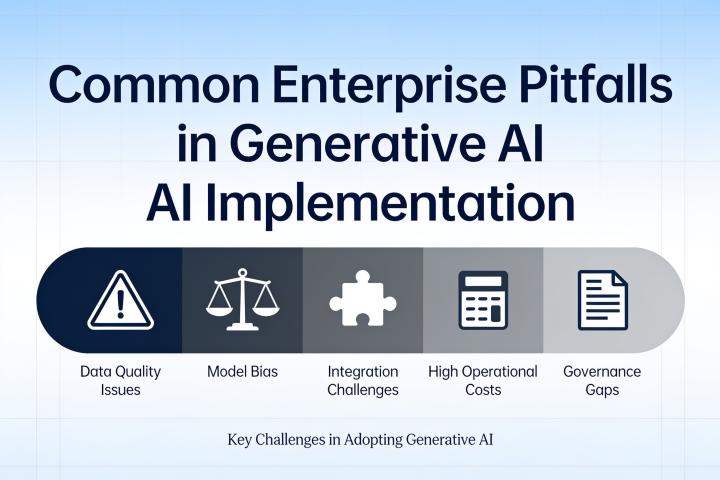
Enterprises often discover that their biggest challenge is not model capability, but data readiness. Without structured retrieval pipelines, permission-aware access layers, and quality controls, output quality degrades quickly. Industry research consistently identifies enterprise data fragmentation as a leading blocker for AI scale.
At this point, many organizations realize they need external expertise to align AI systems with existing data realities.
When Generic Models Stop Meeting Business Expectations
Public foundation models perform well for broad tasks, but enterprise use cases demand specificity. Legal teams require accuracy. Sales teams require contextual relevance. Operations teams require predictable behavior.
This is where Custom Generative Model Development becomes relevant. Rather than depending entirely on general-purpose models, enterprises start investing in systems shaped by their own data, language, and workflows. These systems are easier to control, easier to audit, and more aligned with business goals.
Building and maintaining them internally requires skills that many organizations do not yet have at scale.
Integration Becomes More Difficult Than Model Selection
Generative AI only creates value when embedded inside real workflows. That means connecting AI outputs with CRMs, ERPs, support platforms, analytics tools, and internal applications.
The challenge is not technical novelty. It is operational friction. Authentication, latency, orchestration, fallback logic, and monitoring all become critical. This is where Generative AI Integration Services matter most, because adoption depends on how naturally AI fits into existing systems.
Enterprises that underestimate integration complexity often see promising tools go unused.
Governance and Risk Can No Longer Be Deferred
As AI systems influence customer communication, internal decisions, or compliance-related processes, risk exposure increases. Enterprises face questions around auditability, bias, explainability, and regulatory alignment.
This is not a problem that tooling alone can solve. Policy design, review workflows, escalation paths, and usage boundaries must be defined upfront. Generative AI Consulting plays a role here by helping organizations establish operational guardrails before AI becomes deeply embedded.
Regulatory expectations continue to evolve across regions, making proactive governance a strategic requirement rather than a defensive one.
Internal Teams Reach a Practical Ceiling
Even strong engineering organizations face bandwidth limits. As generative initiatives multiply, teams struggle to balance experimentation, production support, and core roadmap delivery.
Common signals include:
- Prototypes that never reach production
- Heavy dependence on a few AI specialists
- Inconsistent evaluation standards across projects
At this stage, leadership often reframes the challenge. The question becomes how to extend internal capacity without diluting ownership or control.
ROI Becomes a Non-Negotiable Metric
Once generative AI appears on capital allocation plans, financial justification matters. Executives expect measurable outcomes tied to efficiency, revenue, or risk reduction.
This is where mature delivery experience helps. Enterprises that define success metrics early tend to extract more value from their investments. These metrics often include cycle-time reduction, operational cost savings, or improved decision accuracy rather than abstract innovation goals.
Market studies show organizations with defined AI KPIs are more likely to sustain long-term adoption.
Competitive Pressure Accelerates the Timeline
In many industries, generative AI is no longer optional. Customers expect faster responses, better personalization, and smarter tools. Competitors that deploy AI responsibly gain speed advantages that are difficult to reverse.
This pressure often forces enterprises to move faster than internal teams alone can manage. External development support helps compress timelines without compromising stability.
Knowing When the Timing Is Right
Not every organization needs immediate external involvement. The right moment typically appears when:
- AI pilots demonstrate clear operational or commercial value
- Data and integration challenges slow progress
- Governance and compliance risks increase
- Leadership demands consistent ROI visibility
Closing Perspective
Generative AI adoption is not a linear journey. It is a shift in how organizations think about knowledge, automation, and decision-making. Enterprises that recognize when internal efforts must be reinforced with external expertise tend to scale more responsibly and more profitably.
When aligned with business priorities, Generative AI solutions move beyond experimentation and become part of the enterprise operating model. The organizations that succeed are those that invest at the right moment, with clarity, discipline, and long-term intent.