Sales teams today operate under growing pressure. Marketing channels generate more inbound interest than ever, yet sales reps still spend a large portion of their time filtering low-intent leads, answering repetitive questions, and manually updating CRM records. For enterprises and fast-scaling startups, this imbalance directly affects pipeline velocity and revenue predictability.
This is where AI Chatbot Development Services are becoming a practical investment rather than an experimental one. Modern chatbots are no longer simple scripted tools. When powered by generative models and integrated into sales systems, they actively participate in lead qualification and sales operations, working alongside human teams rather than replacing them.
Why traditional lead qualification no longer scales
Conventional lead qualification relies heavily on static forms, manual scoring rules, and delayed follow-ups. While this approach worked when inbound volumes were manageable, it struggles under today’s demand.
High-intent prospects expect immediate responses. Delays of even a few minutes can reduce conversion rates significantly, according to multiple industry studies. At the same time, sales teams cannot afford to engage deeply with every inbound inquiry, especially when many leads are still in early research stages.
Generative chatbots address this gap by handling first-touch interactions at scale while preserving context and intent.
What makes generative AI chatbots different
Unlike rule-based bots, Generative AI Chatbots can interpret open-ended queries, adapt conversations dynamically, and ask intelligent follow-up questions. This capability allows them to behave more like a skilled sales development representative than a static support widget.
They can identify buying signals, understand industry-specific language, and adjust responses based on how a prospect engages. This matters because lead qualification is not just about collecting data. It is about understanding readiness, urgency, and fit.
When implemented as part of AI Chatbot Solutions, these systems become active contributors to revenue operations rather than passive tools.
Improving lead qualification with conversational intelligence
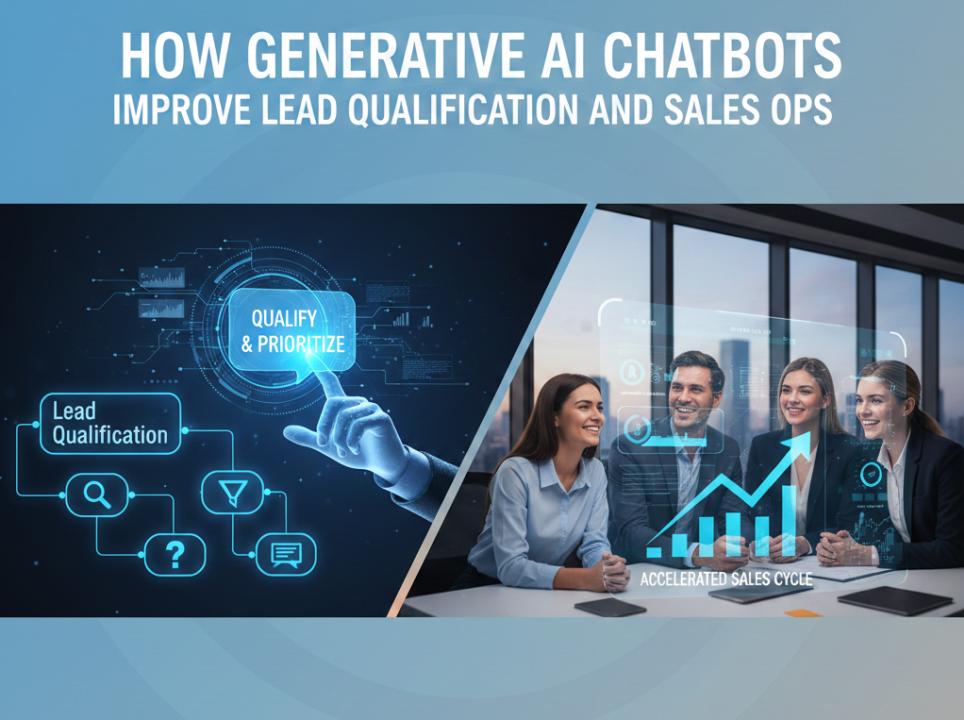
One of the most direct benefits of conversational AI is its impact on lead quality. Instead of relying solely on form fields, chatbots qualify leads through natural dialogue.
For example, a chatbot can ask contextual questions about company size, use case, timeline, and budget without sounding transactional. Based on responses, it can segment leads into categories such as sales-ready, nurture-required, or disqualified.
This approach delivers three measurable outcomes:
- Sales teams receive fewer but higher-quality leads.
- Response time to qualified prospects drops to near zero.
- Marketing gains clearer insight into why leads convert or stall.
Organizations using advanced Conversational AI development often report higher sales acceptance rates for marketing-qualified leads.
Real-time routing and CRM alignment
Lead qualification is only valuable if it connects smoothly to sales workflows. Generative chatbots can integrate directly with CRM platforms, marketing automation tools, and sales engagement systems.
Once a lead meets predefined qualification thresholds, the chatbot can route it instantly to the appropriate sales team, book meetings, or create enriched CRM records. This eliminates manual data entry and reduces the risk of context loss between marketing and sales.
For enterprise environments with complex account structures, Custom Chatbot Development Solutions allow logic to be aligned with account-based sales strategies, regional routing, and compliance requirements.
Reducing sales ops overhead
Sales operations teams often act as the glue between strategy and execution. They manage tools, processes, reporting, and data hygiene. Generative chatbots reduce this operational load in several ways.
They can:
- Automatically log conversations and qualification data
- Update lead and contact records in real time
- Trigger workflows based on conversational outcomes
- Surface insights on objection patterns and buyer intent
Over time, this leads to cleaner data and more reliable forecasting. According to industry benchmarks, poor CRM data quality costs organizations millions annually in lost productivity and missed opportunities.
Use cases across industries
While the mechanics remain similar, application varies by sector.
In B2B SaaS, chatbots qualify demo requests by confirming technical requirements and stakeholder involvement. In manufacturing, they gather specifications and route inquiries to specialized sales engineers. In regulated industries, they handle early-stage education while maintaining compliance boundaries.
For digital-first brands, E-commerce chatbot development focuses on identifying high-value buyers, supporting product discovery, and escalating purchase-ready users to human sales or account teams.
These use cases highlight why enterprises often partner with an experienced AI Chatbot Development Company rather than relying on off-the-shelf tools.
Measuring ROI beyond cost reduction
The business case for chatbots is often framed around cost savings, but the real ROI lies in revenue impact.
Key performance indicators to track include:
- Increase in sales-qualified lead conversion rate
- Reduction in average response time
- Improvement in pipeline velocity
- Higher close rates for chatbot-qualified leads
When chatbots are aligned with sales ops strategy, they directly influence top-line growth. Many organizations also report improved customer perception due to faster and more relevant interactions.
Governance, accuracy, and trust
Enterprise buyers rightly scrutinize how AI systems make decisions. Lead qualification affects revenue forecasts, territory planning, and sales incentives.
Modern chatbot implementations address this through transparent scoring logic, human-in-the-loop escalation, and continuous performance monitoring. Training data, prompt design, and system integrations must be carefully governed to avoid misclassification or bias.
This is where professional AI Chatbot Development Services play a critical role, balancing automation with control and accountability.
The strategic advantage for growing organizations
For enterprises and well-funded startups, speed and focus are competitive advantages. Generative chatbots allow sales teams to focus on high-impact conversations while automation handles early-stage qualification and operational tasks.
As buyer expectations continue to rise, organizations that rely solely on manual processes will struggle to keep pace. Those that invest early in scalable, intelligent chatbot systems position themselves to capture demand efficiently and convert it consistently.
In this context, AI-driven chatbots are not a support add-on. They are becoming a core component of modern sales operations, shaping how revenue teams engage, qualify, and close in a digital-first economy.