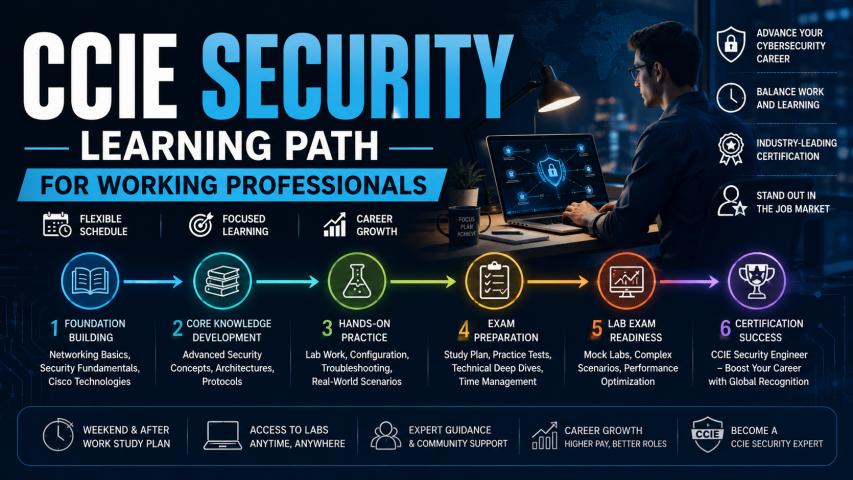

For CCIE aspirants, lab quality often determines the difference between repeated attempts and first-time success. When evaluating a CCIE Security Training Course in Bangalore, one of the most common concerns is whether the lab environment truly reflects the actual CCIE Security lab exam. Given the exam’s real-world focus and time pressure, alignment between practice labs and the exam format is critical.
Bangalore has established itself as a major hub for advanced
networking education, with several institutes offering CCIE security course
in Bangalore, CCIE Security Training course in Bangalore programs supported
by modern lab infrastructure. But how closely do these labs match the real
exam? Let’s break it down.
Understanding the Nature of the CCIE Security Lab Exam
The CCIE Security lab exam is designed to test expert-level
skills in deploying, integrating, and troubleshooting complex security
solutions. It is not a theory exam; instead, it simulates real enterprise
security challenges under strict time constraints.
Key exam characteristics include multi-technology
integration, incomplete or faulty configurations, and the need for structured
troubleshooting. Any training lab that aims to prepare candidates effectively
must mirror these conditions as closely as possible.
Use of Exam-Aligned Technologies
One of the strongest aspects of Bangalore-based CCIE
Security labs is their focus on exam-aligned technologies. Reputed training
providers design their lab topologies around the official CCIE Security
blueprint. This ensures that aspirants regularly practice configurations and
scenarios that are directly relevant to the exam.
Instead of isolated device-level practice, candidates work
on integrated environments that reflect real exam complexity. This helps bridge
the gap between learning individual features and applying them cohesively.
Realistic Lab Topologies and Scenarios
A key way Bangalore-based labs match the actual exam is
through realistic topology design. Rather than simplified setups, labs often
include multiple interconnected devices, layered security policies, and
dependency-based tasks.
These scenarios force aspirants to think holistically, just
as they must during the exam. Misconfigurations are intentionally introduced in
advanced labs, pushing candidates to practice fault isolation and structured
troubleshooting rather than simple configuration tasks.
Time-Bound Lab Practice
Time management is one of the biggest challenges in the CCIE
Security lab exam. Bangalore-based training labs increasingly emphasize timed
practice sessions. Candidates are encouraged to complete full or partial labs
within strict deadlines, simulating exam pressure.
This approach trains aspirants to prioritize tasks, avoid
overthinking, and maintain focus under stress. Regular exposure to timed labs
helps reduce panic and improves decision-making speed during the actual exam.
Troubleshooting-Focused Design
The real CCIE Security lab exam places significant weight on
troubleshooting. Many Bangalore-based labs are now designed with this in mind.
Instead of providing clean environments, trainers deliberately introduce broken
configurations, policy conflicts, and hidden issues.
This forces aspirants to analyze symptoms, validate
assumptions, and resolve issues methodically. Such practice closely mirrors the
exam’s troubleshooting section and builds confidence in handling unfamiliar
problems.
Hybrid and Virtual Lab Infrastructure
Modern CCIE Security labs in Bangalore typically use a
combination of virtualized environments and limited physical hardware. While
the exam itself is software-driven, the behavior of these virtual labs closely
matches real devices when configured correctly.
The advantage of this setup is flexibility. Candidates can
reset labs quickly, repeat scenarios multiple times, and practice outside
classroom hours. This repetition is essential for mastering exam-level
complexity.
Instructor-Led Exam Strategy Integration
Another factor that helps Bangalore-based labs match the
actual exam is the integration of exam strategy into lab sessions. Trainers
often guide aspirants on task sequencing, common pitfalls, and validation
techniques during labs.
This strategic guidance helps candidates not only configure
solutions correctly but also verify them efficiently, which is a critical exam
skill.
Limitations Aspirants Should Be Aware Of
While Bangalore-based labs are highly exam-focused, no
training environment can replicate the exam 100 percent. The actual exam
includes unpredictable elements and psychological pressure that cannot be fully
simulated. However, well-designed labs come close enough to ensure that
candidates are technically and mentally prepared.
Conclusion
Bangalore-based CCIE Security labs are designed to closely
match the actual CCIE Security lab exam through exam-aligned technologies,
realistic topologies, troubleshooting-heavy scenarios, and time-bound practice.
When combined with expert guidance, these labs prepare aspirants for both the
technical and strategic demands of the exam.
In conclusion, candidates evaluating CCIE security course in Bangalore, CCIE Security Training course in Bangalore should focus on
how closely the lab environment mirrors real exam conditions, as this alignment
plays a decisive role in CCIE Security success.