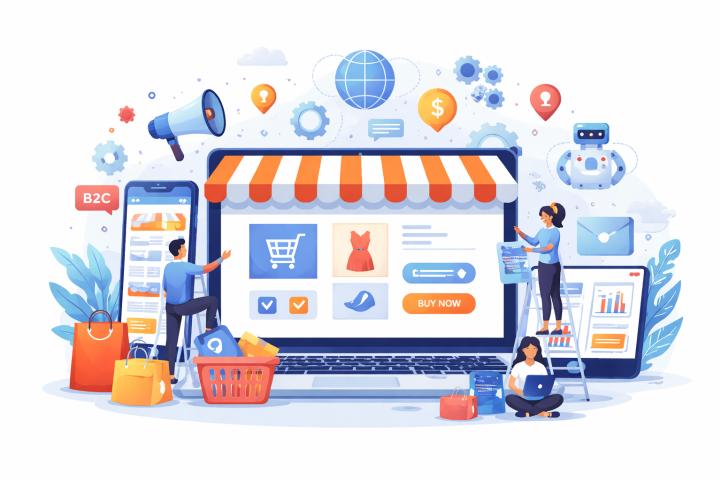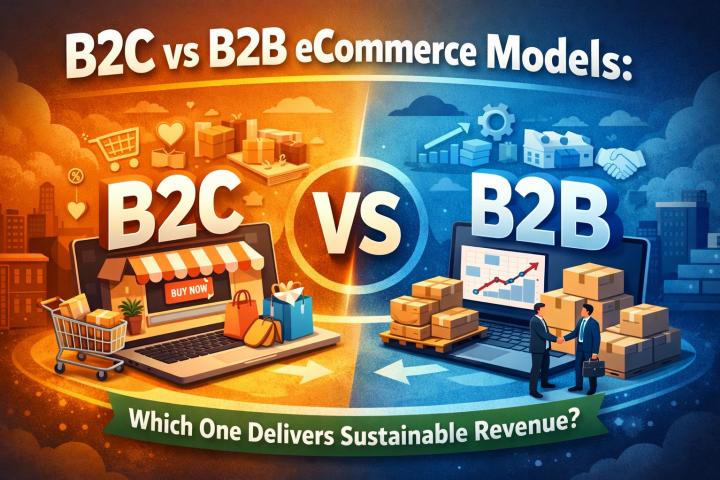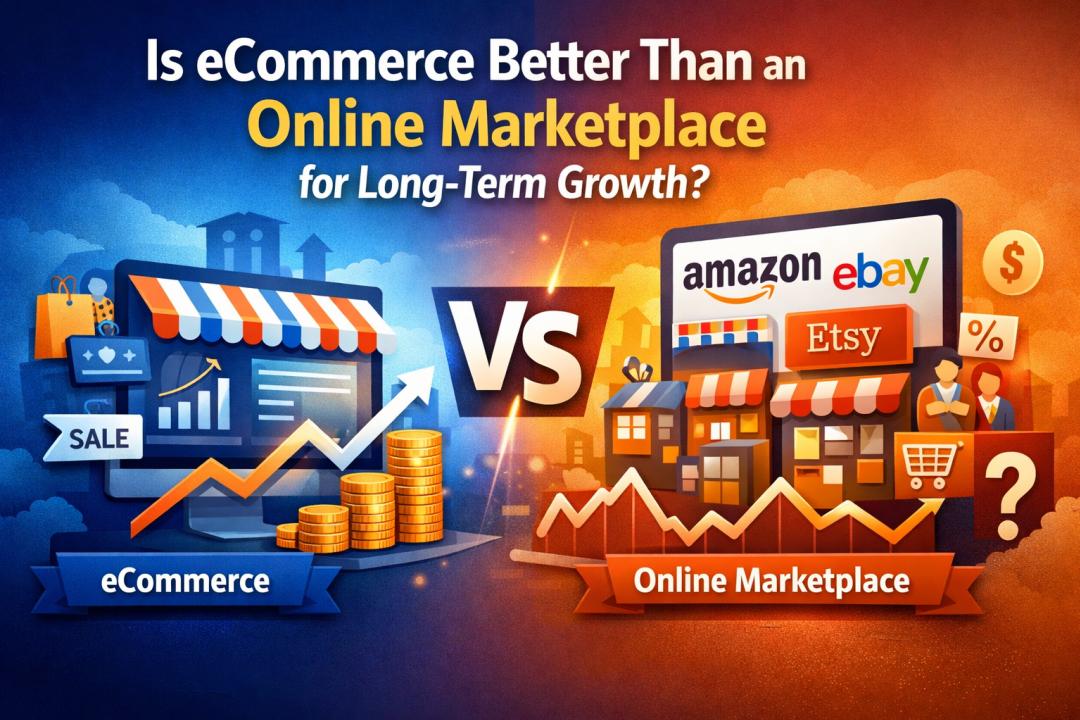
Choosing between building your own eCommerce store and selling through an online marketplace is a long-term business decision with serious growth implications.
The debate between eCommerce and online marketplaces matters because each model offers different levels of control, scalability, and profitability.
This guide breaks down the differences, benefits, risks, and growth potential to help you choose the right path for sustainable success.
Understanding the Core Difference Between eCommerce and Online Marketplaces
At a high level, eCommerce and online marketplaces serve the same goal: selling products online.
However, the ownership, control, and growth mechanics behind each model are fundamentally different.
What Is an eCommerce Business?
An eCommerce business is a standalone online store owned and operated by a brand.
You control the website, customer data, pricing, marketing, and overall experience.
What Is an Online Marketplace?
An online marketplace is a third-party platform where multiple sellers list products.
Examples include Amazon, eBay, Etsy, and Walmart Marketplace.
Ownership and Control: A Long-Term Growth Perspective
Ownership plays a critical role in determining how far a business can scale.
This is one of the most important factors in the eCommerce vs Online Marketplace discussion.
Control Over Branding and Experience
With eCommerce, you fully control your brand identity and customer journey.
Marketplaces limit branding to product listings and basic storefront elements.
Pricing and Profit Margin Control
eCommerce allows flexible pricing strategies without platform interference.
Marketplaces often enforce pricing rules and charge commission fees.
Customer Data and Relationship Building
Long-term growth depends heavily on owning customer relationships.
This is where eCommerce has a structural advantage.
Access to Customer Data
eCommerce stores collect emails, behavior data, and purchase history, which support effective eCommerce customer segmentation.
Marketplaces restrict access to customer information.
Building Repeat Customers
Owned stores enable email marketing, loyalty programs, and retargeting.
Marketplaces prioritize their platform loyalty over seller relationships.
Marketing Flexibility and Growth Channels
Marketing determines how effectively a business scales over time.
The flexibility varies significantly between these two models.
Marketing Freedom in eCommerce
You can use SEO, content marketing, social ads, influencers, and email.
These channels perform better when guided by customer segmentation strategies for eCommerce, ensuring campaigns align with user intent and behavior.
All traffic-building efforts benefit your own brand equity.
Marketplace Marketing Limitations
Advertising options are limited to platform-specific ad tools.
Any traffic you generate ultimately strengthens the marketplace brand.
Scalability and Business Asset Value
Long-term growth is not just about revenue but also business value.
Scalability affects future funding, partnerships, or exits.
eCommerce as a Sellable Asset
An established eCommerce store is a transferable digital asset.
It can be acquired, franchised, or scaled into new markets.
Marketplace Stores and Exit Challenges
Marketplace seller accounts are rarely transferable.
Platform dependency reduces valuation and exit options.
Cost Structure and Financial Predictability
Understanding costs is essential for long-term planning.
Both models have different financial trade-offs.
eCommerce Cost Structure
Common costs include hosting, apps, marketing, and fulfillment.
While upfront costs exist, margins improve over time.
Marketplace Fees and Hidden Costs
Marketplaces charge commissions, listing fees, and advertising costs.
Margins shrink as competition and fees increase.
Platform Risk and Dependency
Dependency risk directly affects business stability.
This factor often decides long-term sustainability.
Algorithm and Policy Risks
Marketplaces can suspend accounts or change policies overnight.
Recovery options are limited and often slow.
Independence With eCommerce
Your store operates under your own rules and infrastructure.
Platform changes have minimal impact on core operations.
Speed to Market vs Sustainable Growth
Both models serve different business stages.
Choosing the right one depends on your growth horizon.
Why Marketplaces Win for Quick Launch
Marketplaces offer built-in traffic and fast setup.
They are ideal for product testing and short-term sales.
Why eCommerce Wins for Long-Term Growth
eCommerce focuses on compounding brand value over time.
Traffic, content, and customer trust accumulate as assets.
SEO and Organic Traffic Potential
Search visibility plays a major role in sustainable growth.
The difference between owning and renting traffic is critical.
SEO Advantages of eCommerce Stores
Your content ranks for branded and non-branded keywords.
Every SEO effort strengthens your domain authority.
SEO Limitations on Marketplaces
Marketplace listings compete with thousands of similar products.
You do not benefit from domain-level SEO authority.
Customization and Technology Flexibility
Technology choices influence how adaptable a business can be.
Customization supports innovation and differentiation.
Custom Features in eCommerce
You can add custom checkout flows, subscriptions, or integrations.
This supports unique value propositions and better conversions.
Marketplace Technology Constraints
Features are limited to what the platform allows.
Innovation is restricted by standardized templates.
Global Expansion and Localization
Scaling internationally requires operational flexibility.
The chosen model impacts how easily you expand.
eCommerce Global Scaling
You can localize language, currency, and shipping rules.
This supports targeted international growth strategies.
Marketplace Expansion Limits
Expansion depends on marketplace availability by region.
Each platform has its own compliance and restrictions.
Trust, Credibility, and Brand Authority
Trust influences repeat purchases and referrals.
Brand authority compounds over time.
Building Trust Through eCommerce
Consistent branding and content build long-term credibility.
Customers associate trust directly with your brand.
Marketplace Trust Is Platform-Based
Customers trust the marketplace, not the seller.
Brand recall remains low even after multiple purchases.
Operational Complexity and Learning Curve
Ease of management affects scalability.
Both models have operational trade-offs.
eCommerce Operations
You manage inventory, marketing, and customer support.
This requires systems but offers long-term efficiency.
Marketplace Operations
Logistics may be simplified through fulfillment services.
However, seller competition increases operational pressure.
When an Online Marketplace Makes Strategic Sense
Marketplaces are not inherently bad for growth.
They serve specific business goals effectively.
Ideal Use Cases for Marketplaces
- Testing product-market fit
- Clearing inventory quickly
- Reaching price-sensitive buyers
Marketplace as a Supporting Channel
Many brands use marketplaces as secondary revenue streams.
The core brand still lives on their eCommerce store.
When eCommerce Is Better for Long-Term Growth
eCommerce aligns with sustainable business building.
It supports compounding returns over time.
Ideal Use Cases for eCommerce
- Brand-led businesses
- High-margin or niche products
- Long-term customer retention strategies
eCommerce as a Growth Foundation
Every marketing and branding effort strengthens your own asset.
Growth becomes predictable and defensible.
eCommerce vs Online Marketplace: A Side-by-Side Growth View
Comparing both models highlights their long-term implications.
The differences become clearer when growth is the priority.
- Control: eCommerce wins
- Customer ownership: eCommerce wins
- Speed to launch: Marketplace wins
- Long-term value: eCommerce wins
- Risk exposure: Marketplace is higher
Hybrid Strategy: Using Both Models Wisely
Many successful brands combine both approaches.
The key is defining clear roles for each channel.
How to Balance eCommerce and Marketplaces
Use marketplaces for acquisition and visibility.
Use eCommerce for retention, branding, and lifetime value.
Avoiding Common Hybrid Mistakes
Do not rely solely on marketplace traffic.
Always direct customers toward owned channels where possible.
Conclusion
The eCommerce vs Online Marketplace decision ultimately depends on whether you prioritize short-term sales or long-term growth.
Marketplaces offer speed and visibility but limit control, data ownership, and brand equity.
eCommerce provides independence, scalability, and stronger long-term business value.
Review your growth goals, apply the insights shared here, and choose the model that supports where you want your business to be in five years.