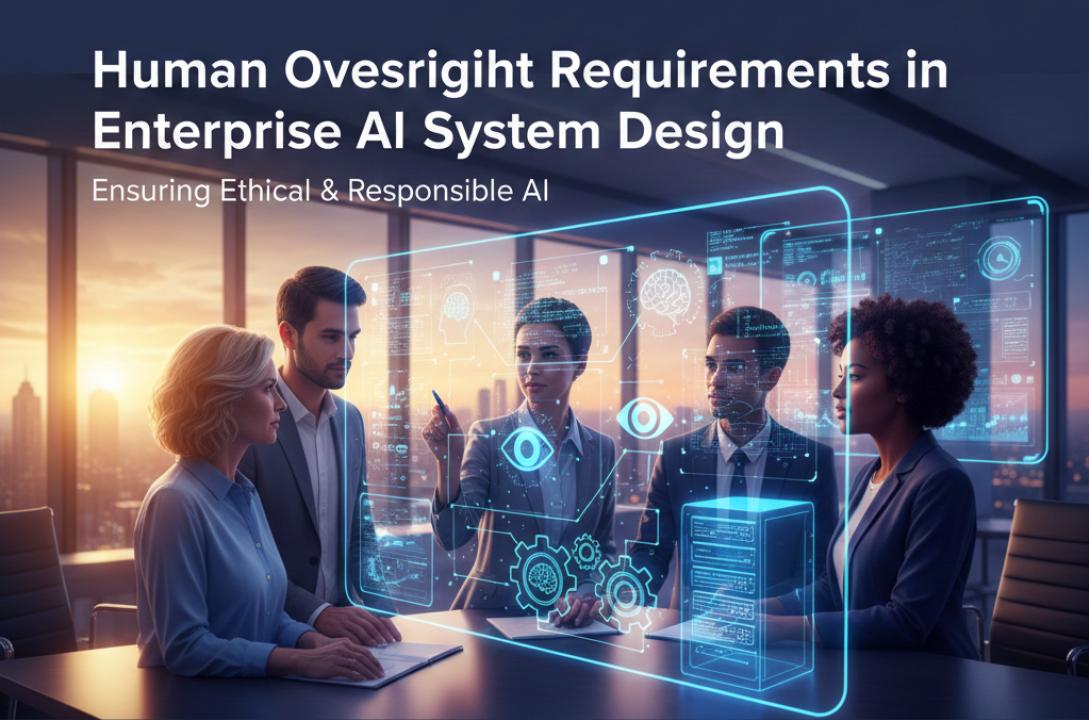
Artificial intelligence has moved beyond experimental pilots and innovation labs. It now drives financial forecasting, customer engagement engines, operational automation, risk detection, and executive decision support. As AI becomes embedded into core business infrastructure, enterprises face a defining question. How do you scale intelligent systems without surrendering accountability?
Human oversight is no longer a compliance checkbox. It is a structural requirement for any organization investing in AI Development Services to modernize operations or build new digital capabilities. Without deliberate oversight mechanisms, AI systems can introduce unseen risk, erode trust, and weaken long term return on technology investment.
This article explores why human oversight matters in enterprise AI system design, how to implement it effectively, and what decision makers should expect when partnering with an AI Development Company.
The new reality of AI driven decision making
Enterprise AI systems influence high value outcomes. Credit approvals, insurance risk scoring, supply chain forecasting, dynamic pricing, fraud detection, and employee evaluation increasingly rely on automated intelligence.
AI models detect patterns faster than human analysts. Yet they lack contextual understanding, ethical judgment, and accountability. When decisions impact revenue, reputation, or regulatory standing, organizations need defined human control points.
Recent industry studies indicate that a majority of large enterprises deploying AI at scale have encountered unexpected model behavior, bias exposure, or data drift incidents. In nearly every case, the root cause was insufficient oversight rather than faulty algorithms alone.
For executive teams, this shifts oversight from an operational concern to a strategic business safeguard.
Designing oversight from the foundation up
Oversight works best when embedded early. Treating governance as an add on after deployment often results in costly redesigns, delayed rollouts, and strained compliance audits.
Effective oversight frameworks begin at three foundational layers:
- Data integrity governance
- Model accountability design
- Continuous performance supervision
Each layer requires human participation to validate assumptions, review outputs, and intervene when conditions change.
This is where Custom AI Development Services become valuable. Tailored AI systems allow enterprises to define oversight depth based on business impact, risk classification, and regulatory exposure.
Oversight at the data level
AI quality depends on data integrity. Enterprise data ecosystems are complex, with inputs coming from internal systems, customer touchpoints, partner platforms, and external sources. Without human review, data pipelines can introduce bias, outdated information, or compliance violations.
Strong data oversight includes:
- Verification of data sourcing policies
- Consent and privacy alignment checks
- Label accuracy reviews for supervised learning
- Ongoing data quality scoring
- Bias detection assessments
Human domain experts validate that training data reflects real world business conditions rather than historical distortions. This prevents flawed intelligence from entering production environments and reduces rework costs later.
Building model transparency and explainability
Enterprise stakeholders need clarity on how AI systems reach decisions. This matters for trust, auditability, and internal adoption. A system that cannot explain its logic creates hesitation among teams asked to rely on its outputs.
Human oversight ensures that:
- Model reasoning pathways are documented
- Decision drivers are visible to business users
- Risk teams can audit automated outcomes
- Legal departments can verify regulatory alignment
Explainable AI also strengthens executive confidence. Leadership teams gain insight into how technology investments influence business performance, improving alignment between AI strategy and organizational objectives.
Human supervision in live environments
AI systems evolve continuously. As customer behavior changes, market conditions shift, and new data enters pipelines, models can lose accuracy or drift away from intended behavior.
Continuous oversight identifies:
- Declining prediction reliability
- Shifts in operational patterns
- Unexpected automation outcomes
- Emerging fairness risks
Modern enterprises require monitoring dashboards, alert systems, and scheduled model reviews. This is where Full-Stack AI Development capabilities prove critical. When infrastructure, data pipelines, and models are built within a unified architecture, real time observability becomes part of the solution rather than a patchwork add on.
The result is higher system stability, reduced downtime, and sustained performance reliability.
Compliance and ethical alignment
AI regulation is evolving rapidly. Global enterprises must navigate data protection laws, sector specific governance requirements, and emerging AI accountability frameworks.
Human oversight ensures:
- AI use cases match jurisdictional compliance requirements
- Automated decisions meet fairness guidelines
- Risk categorization is documented
- Incident response plans are established
Embedding compliance controls early reduces audit friction and prevents expensive post deployment modifications. It also signals maturity to regulators, partners, and customers.
Human in the loop decision design
Not every AI use case requires the same level of intervention. Mature enterprises classify automation systems based on potential impact.
Typical oversight structures include:
- Mandatory human approval for high-risk decisions
- Manual review for exceptional or uncertain predictions
- Randomized sampling audits for routine outputs
- Escalation workflows for flagged anomalies
This balances efficiency with accountability. Automation accelerates operations while human judgment remains present where consequences are significant.
Such calibrated oversight avoids unnecessary friction while protecting business integrity.
Choosing partners who support transparency
Technology partners play a decisive role in oversight success. Enterprises should expect more than technical delivery from service providers.
A capable partner offers:
- Clear documentation of system logic
- Visibility into training processes
- Defined escalation protocols
- Knowledge transfer for internal teams
- Long term monitoring support
Strong partnerships ensure enterprises remain in control of their AI systems rather than dependent on external black boxes.
Financial impact of oversight driven design
Some executives worry that oversight slows innovation. In practice, it accelerates sustainable scale. AI failures trigger remediation costs, lost trust, legal exposure, and stalled transformation programs.
Oversight driven design delivers:
- Faster compliance approvals
- Higher adoption across departments
- Lower retraining and reengineering costs
- Stronger stakeholder confidence
- More predictable ROI outcomes
Industry cost analysis reports show that correcting flawed AI deployments after launch can exceed original project budgets by multiple factors. Preventive oversight is therefore a revenue protection strategy, not an overhead expense.
Developing internal AI maturity
Long term success depends on internal readiness. External vendors build systems, but internal teams provide contextual judgment.
Enterprises investing in AI oversight maturity focus on:
- AI literacy programs for leadership
- Risk and ethics training for teams
- Data governance skill development
- Model evaluation workshops
This cultivates organizations that operate AI confidently rather than passively consuming automated outputs. Internal maturity reduces dependency risks and strengthens strategic agility.
The future of enterprise AI depends on accountability
As AI becomes central to business strategy, oversight will define winners and laggards. Enterprises that embed human judgment into AI system design achieve sustainable automation, regulatory readiness, and trusted innovation.
Those that treat oversight as an afterthought risk operational disruption, compliance setbacks, and eroded stakeholder confidence.
For global enterprises and high growth startups, designing accountability into intelligent systems is no longer optional. It is the foundation of resilient, responsible, and profitable AI adoption.