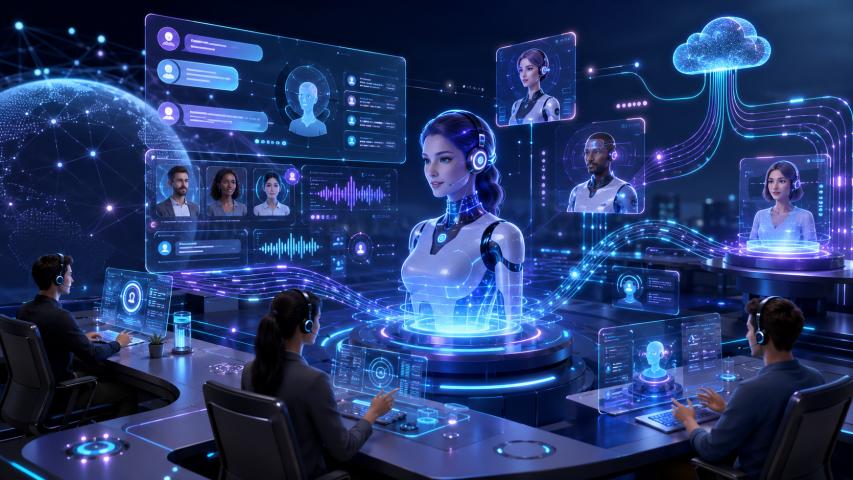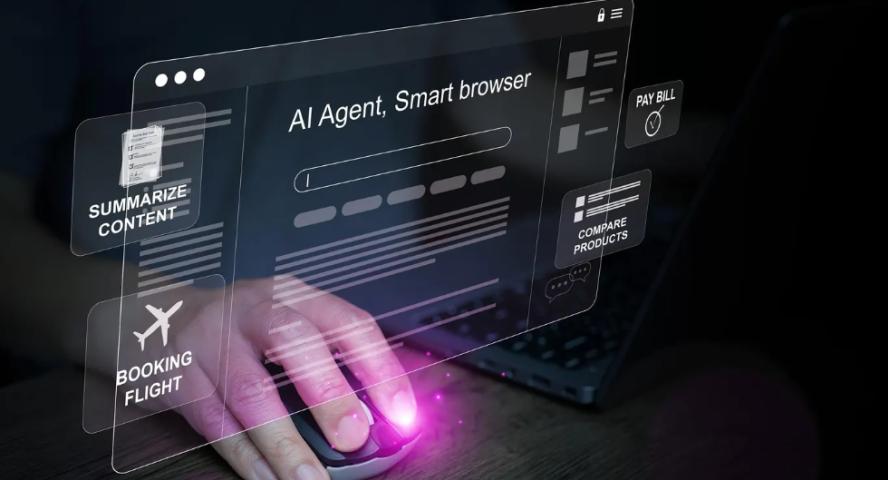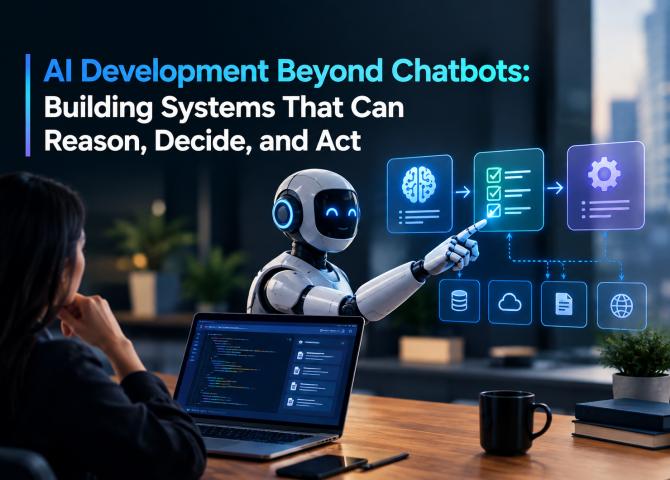

Enterprises are entering a new phase of AI adoption one where systems no longer just respond to prompts but reason, decide, and act autonomously. These systems, often referred to as Agentic AI, represent a shift from passive assistants to goal-driven, self-directed intelligence.
At the center of this shift is Retrieval-Augmented Generation (RAG). Without RAG, agentic systems struggle with reliability, context, and enterprise trust. With it, enterprises can build AI agents that operate on verified internal knowledge, respect governance boundaries, and execute tasks across business systems.
This blog explores how enterprises are building agentic AI systems using RAG, the architectural patterns behind them, and why this approach is becoming foundational to enterprise AI strategy.
What Makes an AI System “Agentic” in the Enterprise Context?
Agentic AI systems are designed to go beyond conversation. Instead of answering isolated questions, they are capable of:
- Understanding high-level objectives
- Planning multi-step actions
- Retrieving relevant knowledge dynamically
- Executing tasks across systems
- Monitoring outcomes and adjusting behavior
For enterprises, agentic AI is not about autonomy without limits. It is about controlled autonomy, where agents operate within defined guardrails while handling complex workflows at scale.
Why Traditional LLM-Based Systems Fall Short for Enterprises
Large language models alone are not sufficient for enterprise-grade agentic systems. They introduce several challenges:
- Lack of access to real-time, proprietary data
- Risk of hallucinations and unverifiable outputs
- Inability to respect fine-grained access controls
- Poor alignment with internal processes
Enterprises cannot rely on generic training data when decisions impact customers, compliance, or revenue. This is where Retrieval-Augmented Generation becomes essential.
The Role of Retrieval-Augmented Generation in Agentic AI
RAG enables AI agents to retrieve information from trusted enterprise sources at runtime and use that data to generate accurate, context-aware responses or actions.
In agentic systems, RAG plays a much larger role than simple Q&A:
- It provides agents with memory grounded in enterprise data
- It ensures decisions are based on up-to-date knowledge
- It allows agents to justify actions using source-backed context
- It supports compliance and auditability
Without RAG, agentic AI becomes risky. With RAG, it becomes operational.
How Enterprises Architect Agentic AI Systems with RAG
Most enterprise agentic AI systems follow a layered architecture:
1. Goal and Task Orchestration Layer
This layer defines objectives, decomposes tasks, and manages execution flow. Agents decide what needs to be done and in what order.
2. Retrieval Layer
Here, the agent queries vector databases, document stores, APIs, and internal knowledge bases to gather relevant information.
This is where rag application development becomes critical retrieval must be optimized for accuracy, latency, and security.
3. Reasoning and Generation Layer
The AI model uses retrieved context to reason, generate outputs, and decide next steps.
4. Action and Integration Layer
Agents interact with enterprise systems CRM, ERP, analytics tools, ticketing platforms to execute tasks.
5. Governance and Control Layer
Logging, access control, monitoring, and human-in-the-loop mechanisms ensure enterprise safety.
Where a RAG Development Company Fits in Enterprise Agentic AI
As enterprises scale beyond pilots, they often partner with a RAG Development Company to design and implement production-ready systems.
Such partners help enterprises:
- Design domain-specific retrieval pipelines
- Optimize embeddings for proprietary data
- Implement secure data access controls
- Integrate agents with enterprise applications
- Ensure scalability and observability
This is not about building a chatbot it is about engineering AI systems that can operate reliably inside enterprise environments.
Enterprise Use Cases Driving Agentic AI + RAG Adoption
Enterprises are deploying agentic AI systems across multiple domains:
Customer Operations
Agents retrieve account data, policies, and past interactions to resolve issues autonomously or assist human agents.
Enterprise Knowledge Management
AI agents continuously retrieve and synthesize internal documentation, enabling faster decision-making.
Financial and Risk Operations
Agents monitor transactions, retrieve regulatory rules, and flag anomalies with source-backed reasoning.
IT and DevOps
Agents retrieve system logs, documentation, and runbooks to diagnose issues and recommend actions.
In each case, RAG ensures that actions are grounded in enterprise truth, not probabilistic guesses.
Why Agentic AI Demands Artificial Intelligence Agent Development Services
Building agentic AI systems is significantly more complex than deploying standard AI applications. Enterprises require artificial intelligence agent development services to handle:
- Multi-agent orchestration
- Workflow-aware decision logic
- Secure system integrations
- Retrieval optimization across data silos
- Human override and escalation paths
These services ensure that agentic systems are aligned with enterprise goals, policies, and risk tolerance.
Governance, Security, and Compliance Considerations
Agentic AI systems introduce new governance challenges. Enterprises must ensure:
- Agents only access authorized data
- Every action is logged and auditable
- Decisions can be traced back to retrieved sources
- Models operate within regulatory boundaries
RAG plays a crucial role here by enforcing retrieval-based grounding, which supports transparency and compliance.
Measuring ROI from Agentic AI Systems
Enterprises adopting agentic AI with RAG report measurable outcomes such as:
- Reduced manual workload across teams
- Faster decision cycles
- Improved accuracy and consistency
- Lower operational costs
- Better utilization of internal knowledge
These benefits compound as agents learn to operate across more workflows and systems.
The Future: From Tools to Autonomous Enterprise Systems
Agentic AI systems powered by RAG represent a fundamental shift. Enterprises are moving from using AI as a tool to deploying AI as an operational layer across the organization.
Future systems will:
- Coordinate multiple agents
- Continuously retrieve and update knowledge
- Execute end-to-end business processes
- Collaborate with humans rather than replace them
This future depends on robust RAG architectures and thoughtful agent design.
Final Thoughts
Agentic AI is no longer experimental for enterprises it is becoming a strategic capability. However, autonomy without grounding is a liability. Retrieval-Augmented Generation provides the foundation that makes agentic systems reliable, explainable, and enterprise-ready.
By investing in rag application development, working with an experienced RAG Development Company, and leveraging artificial intelligence agent development services, enterprises can build agentic AI systems that move beyond experimentation and into real operational impact.