
Running a PrestaShop store on a single traffic source is a manageable way to operate, but it puts a hard limit on growth. Two channels that most independent stores are not using, Google Shopping and Etsy, sit on opposite ends of the buyer discovery spectrum, and together they reach an audience no standard PrestaShop storefront touches on its own.
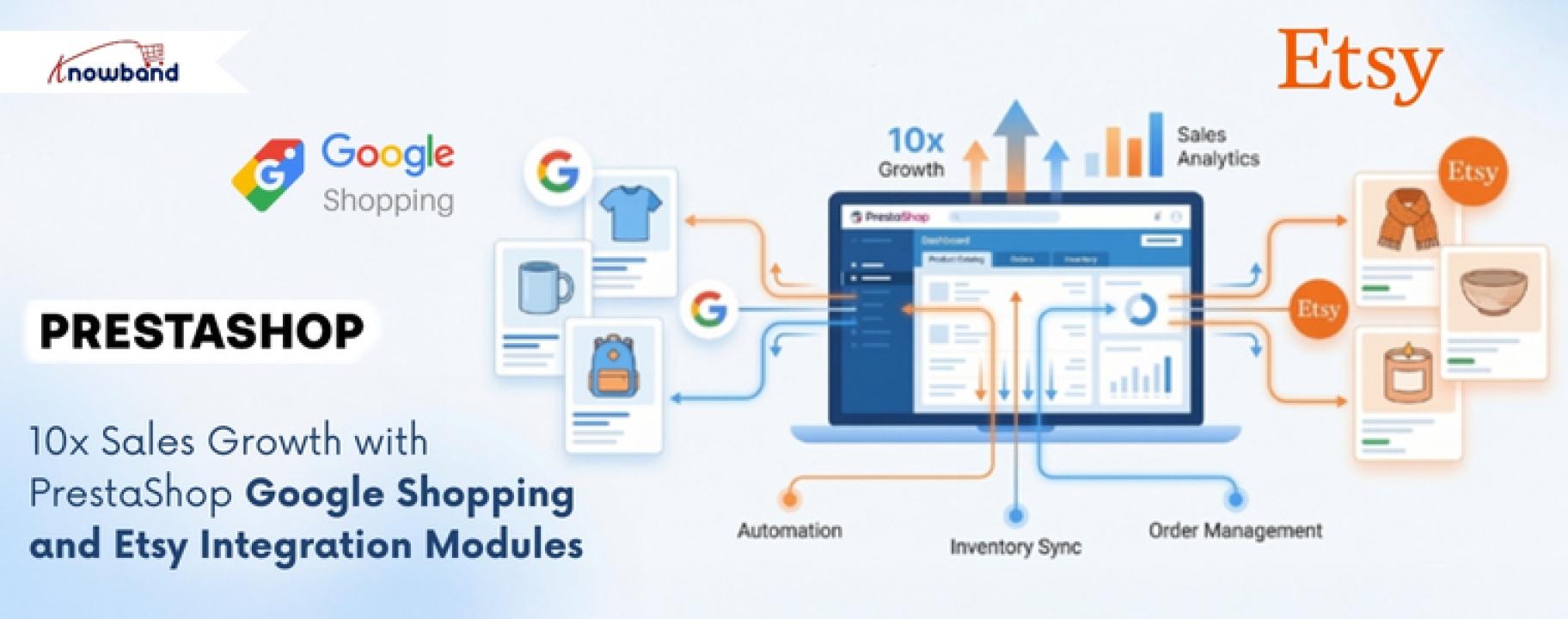
Google Shopping reaches buyers who are already searching with purchase intent. Etsy reached 90 million active buyers in 2023, 79% of whom are specifically looking for handmade or unique products. The PrestaShop Google Shopping Integration and the PrestaShop Etsy Integration Module from KnowBand connect a single store to both channels from the same backend.
Automated Feed Sync That Keeps Listings Accurate
Google Shopping ads drive 66% of all Google retail clicks. That only holds value when the feed behind those ads is updated with the latest information. A product that sold out at noon but stays active in Shopping until the following morning wastes every click it receives.
The PrestaShop Google Shopping Integration runs scheduled cron-based feed synchronisation. Prices, stock status, and product details push to Google Merchant Centre automatically at the interval the admin sets. The PrestaShop Google Shopping Synchronizer separates feed sync, product status sync from Google, and local product loading into three independent cron jobs, each configurable on its own schedule.
Profile-Based Category Mapping for Targeted Feeds
A bulk export of every product in a store is not a feed strategy. Different categories have different Google taxonomy requirements and perform differently in paid campaigns. The PrestaShop Google Shopping Connector uses profiles to handle this. Each profile maps PrestaShop store categories to a Google Shopping category with its own country, language, currency, and schedule. Hence, the Google Shopping Feed for PrestaShop produced by each profile is a clean and targeted XML feed.
Built-in Error Visibility and Campaign Tracking
Google Merchant Centre disapprovals pull products from Shopping results without surfacing a clear reason inside PrestaShop. The PrestaShop Google Shopping Module shows each product's sync status with an error viewer in the Product Listing tab. The Audit Log records every sync action with timestamps. Moreover, the PrestaShop Google Merchant Centre Connector also supports both automatic API-based feed upload and manual submission via a copied feed URL or a downloaded file in JSON, XML, or CSV. Thus, stores not yet ready for API connection can start manually and switch over once the Merchant Centre account is fully verified.
Why Etsy Is a Separate Opportunity
Google Shopping captures search intent. But, Etsy captures something different: a buyer who opened the app to find something they cannot buy at a chain retailer. Etsy generated $2.7 billion in revenue in 2023 from 90 million active buyers. For PrestaShop stores selling handmade, artisan, vintage, or independent products, that audience is already looking for what they sell. Thus, the Etsy PrestaShop Marketplace Integration module connects the store to it without building a separate operation.
Bulk Listings with Custom Pricing Per Profile
Listing products on Etsy manually at any volume is not viable. The PrestaShop Etsy Integration Module maps store categories to Etsy categories through profiles, with attribute fields for colour, materials, occasion, recipient, and more. An entire category syncs to Etsy in one action. Moreover, custom pricing is set per profile, so products can list on Etsy at a different price from the PrestaShop store, either a fixed adjustment or a percentage.
Inventory Sync That Prevents Overselling
A product that sells on the PrestaShop store but stays live on Etsy leads to a cancellation and a negative review. On Etsy, reviews affect listing placement. The PrestaShop Etsy API Integrator syncs every product update from PrestaShop to Etsy on the next cron run. The orders placed on Etsy import into PrestaShop automatically with customer and shipping details. Hence, when an order status changes to shipped in PrestaShop, that update pushes back to Etsy without manual input.
Etsy-Specific Titles, Return Policies, and Sales Reporting
Etsy search uses long, descriptive buyer phrases that bear no resemblance to how products are titled in PrestaShop. The Etsy PrestaShop Integration extension lets admins write separate titles and descriptions for Etsy listings without touching the PrestaShop store at all.
Furthermore, version 4.0.1 added return policy synchronisation. Admins can create return policies inside the module, assign them to profiles, and every product in that profile carries the correct policy on Etsy automatically. Updates to a policy push to all mapped listings in one sync.
Moreover, the PrestaShop Etsy integrator also includes a sales report by channel and a product-level sales report with date filtering. Alongside an Audit Log that records every sync action for full operational visibility.
One Backend for Three Sales Platforms
The PrestaShop Google Shopping Integration and the PrestaShop Etsy Integration Module are managed from the same PrestaShop backend. Products, inventory, orders, and reporting all run through one place. Thus, a store that is currently dependent on a single source of traffic can add two high-intent buyer channels without adding a separate team or workflow to run them.
Google Shopping for buyers who are searching. Etsy for buyers who are browsing. Both are running from a PrestaShop store that does not change.
For stores looking to expand beyond a single traffic source. Integrating both channels creates a balanced strategy that captures buyers searching for products and those browsing for inspiration.