Imagine performing a complex dental implant procedure where every incision, angle, and placement is pre-planned with near-perfect accuracy before the patient even enters the operating room. No guesswork. No unexpected deviations. Just precision-driven outcomes.
This is not the future; it is the present, powered by the 3D printed surgical guide.
As dentistry evolves toward digitization, technologies like Dental surgical guides, 3D dental implants, and advanced solutions for procedures such as Zygoma implant surgeries are redefining clinical workflows. At the forefront of this transformation is Curewith3D, delivering innovative, patient-specific solutions that empower surgeons and improve patient outcomes.
In this blog, we explore how 3D printed surgical guides are revolutionizing implant dentistry, why they matter, and how they are shaping the future of precision-driven care.
What is a 3D Printed Surgical Guide?
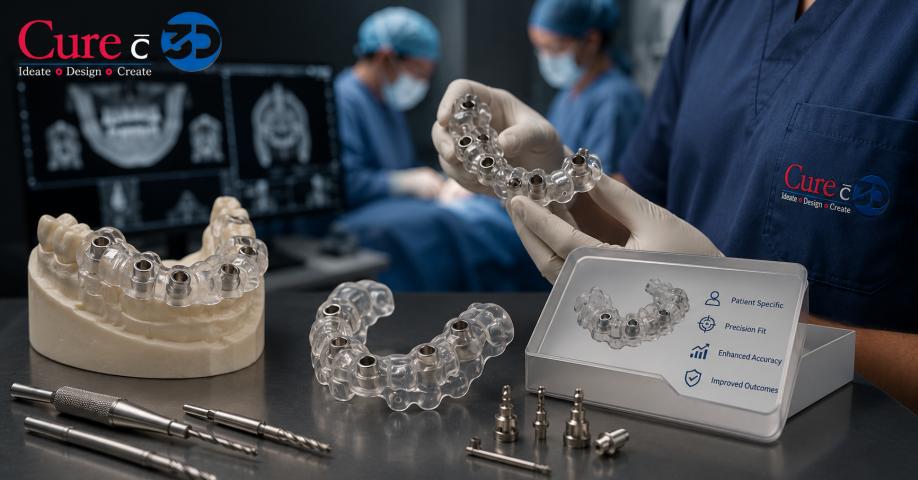
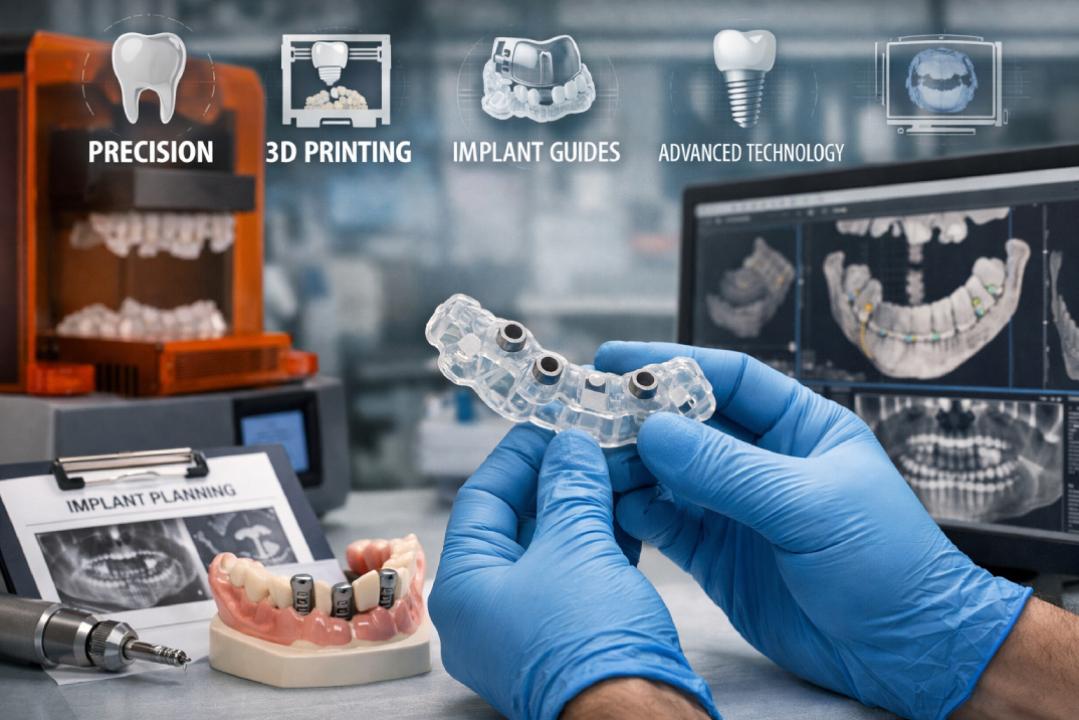
A 3D printed surgical guide is a custom-designed medical device created using digital imaging and additive manufacturing technologies. It serves as a physical guide during surgical procedures, helping clinicians position implants with exceptional accuracy.
These guides are designed based on:
CBCT (Cone Beam Computed Tomography) scans
Intraoral scans
Digital treatment planning software
Once the surgical plan is finalized, the guide is fabricated using 3D printing technology to fit precisely over the patient’s dental anatomy.
Unlike traditional freehand methods, dental surgical guides provide a structured pathway for implant placement, minimizing human error and ensuring predictable results.
The Evolution of Dental Implantology
From manual techniques to digitally assisted workflows, dental implant procedures have come a long way.
Traditional Approach vs Digital Precision
Traditional Implant Placement:
Relied heavily on clinician experience
Increased risk of improper angulation
Limited pre-surgical visualization
Higher chances of complications
Modern Digital Approach with 3D Printed Surgical Guides:
Data-driven planning
3D visualization of anatomy
Guided implant placement
Reduced surgical risks
With the rise of 3D dental implants, clinicians now have access to highly accurate and customized solutions that align with each patient’s unique anatomy.
How 3D Printed Surgical Guides Work
The workflow behind a 3D printed surgical guide is a seamless integration of imaging, planning, and manufacturing.
Step 1: Data Acquisition
High-resolution CBCT scans and intraoral scans capture the patient’s anatomy in detail.
Step 2: Digital Planning
Using specialized software, clinicians map out implant positions, angulations, and depths.
Step 3: Guide Design
A custom Dental surgical guide is designed to align perfectly with the patient’s teeth or gums.
Step 4: 3D Printing
The guide is fabricated using biocompatible materials through advanced 3D printing technologies.
Step 5: Surgical Application
During the procedure, the guide directs drills and implants according to the pre-defined plan.
This workflow ensures unmatched accuracy and consistency, making procedures safer and more efficient.
Key Benefits of 3D Printed Surgical Guides
The key benefits of 3D printed surgical guides include the following:
1. Unparalleled Precision
A 3D printed surgical guide ensures implants are placed exactly where planned. This is especially critical in complex cases like Zygoma implant procedures, where anatomical structures are challenging.
2. Reduced Surgical Time
Guided procedures are faster because clinicians follow a predefined path, reducing intraoperative decision-making.
3. Minimally Invasive Procedures
Precise planning allows for flapless surgeries in many cases, leading to:
Less bleeding
Reduced pain
Faster recovery
4. Enhanced Patient Safety
By avoiding critical anatomical structures such as nerves and sinuses, dental surgical guides significantly reduce complications.
5. Predictable Outcomes
Consistency in implant placement leads to better prosthetic outcomes and long-term success.
Role of 3D Printed Surgical Guides in Zygoma Implant Procedures
Understanding Zygoma Implants
A Zygoma implant is used in cases of severe bone loss in the upper jaw. Instead of anchoring implants in the maxilla, they are placed in the zygomatic bone (cheekbone).
These procedures are complex and demand extreme precision.
Why Surgical Guides are Essential
Using a 3D printed surgical guide in Zygoma implant surgeries offers:
Accurate angulation for long implants
Avoidance of sinus cavities
Reduced surgical risks
Improved prosthetic alignment
For such high-stakes procedures, guided surgery is not just beneficial, it is essential.
3D Dental Implants: The Perfect Synergy
The rise of 3D dental implants complements the use of surgical guides perfectly.
What Makes 3D Dental Implants Unique?
Customized to patient anatomy
Designed for optimal load distribution
Improved aesthetic outcomes
When combined with a 3D printed surgical guide, these implants ensure:
Perfect positioning
Better integration with bone
Enhanced longevity
This synergy is redefining implant dentistry by making treatments more personalized and predictable.
Applications of Dental Surgical Guides
The versatility of dental surgical guides extends across multiple procedures:
Single Tooth Implants - Ensures precise placement without affecting adjacent teeth.
Full Mouth Rehabilitation - Supports complex restorations with accurate implant positioning.
Immediate Loading Cases - Facilitates same-day implant placement and prosthetics.
Zygoma Implant Surgeries - Critical for achieving correct angulation and stability.
Complex Anatomical Cases - Helps navigate challenging bone structures safely.
Why Choose Curewith3D for 3D Printed Surgical Guides?
At Curewith3D, innovation meets precision.
Advanced Technology Integration: Curewith3D utilizes cutting-edge digital planning tools and high-resolution 3D printing systems to deliver superior surgical guides.
Patient-Specific Solutions: Every 3D printed surgical guide is tailored to the individual patient, ensuring a perfect fit and optimal results.
Expertise in Complex Cases: From routine implants to advanced Zygoma implant procedures, Curewith3D specializes in handling complex clinical scenarios.
Seamless Workflow Support: The brand offers end-to-end support (from data processing to guide delivery) making it easier for clinicians to adopt guided surgery.
Challenges and Considerations
While the benefits are significant, there are some factors to consider:
Initial Learning Curve - Clinicians may need training to adapt to digital workflows.
Dependence on Accurate Data - Errors in imaging or planning can affect outcomes.
Cost of Technology - Initial investment in software and equipment may be higher.
However, the long-term benefits in terms of accuracy, efficiency, and patient satisfaction far outweigh these challenges.
The Future of 3D Printed Surgical Guides
The future of implant dentistry is digital, and 3D printed surgical guides are at its core.
Emerging Trends
AI-driven treatment planning
Real-time surgical navigation
Integration with robotics
Improved biocompatible materials
As technology advances, the combination of Dental surgical guides and 3D dental implants will continue to push the boundaries of what is possible in dental care.
Conclusion: Precision is the New Standard
The shift from traditional methods to guided surgery marks a turning point in dentistry. The 3D printed surgical guide is not just a tool, it is a paradigm shift toward precision, safety, and predictability.
With applications ranging from routine implants to complex Zygoma implant procedures, and integration with advanced 3d dental implants, this technology is setting new benchmarks in patient care.
Curewith3D stands at the forefront of this revolution, empowering clinicians with innovative solutions that deliver exceptional outcomes.
In a world where accuracy defines success, guided surgery is no longer optional, it is essential.
FAQs
What is a 3D printed surgical guide used for?
A 3D printed surgical guide is used to assist in precise implant placement by guiding surgical instruments according to a pre-planned design.
Are dental surgical guides necessary for all implant procedures?
While not mandatory, Dental surgical guides significantly improve accuracy and are highly recommended, especially for complex cases.
How do 3D dental implants improve outcomes?
3D dental implants are customized to the patient’s anatomy, ensuring better fit, stability, and long-term success.
Why are surgical guides important in Zygoma implant procedures?
In Zygoma implant surgeries, surgical guides ensure correct angulation and placement, reducing risks and improving outcomes.
How does Curewith3D ensure quality?
Curewith3D uses advanced imaging, precise digital planning, and high-quality 3D printing materials to deliver reliable and accurate surgical guides.