Introduction: Why Enterprises Are Moving Toward AI Agents
Enterprise technology is going through a quiet but major shift.
For years, organizations have invested in automation tools, RPA platforms, dashboards, and AI models. Yet most systems still depend heavily on human intervention to connect processes, make decisions, and execute workflows.
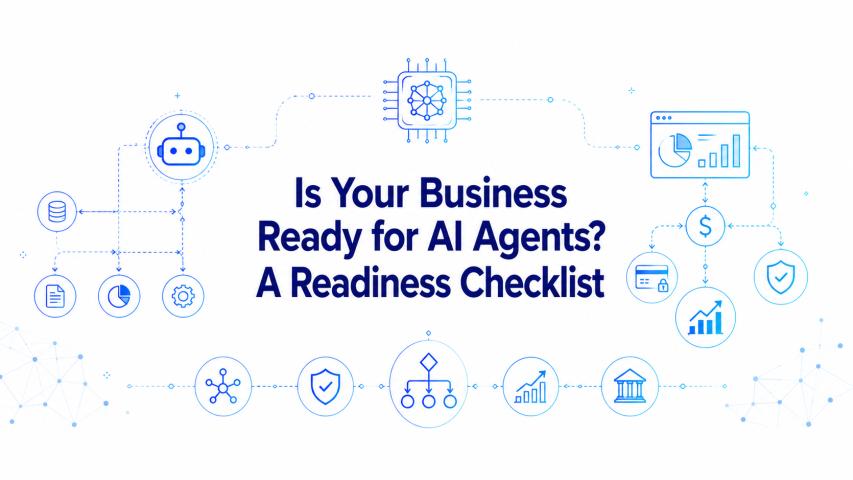
That gap is now being addressed through enterprise AI agent development services.
Unlike traditional automation, AI agents are designed to understand objectives, make decisions, and execute multi-step workflows across enterprise systems—without waiting for manual triggers at every step.
For large organizations dealing with complex operations, fragmented systems, and high-volume processes, this is becoming a foundational shift in how work gets done.
What Are Enterprise AI Agent Development Services?
Enterprise AI agent development services refer to the end-to-end design, development, and deployment of autonomous AI systems that operate within large-scale business environments.
These services focus on building intelligent agents that can:
- Understand business goals
- Break down complex tasks into steps
- Interact with enterprise applications
- Make context-aware decisions
- Execute workflows across systems
- Learn and improve over time
In simple terms, they help enterprises build AI systems that act like digital employees operating inside business infrastructure.
Why Enterprises Need AI Agent Development Services
Enterprise environments are fundamentally different from small-scale digital systems.
They include:
- Multiple legacy platforms
- Distributed teams
- Complex approval hierarchies
- High compliance requirements
- Large volumes of structured and unstructured data
Traditional automation tools struggle in this environment because they rely on rigid rules and predefined workflows.
AI agents solve this limitation by introducing adaptability.
Instead of following fixed instructions, they interpret intent, evaluate context, and decide the best sequence of actions.
This flexibility is the core reason enterprises are increasingly investing in enterprise AI agent development services.
What Do Enterprise AI Agent Development Services Include?
Building enterprise-grade AI agents is not a single-step process. It involves multiple layers of design, engineering, and integration.
1. Enterprise AI Strategy and Use Case Discovery
Every implementation begins with identifying where AI agents can deliver measurable business value.
Common enterprise use cases include:
- Customer support automation
- IT service management
- Finance reconciliation workflows
- HR onboarding processes
- Supply chain coordination
- Sales operations automation
The focus is always on identifying high-impact, multi-step workflows that can be automated end-to-end.
2. Agent Architecture Design
This is the foundation of enterprise AI agent systems.
It includes designing:
- Goal-oriented reasoning frameworks
- Task decomposition logic
- Memory and context systems
- Decision-making layers
- Multi-agent collaboration structures
This architecture determines how the agent thinks and operates within enterprise environments.
3. Large Language Model Integration
At the core of modern AI agents are large language models that enable reasoning and natural language understanding.
Development services include integrating models that support:
- Complex reasoning
- Multi-step planning
- Tool usage
- Context retention
- Enterprise-grade reliability
These models act as the cognitive engine of the system.
4. Enterprise System Integration
The real value of AI agents comes from their ability to act inside enterprise systems.
Development services include integration with:
- ERP systems
- CRM platforms
- HR management systems
- Finance tools
- Internal databases
- Cloud applications and APIs
This allows agents to perform real actions such as updating records, triggering workflows, or generating reports.
5. Workflow Orchestration and Automation
Enterprise AI agents are designed to manage entire workflows, not just isolated tasks.
This includes:
- Multi-step process execution
- Conditional logic handling
- Exception management
- Approval workflows
- Task coordination across systems
This transforms fragmented processes into unified automated workflows.
6. Security, Compliance, and Governance
For enterprises, governance is non-negotiable.
AI agent development services include:
- Role-based access control
- Audit logging
- Data encryption
- Compliance alignment (industry-specific)
- Human-in-the-loop approvals
These safeguards ensure that autonomous systems remain safe and controlled.
7. Deployment, Monitoring, and Optimization
Once deployed, enterprise AI agents require continuous management.
This includes:
- Performance monitoring
- Cost optimization (especially LLM usage)
- Accuracy improvements
- Workflow tuning
- System updates
Enterprise AI is not a one-time build—it is an evolving system.
How Enterprise AI Agents Transform Business Operations
Enterprise AI agents are not just automation tools—they fundamentally change how work is executed.
In operations, they reduce manual effort by handling repetitive and multi-step workflows automatically.
In customer service, they enable faster resolution by independently retrieving data, analyzing issues, and executing solutions.
In finance, they streamline reconciliation, reporting, and anomaly detection processes.
In HR and IT, they automate onboarding, ticket resolution, and internal service requests.
Across all functions, the key transformation is simple: work moves from human-driven execution to AI-coordinated execution.
Challenges in Enterprise AI Agent Implementation
Despite their benefits, enterprise adoption comes with challenges.
One of the biggest challenges is system complexity. Enterprises often operate across multiple legacy systems that are difficult to integrate.
Another challenge is reliability. AI agents must make correct decisions consistently, especially in regulated environments.
Cost management is also important, particularly when using large language models at scale.
Finally, governance and trust remain critical. Enterprises need full visibility into how and why AI agents make decisions.
This is why structured enterprise AI agent development services are essential rather than building systems in isolation.
Why Enterprises Prefer Specialized AI Agent Development Services
Most enterprises do not build AI agents entirely in-house because of the complexity involved.
Specialized development services offer:
- Faster deployment cycles
- Proven architectural frameworks
- Deep integration expertise
- Strong governance models
- Scalable AI infrastructure design
Instead of experimenting internally, enterprises rely on experienced teams to ensure production-ready systems from day one.
Future of Enterprise AI Agents
Enterprise AI agents are evolving rapidly toward fully autonomous business systems.
In the near future, we will see:
- Multi-agent collaboration across departments
- Self-optimizing workflows
- Real-time decision execution systems
- Continuous learning enterprise agents
- End-to-end autonomous business operations
This will shift enterprises from automation-driven organizations to AI-native enterprises.
Conclusion
Enterprise AI is no longer about simple automation or isolated machine learning models. It is about building intelligent systems that can operate, decide, and execute within complex business environments.
Enterprise AI agent development services play a critical role in enabling this transformation by providing the architecture, integrations, governance, and scalability needed to deploy AI at an enterprise level.
As organizations move toward AI-first operations, enterprise AI agents will become a core layer of business infrastructure—driving efficiency, speed, and intelligence across every function.