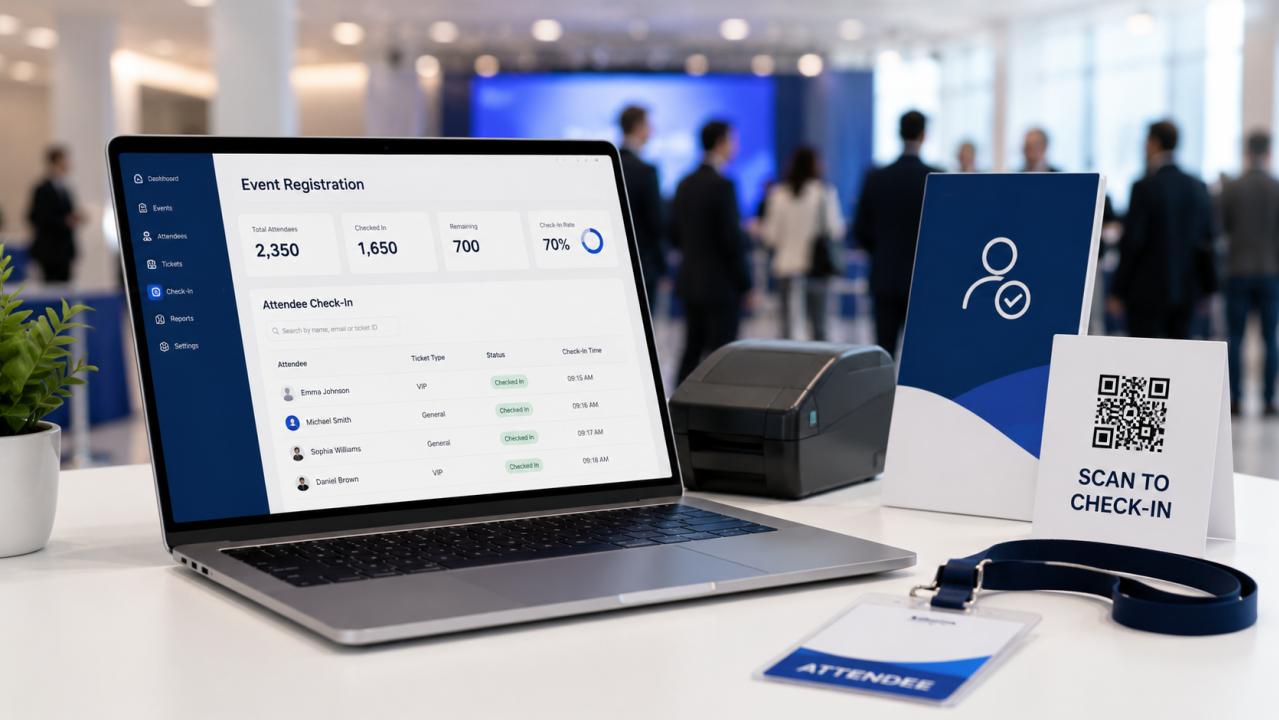
Running a large-scale event is a serious undertaking. You're managing thousands of attendees, multiple ticket categories, onsite check-in, sponsor data requests, and a team that needs everything to work in real time. The registration platform you choose sits at the centre of all of it.
Pick the wrong one and you'll spend event day firefighting slow queues, broken payment flows, missing attendee data. Pick the right one and the whole operation runs quietly in the background, exactly the way it should.
This list covers the best registration software for large events in 2026 — what each platform does well, who it's built for, and what to keep in mind before you commit.
What to Look for in Event Registration Software for Large Events
Before diving into the tools, here's what actually matters at scale:
- Performance under load — can it handle thousands of simultaneous registrations without slowing down?
- Custom registration workflows — different attendee types need different flows
- Onsite check-in and badge printing — speed and reliability on event day
- Integrations — CRM, marketing tools, payment gateways
- Real-time reporting — for your team and your sponsors
- Support — not a ticketing system, but an actual human when things go wrong
With that in mind, here are the top platforms worth evaluating.
1. Dreamcast: Best for Large-Scale and Enterprise Events
If your event regularly crosses thousands of attendees, Dreamcast is one of the most purpose-built platforms available. With over 12 years in enterprise event technology and more than 5,000 events delivered globally, it's designed specifically for the kind of scale and complexity that breaks general-purpose tools.
What makes it stand out:
Dreamcast covers the entire attendee journey, from custom registration forms and multi-tier ticketing to onsite check-in, badge printing, and post-event analytics. Its check-in infrastructure supports QR codes, RFID, NFC, and even facial recognition, which makes it one of the fastest systems available for high-volume entry management. If you're expecting 500 people to arrive in a 20-minute window, that speed difference is everything.
The platform lets you create distinct registration flows for different audience groups — VIPs, delegates, exhibitors, sponsors, media, and speakers, each with its own form logic, access permissions, and ticket type. It also handles cashless payment solutions onsite, which is genuinely useful for large conferences with food, merchandise, or paid breakout sessions.
On the reporting side, you get real-time dashboards, sponsor-level analytics, and data exports that connect cleanly with CRM and marketing platforms. The team also offers on-ground support during live events, which is something that's surprisingly hard to find and worth its weight when you need it.
Best for: Large conferences, trade shows, expos, government summits, corporate events with 1,000+ attendees
Notable clients: World Food India 2025, Zomaland, ITB Berlin (world's biggest travel trade show)
Pricing: Custom, based on event scale and requirements
2. vFairs: Best for Virtual, Hybrid, and In-Person Events Combined
vFairs has built a strong reputation as an all-in-one platform that handles in-person, virtual, and hybrid events from a single system. If your conference format is evolving — or if you're running a mix of physical and digital experiences — it's worth serious consideration.
What makes it stand out:
The registration module includes a drag-and-drop form builder, conditional logic, multi-language support, and dynamic pricing options including group registrations and upsells. For virtual and hybrid events, it brings in 3D virtual environments, customisable exhibitor booths, and live streaming tools that integrate seamlessly with the registration data.
One of vFairs' strongest points is its dedicated project management model. Large events get assigned project managers and 24/7 technical support during live execution — reducing risk for high-stakes events with exhibitors, sponsors, and distributed audiences.
The platform's analytics cover registration trends, session engagement, exhibitor performance, and attendee behaviour, making post-event reporting to sponsors more substantive than most tools allow.
Best for: Organisations running virtual, hybrid, or large in-person conferences and trade shows
Pricing: Custom quote based on features and attendance
3. Swoogo: Best for Flexible, Marketing-Led Events
Swoogo has positioned itself as a highly customisable registration platform built for teams that want control over design, workflows, and branding without needing a developer to make changes.
What makes it stand out:
Its registration builder is genuinely flexible, custom forms, conditional logic, multi-session selection, group registration, and promo codes are all standard. Marketing teams particularly like Swoogo for its branded event pages and the ability to create distinct registration experiences for different audience segments without complex backend configuration.
Where Swoogo differentiates itself from heavier enterprise platforms is speed of setup. Implementation timelines are significantly shorter than many comparable tools, which matters if you're running multiple events per year and can't afford months of onboarding for each one.
It also includes badge printing, onsite payment support, and live check-in tools, making it capable for in-person events, though the onsite infrastructure isn't as deeply built out as dedicated large-event platforms.
Best for: Marketing teams running branded conferences, multi-event programmes, and field marketing campaigns
Pricing: Tiered mid-market pricing, no per-registration fees
4. Hubilo: Best for Attendee Engagement and Networking
Hubilo has evolved into a high-end platform focused on attendee experience, particularly for organisations where networking and engagement are central to the event's value proposition.
What makes it stand out:
The registration and ticketing module is solid, customisable workflows, multiple ticket types, and good integration with marketing tools. But where Hubilo genuinely earns its place is in what happens after check-in. AI-powered matchmaking, interactive lounges, sponsor booths, and session-level engagement tracking give event organisers a much richer picture of how attendees are actually spending their time.
For sponsor reporting specifically, Hubilo has invested meaningfully in linking attendee registration data to onsite behaviour, which helps organisers deliver proof-of-impact reporting rather than just attendance numbers.
It operates now under the VirtualPro/Brandlive umbrella and is positioned at the higher end of the market — not the right fit for organisations with modest budgets, but a strong choice for large organisations where attendee experience and sponsor ROI are both priorities.
Best for: Mid-to-large conferences where networking, engagement, and sponsor reporting are key priorities
Pricing: Custom, enterprise-level
5. Eventdex: Best for Comprehensive Conference and Expo Management
Eventdex is a full-stack event management platform that combines registration, ticketing, check-in, badge printing, lead retrieval for exhibitors, and a mobile event app in a single system.
What makes it stand out:
For conferences and trade shows specifically, Eventdex's lead retrieval tools are a meaningful differentiator. Exhibitors can scan attendee badges, qualify leads on the spot, and export clean contact data, which is a core requirement for many B2B expos and makes Eventdex a strong pitch to sponsors and exhibitors who are used to clunky manual lead collection.
The check-in system supports QR code scanning with real-time attendance tracking, and the platform's architecture is built to handle large attendee volumes without performance drops. Registration forms are customisable with conditional logic, and the platform supports multiple ticket types including group registrations and promo codes.
For organisations that want one platform to cover the full event lifecycle — online registration through to post-event analytics — Eventdex is one of the more complete options in the mid-market range.
Best for: Conferences, trade shows, expos, and association events where exhibitor lead retrieval is important
Pricing: Available on request; competitive for mid-to-large events
6. Eventbrite: Best for Public-Facing, Consumer Events
Eventbrite earns its place on this list not because it's the most powerful enterprise tool — it isn't — but because it's the most widely recognised registration platform among general consumers, and that familiarity has real value for public-facing events.
What makes it stand out:
Setup is fast, the interface is intuitive, and Eventbrite's marketplace exposes your event to millions of potential attendees who are already browsing the platform. For public conferences, festivals, community events, and ticketed gatherings where discovery matters, that built-in audience is genuinely useful.
Payment processing is handled natively, though Eventbrite's fee structure (approximately 3.7% + $1.79 per paid ticket) is worth factoring into your budget. One notable caveat: Eventbrite retains around 20% of ticket revenue until after the event concludes, which can affect cash flow for large events with significant ticket volumes.
For complex enterprise conference workflows, multiple audience types, custom approval flows, detailed sponsor reporting, Eventbrite will feel limited. But for straightforward, public-facing ticketed events at scale, it remains one of the most accessible options available.
Best for: Public conferences, consumer events, festivals, and community gatherings
Pricing: Free for free events; 3.7% + $1.79 per paid ticket
7. Zoho Backstage: Best for Teams Already in the Zoho Ecosystem
Zoho Backstage is a solid event management platform that earns particular mention for organisations already using Zoho CRM, Zoho Campaigns, or other tools in the Zoho suite.
What makes it stand out:
The native integration between Backstage and Zoho CRM means that registration data flows directly into your existing contact and lead management workflows without any custom development. For B2B conferences where post-event follow-up is critical, that clean data connection removes a significant manual step.
The platform covers registration, ticketing, event websites, speaker management, and attendee engagement tools. It supports multiple ticket types, promo codes, and group registrations, and the reporting is solid for standard event metrics.
Where it may feel limited compared to dedicated enterprise platforms is in onsite check-in infrastructure and the depth of custom workflow logic for highly complex registration scenarios. But for mid-to-large events where you want a capable, well-integrated platform without enterprise-level pricing, Zoho Backstage is a strong option.
Best for: Mid-sized conferences run by teams already using the Zoho product suite
Pricing: Tiered plans available; competitive pricing relative to feature set.
Final Thoughts
There is no single best registration platform for every event. The right choice depends on your scale, your audience type, your team's technical capacity, and what you need the data to do after the event is over.
That said, a few principles hold across the board. For large-scale, high-volume events where onsite performance and attendee experience are non-negotiable, Dreamcast is the most purpose-built option on this list. For hybrid and virtual-first programmes, vFairs is consistently strong. For marketing teams that want design control without developer dependency, Swoogo delivers. And for public-facing events where audience discovery matters, Eventbrite still has an edge no other platform can match.
Start with your requirements. Match them to the platform. And always test the check-in flow yourself before you go live.