Organizations are rushing to deploy autonomous AI agents with a clear goal: hand over the keys to the algorithms and let them run at scale. But out in the wild, executing these deployments without specialized AI testing services quickly transforms efficiency drivers into massive operational liabilities.
The hazards of unexpected AI behavior are no longer theoretical, whether it’s customer-facing bots spouting poisonous hallucinations or backend agents making biased choices and engaging in unlawful conduct. When an intelligent system is running without a safety net, one algorithmic misfire can immediately create significant compliance breaches, financial losses and serious brand harm.
Bridging the Critical Trust Gap in Enterprise AI
Traditional QA relies on deterministic principles : input X will always produce outcome Y. Generative systems are based on statistical probabilities, therefore the same prompt might produce an entirely different execution route each time. This non-determinism creates a serious trust gap. A system that manages supply chain records or internal procedures can suddenly invent parameters that don’t exist with complete assurance.
Furthermore, bias accumulation remains a persistent issue, as algorithms naturally consolidate structural skews hidden within historical training data. Automated scripts cannot spot these nuanced, contextual errors. Overcoming these limitations requires a comprehensive human in the loop testing strategy to catch structural flaws before they impact production environments.
Scaling Safely with Enterprise AI Testing Services
Mitigating these systemic risks requires shifting away from legacy functional methodologies. Deploying specialized AI testing services built around a structured human in the loop testing framework ensures that automation scale is backed by reliable human oversight.
Instead of manual testers checking every single baseline transactional step, human quality engineers focus their efforts where models struggle most evaluating context accuracy, validating complex business logic, and monitoring edge cases. This approach combines the sheer speed of algorithmic generation with the nuanced reasoning of experienced QA professionals.
Organizations looking to master these workflows often study advanced deployment frameworks, such as the strategies outlined in this detailed guide on Agentic AI in Software Testing, which helps teams scale production safely without sacrificing quality.
Real-Time Stress Testing via AI Security Testing
The threat landscape for intelligent applications introduces entirely new vulnerabilities that traditional firewalls and automated syntax checkers completely miss. Robust security testing demands continuous human in the loop testing to combat sophisticated, non-linear threats like prompt injection, data poisoning, and unauthorized system data extraction.
Human teams excel at designing complex adversarial inputs to probe the boundaries of an LLM’s guardrails. While automated scrapers can run basic compliance checks, it takes a human supervisor to review a creative model's output and recognize that a security filter has been subtly bypassed, ensuring sensitive corporate IP remains protected.
Hardening Infrastructure Performance with AI Performance Testing
Unlike standard software, AI systems do not maintain static resource utilization curves. Enterprise-grade AI performance testing evaluates how these complex models behave under varying context lengths, heavy token generation bursts, and multi-agent loops.
When data demands spike, models often experience severe latency issues or gradual memory leakage across continuous user flows. Automated monitoring tools can flag that a system is running slowly, but human engineering teams are required to trace the root cause, optimize the context window, and ensure the underlying model logic remains efficient under heavy enterprise workloads.
The HITL Blueprint: A Tactical Operational Roadmap
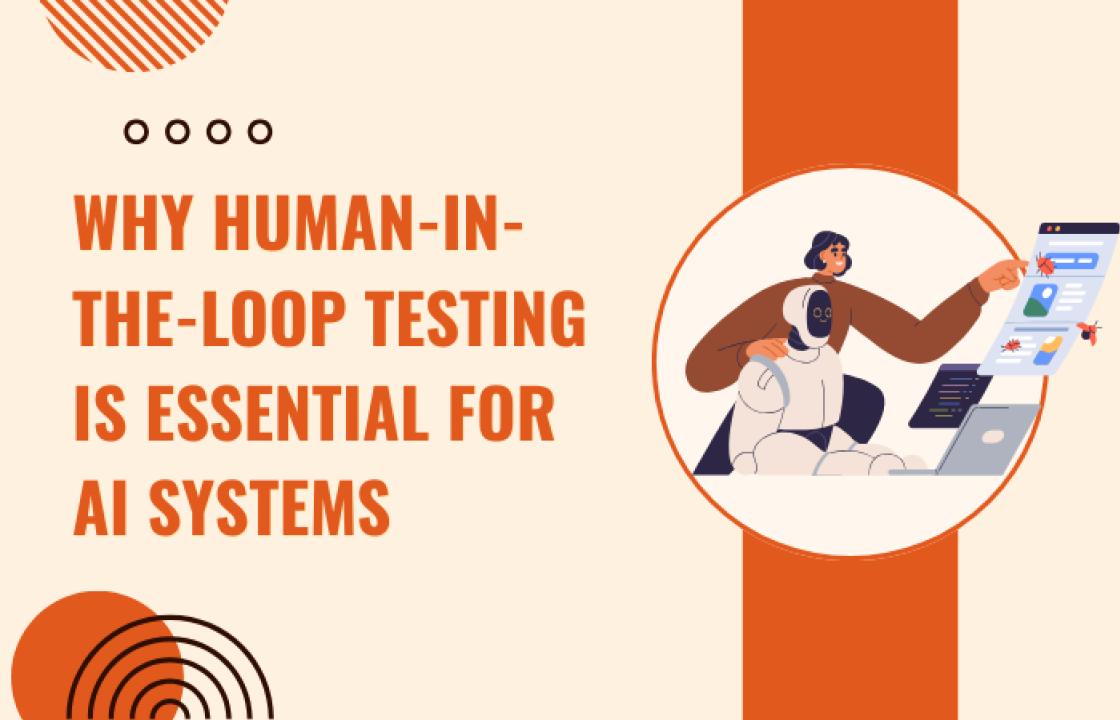
Integrating human in the loop testing into an automated testing pipeline cannot be a reactive process. It requires a structured, multi-layered blueprint where human intelligence actively directs the automated validation lifecycle:
- Automated Scaffolding
Generative tools ingest comprehensive system requirements and API schemas to rapidly generate baseline test-scenario code. This phase relies on automation to build breadth and scale across hundreds of application paths.
- Contextual Validation and Sanitization
Experienced QA professionals review the AI-generated scripts. This active checkpoint targets the removal of logic flaws, cleans up hallucinated parameters, and ensures the code matches strict enterprise compliance guidelines before execution.
- Adversarial Exploratory Testing
Human engineers step out of structured test scripts to perform unstructured, cognitive testing. Testers simulate creative user errors, unexpected prompt deviations, and complex behavioral stress conditions that static automation blocks fail to predict.
- Telemetry and Closed-Loop Optimization
Production failure logs are programmatically grouped into distinct behavioral patterns. Human domain experts analyze these error clusters to uncover the root systemic causes and feed verified edge-case data directly back into the model's training pipeline.
This operational roadmap ensures a balanced workflow. When features like automated self-healing scripts attempt to automatically correct broken selectors on a dynamic interface, a human engineer is positioned to review the adaptation, guaranteeing the structural fix aligns with core business intent.
Achieving Balanced Quality and Speed
Relying solely on unsupervised algorithms leaves modern enterprises exposed to severe brand damage, legal liabilities, and sudden software rollbacks. Real security and reliability do not come from removing humans from the loop, but from positioning them where their analytical judgment matters most.
By blending programmatic speed with expert human validation, organizations turn unpredictable, probabilistic models into stable, highly secure, and enterprise-grade software assets. Implementing continuous human-in-the-loop testing is the only definitive way to safely scale software delivery while maintaining total operational control over intelligent systems.