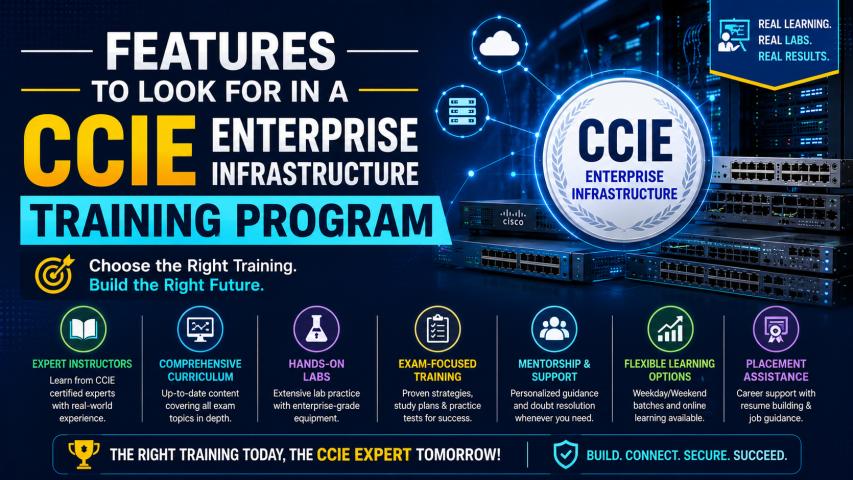

The demand for advanced enterprise networking professionals continues to rise as organizations modernize their IT infrastructure. Many network engineers aiming for expert-level roles often consider CCIE Enterprise Infrastructure Training to strengthen their practical and theoretical understanding of complex enterprise environments.
The CCIE Enterprise Infrastructure certification validates a candidate’s ability to design, deploy, operate, and troubleshoot large-scale enterprise networks. To succeed, candidates must develop a strong combination of technical, analytical, and operational skills that go beyond basic networking knowledge.
Understanding CCIE Enterprise Infrastructure Certification
The CCIE Enterprise Infrastructure certification is among Cisco’s highest-level credentials for networking professionals. It focuses on validating expertise in enterprise networking technologies, including routing, switching, automation, and network design.
Core Purpose of the Certification
The test is designed to determine a candidate’s ability to:
Build scalable enterprise networks
Implement advanced routing and switching solutions
Troubleshoot complex network issues
Integrate automation and programmability
Design resilient and secure infrastructures
Importance in the Industry
Organizations value CCIE-certified professionals for their ability to manage mission-critical networks and ensure high availability, performance, and security.
Strong Foundation in Networking Fundamentals
A solid understanding of networking basics is essential for CCIE Enterprise Infrastructure success.
Key Networking Concepts
Candidates must be proficient in:
TCP/IP protocol suite
IPv4 and IPv6 addressing
Subnetting and summarization
OSI model and packet flow
Basic network troubleshooting
Why Fundamentals Matter
Advanced enterprise topics are built on these fundamentals, making them critical for understanding complex scenarios in both written and lab exams.
Mastery of Routing Protocols
Routing is a core pillar of enterprise infrastructure and a critical skill for CCIE candidates.
Essential Routing Protocols
Candidates should have deep expertise in:
OSPF (Open Shortest Path First)
BGP (Border Gateway Protocol)
EIGRP (Enhanced Interior Gateway Routing Protocol)
Route redistribution techniques
Advanced Routing Skills
Beyond basics, candidates must understand:
Route filtering and path manipulation
Convergence optimization
Policy-based routing
Scalability in large networks
Advanced Switching Knowledge
Switching technologies form the backbone of enterprise LAN environments.
Key Switching Concepts
Candidates must master:
VLAN configuration and segmentation
Trunking protocols
Spanning Tree Protocol (STP/RSTP/MSTP)
EtherChannel aggregation
Enterprise Switching Challenges
Real-world environments require:
Loop prevention strategies
High availability switching design
Redundancy planning
Layer 2 troubleshooting expertise
Network Design Skills
Designing scalable and resilient networks is a critical requirement for CCIE Enterprise Infrastructure professionals.
Core Design Principles
Candidates should understand:
Hierarchical network design
Scalability and redundancy
High availability architectures
Fault tolerance strategies
Enterprise Design Scenarios
Typical design challenges include:
Multi-site enterprise connectivity
Campus network architecture
Data center integration
WAN optimization strategies
Network Automation and Programmability
Modern enterprise networks rely heavily on automation to improve efficiency and reduce human error.
Key Automation Concepts
Candidates must learn:
Python for network automation
REST APIs
NETCONF and RESTCONF protocols
Cisco DNA Center automation
Benefits of Automation
Automation helps in:
Faster configuration deployment
Reduced operational errors
Improved scalability
Efficient network monitoring
Troubleshooting and Analytical Skills
Troubleshooting is one of the most important skills for CCIE Enterprise Infrastructure candidates.
Structured Troubleshooting Approach
Candidates should follow:
Problem identification
Data collection and analysis
Root cause isolation
Solution validation
Common Troubleshooting Areas
Routing failures
VLAN misconfigurations
Connectivity issues
Protocol adjacency problems
Understanding SD-WAN Technologies
SD-WAN is a key component of modern enterprise networking.
SD-WAN Fundamentals
Candidates should understand:
Overlay and underlay networks
Traffic segmentation
Policy-based routing
Centralized management
Importance in Enterprises
SD-WAN improves:
Network performance
Cost efficiency
Application visibility
Security and control
Security Integration in Enterprise Networks
Security is deeply integrated into enterprise infrastructure designs.
Key Security Concepts
Candidates must understand:
Access control mechanisms
Network segmentation
Secure routing and switching
Identity-based policies
Security Best Practices
Implement least privilege access
Use encrypted communication protocols
Monitor network traffic continuously
Apply segmentation strategies
Time Management and Exam Strategy
Success in CCIE Enterprise Infrastructure requires strong time management skills.
Effective Exam Strategies
Candidates should:
Prioritize tasks based on weightage
Avoid dedicating excessive time to a single problem
Maintain steady progress across sections
Review configurations efficiently
Practice Under Timed Conditions
Simulated lab environments help candidates:
Improve speed
Build confidence
Enhance accuracy under pressure
Hands-On Lab Experience
Practical experience is essential for mastering CCIE-level skills.
Importance of Lab Practice
Hands-on labs help candidates:
Reinforce theoretical knowledge
Improve configuration speed
Build troubleshooting confidence
Simulate real-world environments
Recommended Practice Methods
Virtual lab setups
Scenario-based exercises
Repeated configuration drills
Mock lab exams
Soft Skills for CCIE Candidates
Technical expertise alone is not enough for success in enterprise environments.
Communication Skills
Professionals must clearly communicate:
Technical issues
Design decisions
Troubleshooting outcomes
Problem-Solving Mindset
Candidates should develop:
Analytical thinking
Logical reasoning
Attention to detail
Structured decision-making
Continuous Learning and Adaptability
Enterprise networking technologies are evolving quickly, making continuous learning essential.
Staying Updated
Candidates should:
Follow Cisco updates
Participate in technical communities
Explore new networking technologies
Practice emerging tools
Importance of Adaptability
Adaptability helps professionals:
Handle new technologies effectively
Solve unfamiliar problems
Stay competitive in the industry
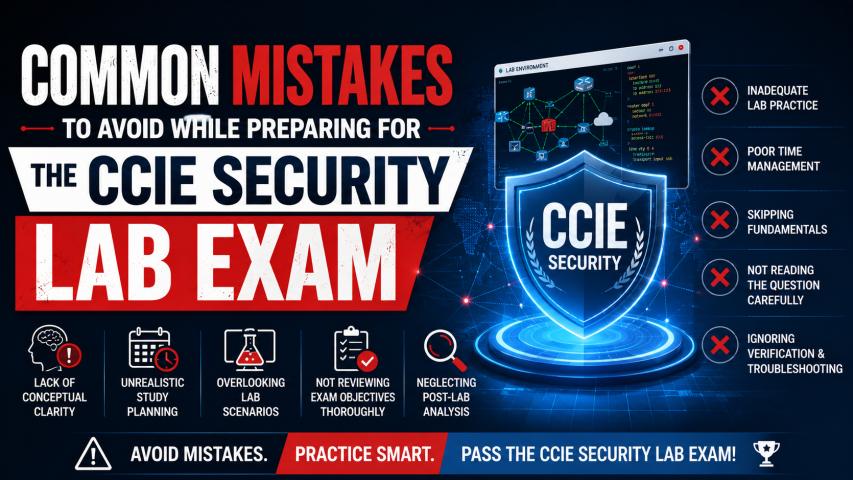
Common Mistakes to Avoid
Over-Reliance on Theory
Focusing only on theory without practice can limit practical readiness.
Lack of Structured Preparation
Unplanned study schedules reduce efficiency and retention.
Ignoring Weak Areas
Avoiding difficult topics can lead to knowledge gaps.
Career Benefits of CCIE Enterprise Infrastructure
Earning this certification unlocks advanced career opportunities.
High-Demand Roles
Network Architect
Senior Network Engineer
Infrastructure Consultant
Enterprise Network Specialist
Industry Recognition
CCIE-certified professionals are recognized globally for their advanced technical expertise and problem-solving abilities.
Conclusion
Mastering the essential skills required for CCIE Enterprise Infrastructure is crucial for achieving success in this highly competitive certification. From networking fundamentals to automation, troubleshooting, and design expertise, each skill plays a vital role in preparing candidates for real-world enterprise environments. With disciplined preparation and strong technical understanding, professionals can achieve excellence in CCIE Enterprise Infrastructure and advance their careers in enterprise networking.