
Introduction to Enterprise Security Career Growth
The demand for skilled cybersecurity professionals is increasing as organizations continue to expand their digital infrastructure and adopt cloud-first and hybrid networking environments. Businesses are actively seeking experts who can secure complex enterprise systems, manage evolving threats, and ensure regulatory compliance across distributed networks.
Within this context, CCIE Security is considered a highly advanced and prestigious certification in the field of enterprise security. It validates deep expertise in designing, implementing, and managing secure network infrastructures at scale.
Understanding the Role of CCIE Security in Modern IT Environments
Why Enterprise Security Skills Are in Demand
Modern enterprises rely heavily on interconnected systems that span across on-premises data centers, cloud platforms, and remote endpoints. This interconnectedness increases the attack surface, making security a top priority for organizations.
Key reasons for rising demand include:
Increased frequency of cyberattacks
Expansion of cloud-based infrastructures
Increasing adoption of flexible remote and hybrid work arrangements
Growing regulatory compliance requirements
Need for continuous threat monitoring
As a result, professionals who can manage these challenges are highly valued in the job market.
How Certification Bridges the Skills Gap
Many organizations face a shortage of skilled security professionals who can handle complex enterprise environments. Certifications help bridge this gap by standardizing knowledge and validating hands-on expertise.
CCIE Security certification specifically focuses on advanced-level skills that go beyond theoretical understanding, emphasizing real-world application.
Core Areas of Expertise Developed Through CCIE Security Certification
Advanced Network Security Architecture
Enterprise security professionals are expected to design secure and scalable network infrastructures.
This includes:
Building multi-layered security architectures
Designing segmentation strategies
Implementing defense-in-depth models
Aligning security with business requirements
These capabilities are essential for protecting sensitive enterprise data and systems.
Firewall and Security Infrastructure Management
Firewalls remain a core component of enterprise security systems.
Professionals develop skills in:
Configuring advanced firewall policies
Managing access control rules
Monitoring traffic patterns
Troubleshooting security enforcement issues
These skills help organizations maintain strong perimeter and internal security controls.
Secure Connectivity and VPN Technologies
With distributed workforces becoming the norm, secure connectivity is essential.
Key competencies include:
Designing VPN architectures
Configuring site-to-site and remote access VPNs
Ensuring encrypted communication channels
Managing secure branch connectivity
These skills enable secure communication across enterprise environments.
Identity and Access Management in Enterprise Security
Role-Based Access Control and Authentication
Identity-based security is a major focus area in modern enterprises.
Professionals learn how to:
Implement role-based access control (RBAC)
Configure authentication mechanisms
Manage user identity policies
Enforce least-privilege principles
This ensures that only authorized users can access critical systems.
Multi-Factor Authentication Implementation
Multi-factor authentication (MFA) is widely adopted to strengthen security frameworks.
Key responsibilities include:
Integrating MFA solutions into enterprise systems
Enhancing user verification processes
Reducing risks of credential theft
Strengthening access security layers
These practices significantly improve organizational security posture.
Threat Detection and Security Operations
Monitoring and Incident Detection
Security professionals are expected to continuously monitor enterprise networks for potential threats.
This involves:
Analyzing security logs
Identifying abnormal behavior
Detecting intrusion attempts
Using monitoring tools for real-time visibility
Effective monitoring helps prevent security incidents before they escalate.
Incident Response and Recovery
When security breaches occur, timely response is critical.
Professionals must be capable of:
Identifying the source of the attack
Containing security incidents
Restoring affected systems
Documenting incident details
Strong incident response skills reduce downtime and business impact.
Zero Trust and Modern Security Frameworks
Understanding Zero Trust Architecture
Zero Trust has become a foundational principle in enterprise security design.
Key principles include:
Never trust, always verify
Continuous authentication
Strict access control enforcement
Micro-segmentation of networks
Professionals with Zero Trust expertise are highly valued in modern IT environments.
Application in Enterprise Environments
Zero Trust implementation helps organizations:
Reduce lateral movement of threats
Strengthen access control policies
Improve visibility across networks
Enhance overall security resilience
This makes it a critical skill set for enterprise security professionals.
Cloud and Hybrid Security Skills
Securing Multi-Cloud Environments
As organizations adopt multiple cloud platforms, security complexity increases.
Professionals are expected to:
Secure cloud workloads
Manage hybrid connectivity
Implement cloud access controls
Monitor distributed environments
These skills ensure consistent security across all platforms.
Integration with Enterprise Systems
Security professionals must also integrate cloud security with existing enterprise infrastructure.
This includes:
Identity synchronization
Policy alignment across environments
Unified threat management
Centralized security monitoring
Such integration ensures seamless protection across hybrid ecosystems.
Automation and Network Programmability in Security
Importance of Security Automation
Automation plays a crucial role in modern security operations by improving efficiency and reducing human error.
Key areas include:
Automated threat detection
Policy enforcement automation
Incident response workflows
Configuration management
Automation enables faster and more consistent security operations.
Role of Programmability Skills
Network programmability allows professionals to manage complex environments more effectively.
Skills include:
API integration
Script-based automation
Infrastructure as code concepts
Workflow optimization
These capabilities enhance scalability and operational efficiency.
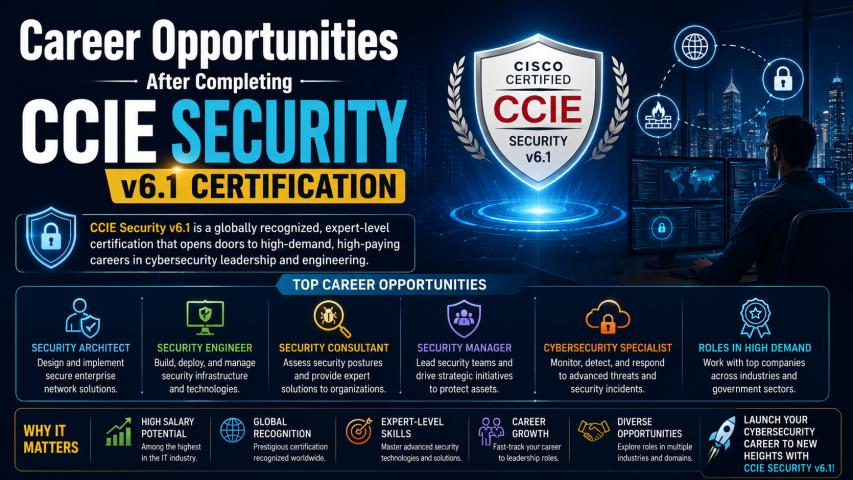
Career Opportunities After CCIE Security Certification
Enterprise Security Job Roles
Professionals with advanced security certifications can pursue roles such as:
Security Architect
Network Security Engineer
Security Consultant
Infrastructure Security Specialist
Cybersecurity Engineer
These roles are critical in large enterprise environments.
Career Growth and Industry Demand
Organizations across various industries are dedicating significant resources to cybersecurity talent.
Key trends include:
Increasing demand for senior security engineers
Higher salary potential for certified professionals
Greater responsibility in enterprise architecture
Opportunities in global organizations
This enhances the certification’s value for long-term career development.
Skills That Differentiate CCIE Security Professionals
Technical Depth and Practical Expertise
One of the key advantages of this certification is the emphasis on real-world skills.
Professionals are trained to:
Solve complex network security problems
Design scalable enterprise solutions
Troubleshoot advanced infrastructure issues
This practical expertise sets them apart in competitive job markets.
Strategic Security Thinking
Beyond technical skills, professionals also develop strategic thinking abilities.
This includes:
Aligning security with business goals
Assessing enterprise risk
Designing long-term security strategies
Such skills are essential for leadership roles in cybersecurity.
Conclusion
The growing complexity of enterprise networks has significantly increased the need for highly skilled cybersecurity professionals. Certifications like CCIE Security play a crucial role in preparing individuals for these challenges by providing advanced knowledge in network security design, identity management, threat detection, automation, and modern security frameworks such as Zero Trust.
Professionals who earn CCIE Security certification are well-positioned to advance their enterprise security careers, contribute to organizational resilience, and take on high-impact roles in the evolving cybersecurity landscape.