Remote Patient Monitoring Market Size
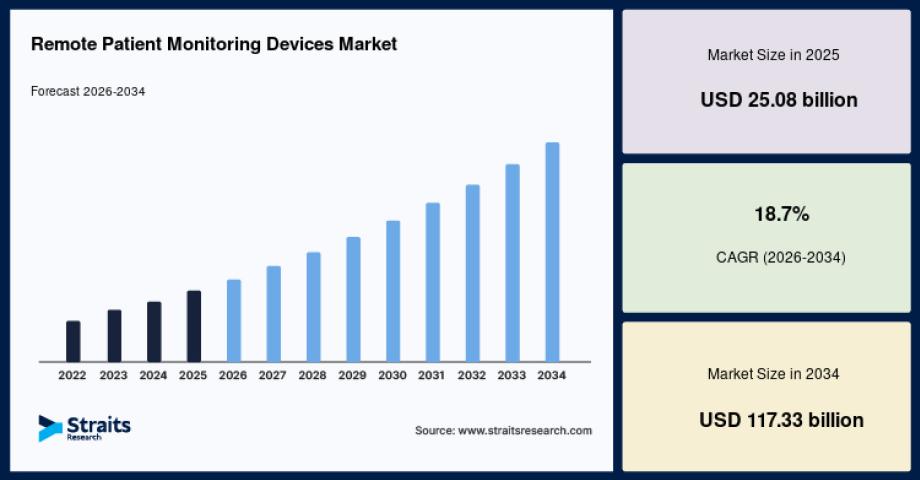
The global remote patient monitoring market was valued at approximately USD 30.61 billion in 2025 and is forecast to reach nearly USD 77.75 billion by 2035. Growing at a projected CAGR of 9.77% from 2026 to 2035, the market is being propelled by the rapid adoption of digital healthcare technologies, increasing use of telehealth services, and rising demand for data-driven patient management solutions.
What is the Remote Patient Monitoring Market?
The remote patient monitoring market comprises an extensive network of healthcare technologies, connected medical devices, software applications, and support services that enable healthcare professionals to monitor patients beyond traditional clinical settings. RPM systems capture and transmit essential health information—including blood pressure, glucose levels, heart rate, oxygen saturation, ECG readings, and other physiological metrics—through wearable devices and connected monitoring equipment.
Information collected through these systems is transmitted securely via cloud-based platforms, mobile applications, and IoT-enabled networks, allowing healthcare providers to assess patient conditions in real time. RPM solutions have become essential for chronic disease management, post-discharge care, elderly patient monitoring, and preventive healthcare initiatives. The market includes wearable sensors, implantable monitoring devices, telehealth platforms, AI-enabled analytics tools, and mobile health applications that support decentralized healthcare delivery.
Why the Remote Patient Monitoring Market is Important
The increasing relevance of the RPM market lies in its ability to shift healthcare from a reactive treatment approach toward proactive and preventive care management. Continuous monitoring helps reduce hospital readmissions, improves chronic disease outcomes, enhances patient engagement, and lowers overall healthcare costs.
Healthcare providers gain continuous visibility into patient health without the need for frequent in-person consultations. Patients benefit from improved accessibility and convenience, particularly individuals living in remote locations or experiencing mobility limitations. Governments and healthcare payers also benefit through reduced healthcare spending and improved population health outcomes.
Following the global healthcare transformation accelerated by the pandemic, RPM has become a critical pillar of modern digital healthcare strategies, supporting hybrid care models that integrate virtual and traditional healthcare services.
Get a Free Sample Report:
https://www.cervicornconsulting.com/sample/2590
Key Growth Factors Driving the Remote Patient Monitoring Market
The remote patient monitoring market is witnessing substantial growth due to several interconnected factors. The increasing prevalence of chronic conditions such as diabetes, cardiovascular diseases, hypertension, and respiratory disorders is generating strong demand for continuous patient monitoring. Additionally, the rapid expansion of telehealth and virtual care services has accelerated RPM adoption across healthcare systems.
Technological advancements in wearable medical devices, IoT-enabled healthcare equipment, cloud-based platforms, and artificial intelligence-driven analytics continue to enhance monitoring capabilities. Rising healthcare costs are encouraging providers and payers to adopt more cost-efficient care models, while supportive reimbursement policies and government initiatives are fostering greater acceptance of remote monitoring technologies. Growing smartphone penetration and internet accessibility worldwide are further strengthening patient-provider connectivity.
Key Companies in the Remote Patient Monitoring Market
Abbott
Specialization: Continuous glucose monitoring systems, implantable cardiac devices, and remote patient monitoring technologies.
Key Focus Areas:
Diabetes management through the FreeStyle Libre platform
Cardiac rhythm monitoring
Remote cardiac telemetry
Connected healthcare ecosystems
Notable Features:
Extensive implantable monitoring portfolio
Real-time patient insights
Strong healthcare provider integration
2025 Revenue Contribution: Significant multi-billion-dollar revenue from diabetes and cardiovascular monitoring businesses.
Market Position: Among the leading global providers of cardiac RPM technologies.
Global Presence: Strong operations across North America, Europe, and Asia-Pacific.
American Telecare
Specialization: Home-based telehealth and chronic disease monitoring solutions.
Key Focus Areas:
Home healthcare services
Elderly patient care
Vital signs monitoring
Notable Features:
Early telehealth innovator
Specialized home monitoring platforms
2025 Revenue: Moderate revenue focused on niche telehealth applications.
Market Position: Established participant within home-based RPM solutions.
Global Presence: Primarily North America.
Biotronik
Specialization: Implantable cardiovascular devices and remote cardiac monitoring systems.
Key Focus Areas:
Pacemakers
Defibrillators
Cardiac telemetry technologies
Notable Features:
Advanced cardiac monitoring platforms
High data accuracy and reliability
2025 Revenue Contribution: Strong revenues from cardiovascular monitoring products.
Market Position: Significant player within the European cardiac RPM segment.
Global Presence: Europe, North America, and Asia-Pacific.
Boston Scientific Corporation
Specialization: Cardiac rhythm management technologies and connected healthcare solutions.
Key Focus Areas:
Cardiovascular care
Neurovascular monitoring
Digital health integration
Notable Features:
AI-powered monitoring capabilities
Connected medical device ecosystem
2025 Revenue Contribution: Significant revenue generated through cardiovascular and digital health divisions.
Market Position: One of the leading RPM technology providers globally.
Global Presence: Broad presence across developed and emerging healthcare markets.
CareValidate
Specialization: Digital healthcare monitoring software and workforce health management solutions.
Key Focus Areas:
Remote health screening
Symptom monitoring
Compliance management
Notable Features:
SaaS-based monitoring platform
Advanced analytics capabilities
2025 Revenue: Mid-sized digital health software revenues.
Market Position: Emerging software-focused RPM provider.
Global Presence: North America with expanding international adoption.
Major Trends Influencing the Remote Patient Monitoring Market
AI-Enabled Predictive Healthcare
Artificial intelligence is increasingly being incorporated into RPM platforms to analyze patient data and identify potential health risks before they become critical. Predictive analytics supports earlier intervention and reduces hospitalization rates.
Growing Adoption of Wearable Technologies
Wearables such as smartwatches, biosensors, and health-monitoring patches continue to gain popularity, improving patient compliance and enhancing the quality of health data collected.
Telehealth and RPM Integration
RPM systems are increasingly integrated with telehealth platforms, enabling seamless communication between clinicians and patients while facilitating continuous care management.
Expansion of Cloud-Based Healthcare Platforms
Cloud infrastructure enables secure storage, sharing, and accessibility of patient information, enhancing healthcare collaboration and care coordination.
Hospital-at-Home Programs
Healthcare providers are increasingly implementing home-based care models that utilize RPM technologies to deliver advanced medical care outside hospital environments.
Improved Interoperability Standards
Advancements in healthcare data standardization are enabling RPM systems to integrate more effectively with electronic health records, improving clinical workflows and treatment decisions.
Global Examples of RPM Adoption
United States
Healthcare providers utilize RPM solutions extensively for diabetes, hypertension, and cardiovascular disease management through connected monitoring devices that help reduce hospital admissions.
Europe
Countries such as Germany and the United Kingdom have integrated remote cardiac monitoring technologies into healthcare systems to support high-risk cardiovascular patients.
India
Telemedicine networks and rural healthcare initiatives are expanding RPM adoption, improving access to healthcare services in underserved communities.
Japan
RPM technologies play a crucial role in elderly care, with wearable devices supporting continuous monitoring and fall detection for aging populations.
Australia
Remote patient monitoring solutions are widely used to support healthcare delivery in geographically isolated communities and remote regions.
Regional Outlook
North America
North America remains the largest RPM market, supported by advanced healthcare infrastructure, favorable reimbursement policies, and widespread telehealth adoption.
Europe
Europe continues to experience strong market growth due to healthcare digitization initiatives and supportive regulatory environments.
Asia-Pacific
Asia-Pacific is projected to witness the fastest growth, driven by healthcare modernization, increasing smartphone usage, and government-led digital health programs.
Latin America
Healthcare providers across Brazil, Mexico, and other regional markets are increasingly investing in telehealth and remote monitoring infrastructure.
Middle East & Africa
Digital healthcare transformation initiatives and smart hospital investments are accelerating RPM adoption across GCC countries and other regional healthcare markets.
Government Policies Accelerating Market Growth
Several government programs are helping expand RPM adoption worldwide, including:
Medicare reimbursement support for RPM services in the United States
The European Union Digital Health Strategy promoting healthcare interoperability
India's Ayushman Bharat Digital Mission supporting digital healthcare transformation
China's Smart Healthcare initiatives emphasizing AI-enabled healthcare systems
Japan's eldercare support programs promoting home-based monitoring
Saudi Vision 2030 healthcare modernization initiatives
These policies are improving healthcare infrastructure, encouraging innovation, and accelerating digital healthcare adoption globally.
Market Evolution and Industry Transformation
The remote patient monitoring market has evolved significantly from simple vital-sign tracking systems to comprehensive digital healthcare ecosystems. Modern RPM platforms combine artificial intelligence, predictive analytics, cloud connectivity, and interoperability with electronic health record systems.
Healthcare providers are increasingly adopting value-based care models, where reimbursement is linked to patient outcomes rather than service volume. This transition is significantly contributing to RPM adoption worldwide.
Insurance providers are also expanding reimbursement coverage for RPM services, helping accelerate market penetration across developed and emerging healthcare markets.
Technologies Powering Market Growth
Several advanced technologies continue to support RPM market expansion:
IoT-enabled medical devices for real-time health monitoring
Artificial intelligence and machine learning solutions
Cloud-based healthcare management platforms
5G communication networks for faster data transfer
Blockchain technologies enhancing healthcare data security
Mobile health applications improving patient engagement
Together, these innovations improve healthcare accessibility, scalability, operational efficiency, and patient outcomes.
Future Outlook
The remote patient monitoring market is expected to maintain strong growth momentum over the coming decade. Continued advancements in artificial intelligence, wearable technologies, telehealth integration, and predictive healthcare analytics will reshape healthcare delivery worldwide.
Demand is expected to remain particularly strong across cardiovascular monitoring, diabetes management, respiratory care, and elderly healthcare applications, positioning RPM as a fundamental component of future healthcare infrastructure.
For Detailed Market Insights and Customized Research:
https://www.cervicornconsulting.com/contact-us