
Large language models have quickly moved from being experimental AI tools to becoming practical business assets. A few years ago, most companies were simply curious about what generative AI could do. Today, they are asking much more serious questions: How can we use it inside our workflows? Can it reduce repetitive work? Can it improve customer service? Can it help employees find information faster? Can it support decision-making without creating risk?
That shift has made custom LLM solutions more important than ever. Instead of using generic AI tools in isolation, businesses now want models and applications that understand their data, follow their rules, and work inside their existing systems. This is where LLM Development Services become valuable, especially for organizations that need tailored AI applications rather than one-size-fits-all chatbots.
At its core, LLM development is about building software around large language models so they can perform useful tasks. The model itself may be provided by OpenAI, Anthropic, Google, Meta, or another provider. But the real value comes from how the model is connected to business data, applications, workflows, user roles, and security requirements. A well-designed LLM application does not just answer questions. It solves a specific problem in a reliable and repeatable way.
For example, a company may want an internal knowledge assistant that helps employees find answers from policy documents, SOPs, project files, and training material. Another company may need an AI support assistant that summarizes customer tickets, recommends responses, and escalates urgent issues. A sales team may want an assistant that reviews CRM activity, drafts follow-up emails, and highlights deals that need attention. In each case, the model is only one part of the solution. The surrounding architecture determines whether the system is actually useful.
One of the most common use cases for LLM applications is enterprise search. Many organizations have thousands of documents stored across Google Drive, SharePoint, Notion, Confluence, CRMs, and internal databases. Employees often waste time looking for the right file, reading through long documents, or asking colleagues for information that already exists somewhere. An LLM-powered search assistant can retrieve relevant content, summarize it, and provide answers in plain language. When built properly, it can also cite source documents so users know where the answer came from.
Another strong use case is customer support automation. Support teams deal with repetitive questions, long ticket histories, and pressure to respond quickly. LLMs can help by classifying tickets, summarizing conversations, suggesting replies, translating messages, detecting customer sentiment, and routing issues to the right team. This does not mean support teams disappear. In most businesses, the best approach is to let AI handle the repetitive preparation work while humans review and send final responses when needed.
Document processing is another area where LLMs are extremely useful. Businesses often process invoices, contracts, resumes, insurance claims, reports, legal documents, medical records, or compliance files. Traditional automation struggles when documents vary in format or contain unstructured text. LLMs can extract key information, summarize long sections, identify risks, compare clauses, and convert messy content into structured outputs. This can save hours of manual review, especially in departments that handle large document volumes.
LLMs can also improve sales and marketing workflows. Sales teams can use them to research prospects, summarize account history, draft personalized emails, analyze call notes, and recommend next actions. Marketing teams can use them to repurpose content, generate campaign briefs, analyze customer feedback, and create product messaging variations. The key is not to use AI for generic content generation alone, but to connect it with real business context so the outputs are more accurate and relevant.
In operations, LLMs can help teams monitor exceptions and generate alerts. For instance, an AI workflow can review order delays, supplier emails, inventory notes, or service logs and then summarize what needs attention. Instead of managers manually checking multiple systems, the AI can surface the most important issues with context and suggested next steps. This is especially useful for ecommerce, logistics, finance, healthcare, and manufacturing teams where small delays can become larger problems if missed.
One of the biggest benefits of custom LLM development is productivity. Employees spend a lot of time reading, summarizing, searching, rewriting, reporting, and transferring information between tools. LLM applications can reduce that burden by handling the first draft, first summary, first classification, or first analysis. Even when a human still makes the final decision, the time saved can be significant.
Another benefit is consistency. Human work can vary based on experience, workload, mood, or available context. A properly designed AI workflow can apply the same rules every time. For example, it can evaluate support tickets using the same urgency criteria, summarize sales calls in the same format, or check contracts against the same risk checklist. This consistency becomes valuable when teams need standardized outputs across departments or locations.
Speed is also a major advantage. LLM systems can process large volumes of text faster than humans. A task that might take an employee thirty minutes, such as reading a long report and creating a summary, can often be completed in seconds or minutes. In customer-facing workflows, faster response times can improve satisfaction. In internal workflows, faster access to information can improve decision-making.
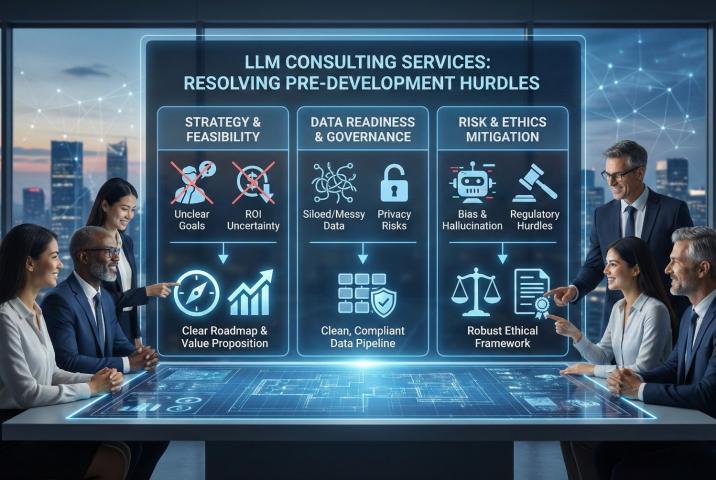
However, businesses should not treat LLMs as magic. They are powerful, but they also have limitations. They can misunderstand context, produce inaccurate answers, or generate confident-sounding outputs that need verification. That is why serious LLM development requires good architecture, testing, monitoring, and governance. The goal is not just to make the model respond. The goal is to make the overall system trustworthy enough for business use.
A best practice is to start with a clearly defined use case. Many AI projects fail because they begin with a vague idea like “we want to use AI.” A better starting point is a specific workflow: reduce manual ticket summarization, improve document search, automate invoice review, or generate weekly portfolio reports. The more specific the problem, the easier it is to design, test, and measure the solution.
Data preparation is another important step. LLMs perform better when the input data is clean, organized, and accessible. If a company wants a knowledge assistant, documents need to be collected, cleaned, chunked, indexed, and tagged with metadata. If a company wants CRM-based insights, records need to be accurate and consistently maintained. AI cannot fully fix poor data discipline. In many cases, the success of an LLM project depends as much on data quality as on model capability.
Retrieval-augmented generation, often called RAG, is one of the most useful patterns for business LLM applications. Instead of asking the model to rely only on its general training, the system retrieves relevant internal data and gives it to the model before generating an answer. This helps reduce hallucinations and makes responses more specific to the business. RAG is especially useful for company knowledge bases, legal documents, product documentation, support articles, and compliance material.
Security should be built into the project from the beginning. Companies must decide what data can be sent to third-party APIs, what must remain private, who can access AI outputs, and how user activity should be logged. Sensitive information such as customer data, employee records, financial details, and intellectual property should be handled carefully. Role-based access, encryption, audit logs, and data retention policies are essential for responsible AI adoption.
Human review is another best practice. Not every AI-generated action should be automated end-to-end. In many workflows, the safest model is AI-assisted work, where the system prepares a recommendation and a human approves it. Over time, companies may automate more steps as the system proves reliable. This gradual approach builds trust and reduces risk.
Testing is also critical. LLM applications should be tested with real examples, edge cases, incomplete inputs, and unusual scenarios. Teams should check whether the system gives accurate answers, follows instructions, handles missing data properly, and avoids unsafe outputs. Testing should continue after launch because business data and user behavior change over time.
Cost management matters too. LLM usage can become expensive if every workflow sends long documents or large conversation histories to powerful models. Developers can reduce cost by using smaller models for simple tasks, summarizing long content before deeper analysis, caching repeated answers, and limiting unnecessary token usage. A smart system uses the right model for the right task.
For larger companies, LLM initiatives often connect with broader AI transformation efforts. Many organizations combine model-based applications with automation platforms, analytics tools, data warehouses, APIs, and internal software systems. This is where Enterprise AI Development Services may support a wider roadmap, helping businesses move from isolated AI experiments to scalable, governed AI solutions across departments.
The best LLM projects are not built around technology alone. They are built around people and workflows. Employees need to understand how to use the system, when to trust it, and when to verify its output. Managers need to know how success will be measured. Technical teams need feedback from real users so they can improve prompts, retrieval logic, integrations, and user experience.
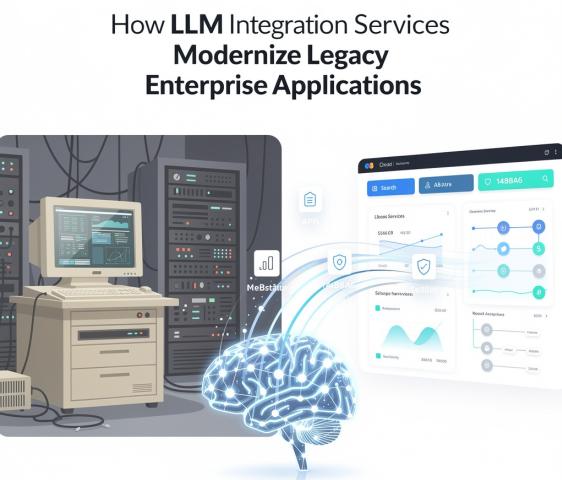
In the future, LLM applications will become more deeply embedded into business systems. Instead of opening a separate chatbot, employees will interact with AI inside the tools they already use: CRMs, ERPs, email, spreadsheets, support platforms, project management tools, and communication apps. The most successful solutions will feel less like standalone AI products and more like intelligent layers inside everyday work.
LLM development is not about replacing every human task. It is about removing friction, improving access to knowledge, speeding up repetitive work, and helping teams make better decisions with less manual effort. Businesses that approach it with clear goals, strong data practices, secure architecture, and thoughtful human oversight will get far more value than those that simply add AI for the sake of following a trend.
As adoption grows, the difference between successful and unsuccessful AI projects will come down to execution. The companies that win will be the ones that choose practical use cases, integrate AI into real workflows, measure results, and keep improving the system over time. With the right approach, large language models can become a dependable part of modern business operations, not just an impressive demo.