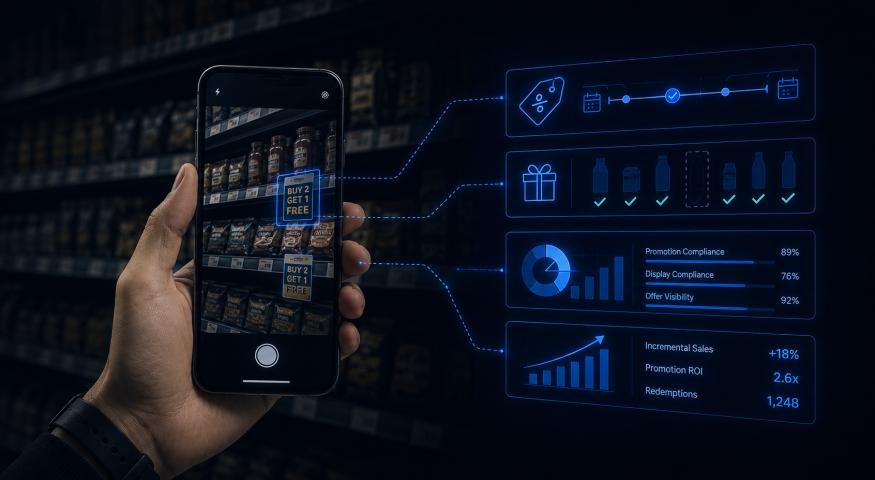
Every consumer goods company runs on promotions. Buy-two-get-one offers, slab-based volume discounts, seasonal push schemes for distributors, these mechanisms move billions of dollars in inventory every quarter across Asia's retail markets. Yet ask most CPG finance teams a simple question "what did we actually get back for last quarter's trade spend?" and the answer is usually a shrug, a spreadsheet, and a guess.
Trade spend is typically the second-largest line item on an FMCG company's P&L, right after the cost of goods sold. And it remains, for a shocking number of otherwise sophisticated companies, the least measured one.
Why Promotions Are Still Run on Guesswork
The mechanics of trade promotion sound simple on paper. A brand decides to run a scheme, say, a 5% discount on cases of ten or more and pushes it out to distributors and retailers through field teams. In practice, the execution chain is anything but simple.
A scheme has to be communicated to hundreds or thousands of field reps. It has to be applied correctly at the point of order, whether that order is placed by a distributor's back office or a retailer through a sales rep's device. It has to respect eligibility rules this outlet qualifies, that one doesn't, this SKU combination unlocks the offer, that one falls short. And it has to stop the moment the allocated budget runs out, not two weeks later when finance finally reconciles the numbers.
Most companies still manage this through a patchwork of Excel trackers, WhatsApp instructions to field teams, and manual claim verification. The result is predictable: schemes get applied when they shouldn't, budgets get blown past their caps before anyone notices, and a meaningful share of trade spend disappears into what the industry euphemistically calls "leakage" — discounts given without the qualifying purchase behavior actually happening.
The Real Cost of Manual Promotion Management
The consequences show up in three places.
First, margin erosion. When a scheme isn't validated against actual basket composition the right SKUs, the right quantities, the right outlet a company ends up subsidizing purchases that would have happened anyway, at full price.
Second, blind budgeting. Without real-time tracking of how much of a scheme's allocated spend has been used, finance teams routinely discover overruns only at month-end reconciliation, by which point the damage to that quarter's numbers is already done.
Third, and less discussed, is the disconnect between primary and secondary sales. A brand might design a scheme to drive sell-through at the retail shelf, but if the system only tracks what distributors ordered (sell-in) rather than what actually moved to retailers (sell-through), the company is often just shifting inventory into warehouses and calling it growth.
What Structured Trade Promotion Execution Looks Like
The shift underway across better-run FMCG and CPG organizations isn't complicated in concept; it's about replacing manual judgment calls with rule-based, automated scheme execution at the moment an order is placed.
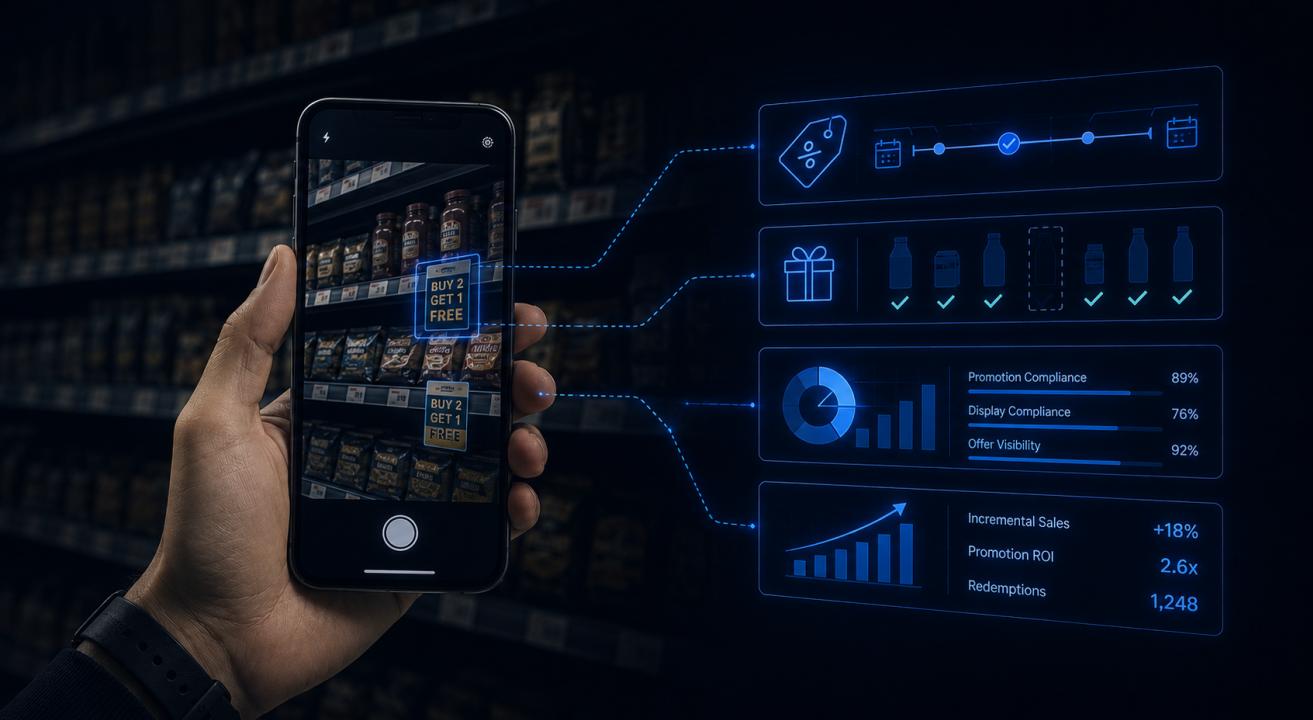
That means a scheme's eligibility conditions: basket composition, outlet segment, geography, quantity thresholds are checked instantly against every order, rather than reviewed after the fact. It means budgets are capped and monitored in real time, with schemes automatically deactivating once their allocated spend is exhausted, rather than relying on someone to notice a spreadsheet has gone red. And it means primary scheme logic extends cleanly into secondary distributor-to-retailer transactions, so a brand can actually see whether a promotion drove sell-through or just sell-in.
Some FMCG operators have started approaching this the way they approach any other operations problem by treating trade promotion as a system to be engineered rather than a process to be supervised. Platforms built specifically for this, like FieldAssist's trade promotion management software, are designed to reduce scheme leakage and improve trade spend ROI through real-time visibility and automated budget governance rather than post-hoc reconciliation, which is a meaningfully different approach from bolting promotion tracking onto a generic ERP module
What This Means for Growth-Stage CPG Brands
For founders and operators scaling a consumer brand across new geographies or channels, trade promotion discipline tends to matter more, not less, as the business grows. A young D2C-turned-omnichannel brand running a handful of local schemes can survive on manual tracking. A brand distributing across a few hundred towns, several thousand outlets, and multiple regional distributors cannot the coordination overhead alone becomes a full-time liability, and every point of margin lost to unvalidated discounts compounds across the network.
This is part of why trade promotion management has quietly become a category worth watching within the broader retail-tech and RetailTech investment landscape in Asia. It sits at an unusually clear intersection of two things investors care about: measurable ROI (every rupee or peso of trade spend can, in principle, be tracked back to incremental sales) and operational scalability (the same rule engine that governs ten schemes can govern ten thousand, without proportional headcount growth).
The Bigger Shift: From Spend Tracking to Spend Intelligence
The next phase of this shift is less about tracking spend accurately and more about predicting which promotional structures will actually work before they're launched, modeling baseline lift, testing scheme variants, and reallocating budget toward the geographies and product groups where a given rupee of trade spend produces the most incremental volume. That's a genuinely harder problem than compliance and tracking, and it's where the category is headed next.
For now, though, most FMCG and CPG companies operating across emerging markets haven't solved the basic problem: knowing, in real time, where trade money is going and whether it's earning its keep. Fixing that isn't a nice-to-have anymore, it's becoming table stakes for any consumer brand trying to scale distribution profitably.