In flexible packaging production, some costly issues are not necessarily due to obvious material defects.
Even if the material meets requirements for thickness, tensile strength, sealability, and appearance, problems can still arise on the production line. Common issues include unstable material feeding, misalignment, and material sticking, which, in severe cases, can lead to production line shutdowns. These issues all stem from a factor that is often overlooked: the coefficient of friction.
The coefficient of friction is crucial in flexible packaging because the film constantly interacts with rollers, guide rails, forming components, and sealing elements during processing. However, friction is not a constant. The same film will exhibit different friction characteristics when encountering different contact surfaces.
Why Does the Friction of Packaging Film Vary?
1. Surface Roughness and Topography
From a microscopic perspective, the surface of a film is not perfectly smooth; it typically contains microscopic protrusions and depressions. When two material surfaces come into contact, these irregularities create a certain amount of resistance.
2. Slip Agents and Migration
To reduce friction, many flexible packaging materials contain slip agents. Over time, these lubricants gradually migrate and migrate to the material’s surface. This process affects the interaction between the material and the contact surface.
3. Surface Treatment and Coating
Flexible packaging films may undergo corona treatment, coating, printing, lamination, or other surface modifications. These treatments alter the film’s surface, resulting in inconsistent friction properties before and after treatment.
4. Temperature, Humidity, and Environmental Conditions
Temperature fluctuations can affect the mechanical properties of polymers as well as the flow or migration of lubricants on the film surface. Humidity can also alter the surface condition of the film or the interaction between contacting materials, particularly for moisture-sensitive materials. Additionally, differences between laboratory and production environments can affect the measured or actual friction properties of the film.
5. Test Conditions
Differences in test conditions—such as test speed, applied load, specimen preparation, and contact surfaces—can also lead to inconsistent friction results.
Why Are Changes in Friction Critical for Production Lines?
Changes in the coefficient of friction (COF) affect the operational stability of flexible packaging films on production lines. Even relatively small changes can lead to:
Unstable film transport: Changes in friction disrupt the balance between film movement, tension, and driving force, resulting in unstable transport.
Tracking Issues and Wrinkling: Variations in friction between the film and rollers or guide rails can cause the film to deviate from its intended path, increasing the risk of wrinkling.
Positioning and Registration Errors: Film slippage or inconsistent movement can affect the registration accuracy of printing, cutting, forming, and sealing processes.
Increased Equipment Adjustments: Variations in film friction may require operators to repeatedly adjust tension, speed, or other equipment parameters.
Reduced Production Efficiency: Frequent adjustments, reduced line speeds, material waste, and occasional downtime all increase overall production costs.
How Can Manufacturers Investigate COF Variability?
When friction-related issues arise during production, comparing material data can be helpful.
Manufacturers can compare the coefficient of friction (COF) under the following conditions:
Different production batches: This helps determine whether friction behavior varies with material production.
Different locations on the film: This can reveal potential variations in the film’s surface.
Both sides of the film: Treated and untreated surfaces, or different coatings, may exhibit different friction characteristics.
Different storage periods: This helps identify changes related to surface evolution or additive migration.
Different production conditions: Comparing coefficient of friction (COF) data with processing conditions helps determine whether friction variations are related to specific manufacturing parameters.
Conclusion
Changes in the coefficient of friction (COF) can affect film feeding, web guidance, positioning, and overall production efficiency. Continuous monitoring of the COF helps manufacturers detect changes in material behavior before they escalate into more serious production issues.
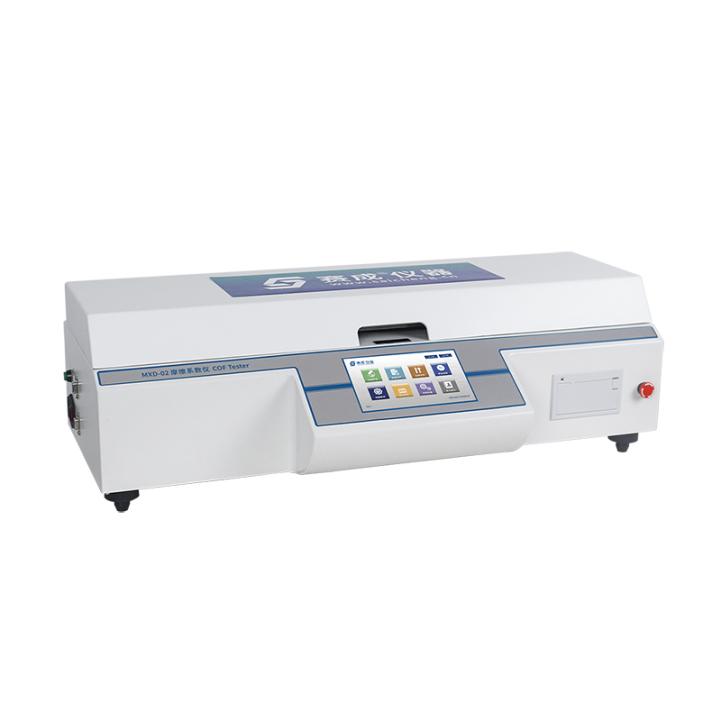
For an in-depth understanding of COF testing methods, standards, influencing factors, and packaging applications, please refer to the “Guide to Testing the Coefficient of Friction of Packaging Materials” published by Saicheng.