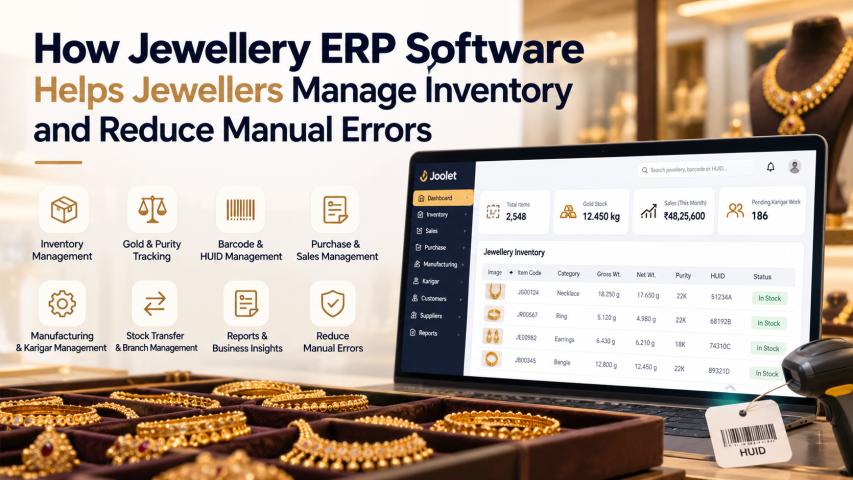
Managing jewellery inventory is not the same as managing ordinary retail stock. A jewellery item carries details such as gross weight, net weight, purity, stones, making charges, barcode, HUID and location. At the same time, gold itself is a high-value material whose price can change significantly. That makes accurate inventory management one of the most important parts of running a jewellery business.
The need for better control is even more relevant in the current market. According to the World Gold Council, Indian jewellery demand reached 75.1 tonnes in Q2 2026, while the value of jewellery demand increased 34% year over year to ₹1,132 billion. Retail inventories were around 21 tonnes, above the 13-year average of 15 tonnes.
When inventory represents this much value, even small recording mistakes can become expensive.
Why Manual Jewellery Inventory Management Becomes Difficult
Many jewellery businesses still depend on registers, spreadsheets, separate billing systems and verbal communication to track stock.
This may work when the business is small. As the number of jewellery pieces, customers, suppliers, employees and transactions increases, however, maintaining accurate records becomes much harder.
Common problems include:
- Incorrect weight or purity entries
- Difficulty locating a particular jewellery item
- Duplicate or missing stock records
- Delays in updating sold or transferred items
- Errors while recording old-gold exchanges
- Difficulty tracking jewellery sent to karigars
- Differences between physical and system stock
- Missing HUID or barcode information
- Time-consuming stock reconciliation
The problem is not always employee negligence. Manual systems simply create more opportunities for information to be entered incorrectly or updated late.
What Does Jewellery ERP Software Do?
Jewellery ERP software connects important business activities to a central system.
Instead of maintaining separate records for inventory, purchases, sales, billing and customer transactions, the information can flow through the same system.
For example:
Purchase → Stock Entry → Barcode → Showroom Stock → Sale → Billing → Stock Reduction
When these activities are connected, the system can automatically update relevant records instead of requiring employees to enter the same information repeatedly.
This reduces unnecessary data entry and makes the inventory history easier to follow.
1. Maintain Detailed Jewellery Records
A jewellery item needs more information than a simple product name and quantity.
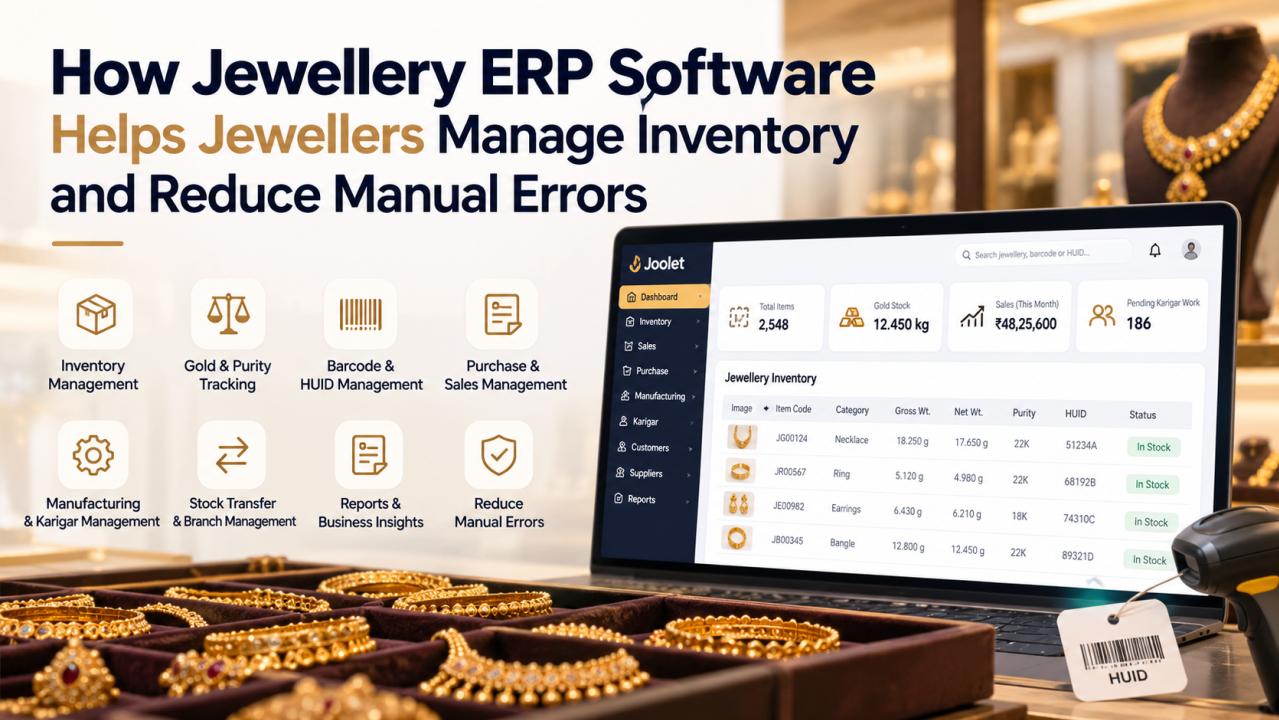
A proper jewellery inventory system can maintain information such as:
- Item code
- Jewellery category
- Gross weight
- Net weight
- Purity
- Stone details
- Making charges
- Barcode
- HUID
- Purchase details
- Current location
- Stock status
This creates a more complete digital record for every piece.
Instead of searching through multiple registers to understand an item's history, staff can access the relevant information from one record.
2. Improve Gold and Purity Tracking
Gold inventory requires careful weight and purity management.
For example, two jewellery pieces may have similar designs but different weights and purity levels. Treating them simply as "two items in stock" would not provide enough information for proper inventory control.
An ERP system can maintain item-level weight and purity information and connect those details with purchase, sale and stock transactions.
This becomes particularly useful during stock reconciliation, exchanges and audits.
3. Make HUID and Barcode Management Easier
HUID has become an important part of jewellery identification in India. BIS states that HUID is a six-digit alphanumeric number unique to each hallmarked item, and consumers can verify it through the BIS Care App.
For jewellers, maintaining accurate HUID information alongside the correct jewellery item can make identification and record-keeping easier.
Barcodes add another practical layer of control. Staff can scan an item rather than repeatedly searching for its details and manually typing information.
This can make activities such as stock checking, billing and item movement faster and less prone to typing errors.
4. Track Every Stock Movement
Knowing that an item exists in the inventory is only the beginning.
A jewellery business should also know where the item is and what happened to it.
For example:
Main Stock → Branch → Exhibition → Return → Showroom → Sale
An ERP system can record these movements so that the business has a clearer picture of current stock.
This is especially useful for businesses operating multiple branches or moving jewellery between different locations.
5. Control Karigar and Job Work
Jewellery sent for manufacturing, repair, polishing or other job work should not disappear from the inventory records.
A systematic workflow can record:
Material Issued → Karigar → Work in Progress → Material Returned → Quality Check → Finished Stock
The business can then compare the material issued with the material received back and investigate unusual differences.
This creates better accountability without relying entirely on handwritten notes or verbal updates.
6. Reduce Repeated Data Entry
One of the biggest advantages of an ERP system is that the same information does not have to be entered repeatedly.
For example, when a jewellery item is sold, the transaction can simultaneously update:
- Sales records
- Inventory
- Customer records
- Billing
- Stock quantity
- Relevant reports
This reduces duplicate work and lowers the chance of inconsistent information between different registers.
7. Make Stock Reconciliation Easier
Physical stock verification is essential for jewellery businesses.
Suppose the system shows 250 items, but the physical count is different. Finding the reason manually can take considerable time.
A jewellery ERP can provide transaction history and item-level information that helps staff investigate differences.
Instead of simply asking "Why is the stock different?", the business can examine purchases, sales, transfers, repairs, exchanges and other movements that affected the item or stock category.
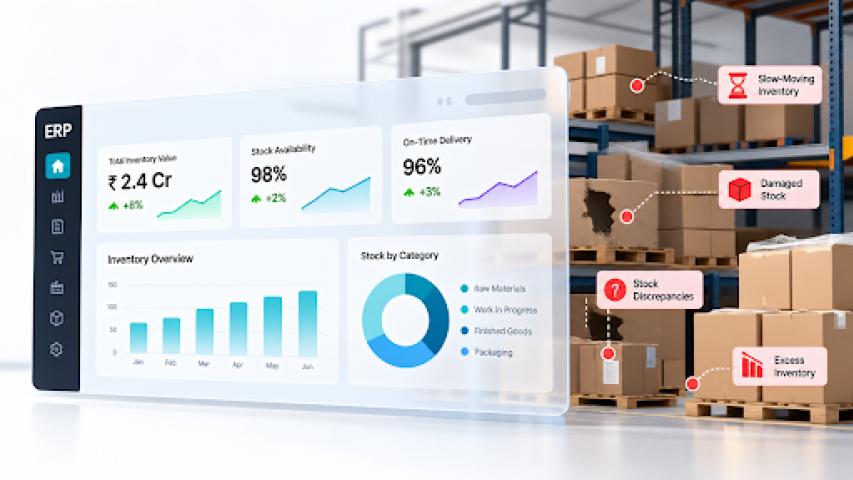
8. Get Better Business Visibility
Good inventory management is not only about avoiding mistakes. It also helps owners make better decisions.
Reports can help identify:
- Fast-moving jewellery
- Slow-moving stock
- Stock by category
- Stock by branch
- Stock by purity
- Pending karigar work
- Purchase and sales trends
- Stock ageing
- Metal movement
- Inventory discrepancies
This information can help a jeweller decide what to reorder, which products need attention and where capital is tied up in inventory.
Why Jewellery ERP Is More Than Just Inventory Software
A good jewellery ERP should connect inventory with the rest of the business.
Purchase → Inventory → Manufacturing/Job Work → Stock → Billing → Customer → Reports
This connected approach is more useful than having separate software for billing, spreadsheets for stock and notebooks for karigar work.
The objective is not to add more technology to the business. The objective is to create one reliable flow of information.
Final Thoughts
Jewellery inventory management requires accuracy because every item represents both a product and a financial value.
As the business grows, relying entirely on manual registers and spreadsheets can make it harder to maintain accurate records, track stock movements and identify errors.
The Best Jewellery ERP software can bring these processes together by connecting inventory, purchases, sales, billing, gold and purity records, HUID, barcodes, karigar work and reporting in one system.
The real benefit is not simply having software. It is having better visibility and control over what the business owns, where it is, how it moved and what happened to it.
For a growing jewellery business, that can mean less manual work, fewer avoidable errors, faster stock management and greater confidence in the numbers.