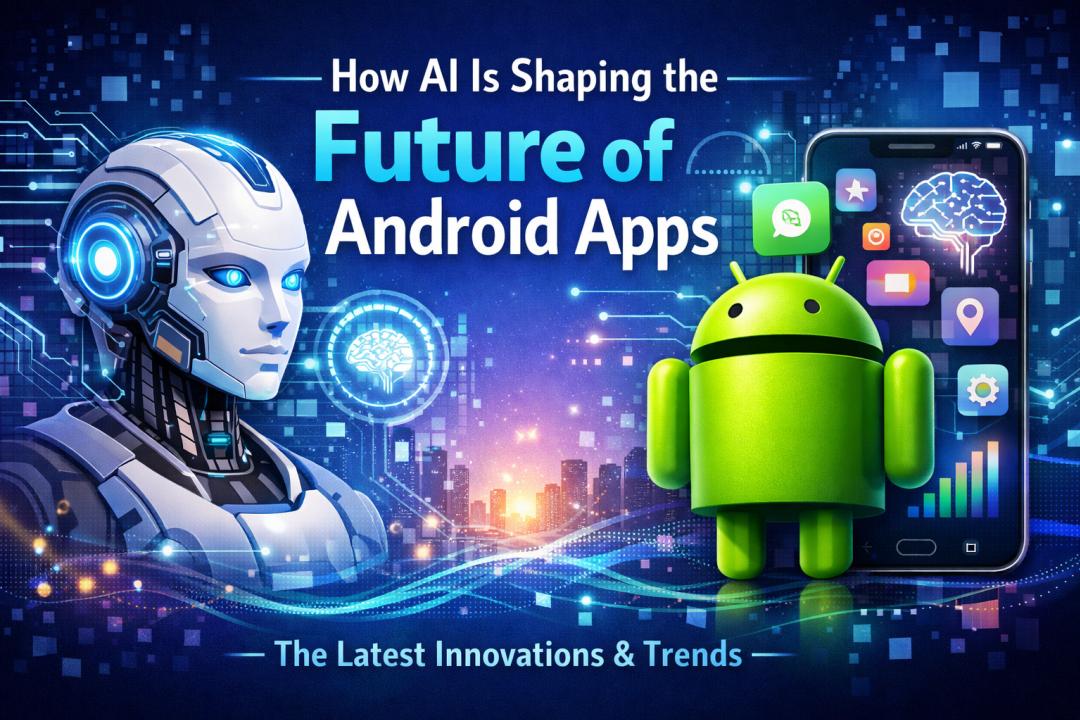
In recent years, artificial intelligence (AI) has moved from a futuristic concept into a practical force reshaping software development, particularly in the mobile app ecosystem. Android — the world’s most widely used mobile platform — isn’t just benefiting from AI; it’s embracing it at every level. From smarter user experiences to data-driven personalization, AI is transforming how Android apps are built, delivered, and monetized.
In this blog, we explore how AI is shaping the future of Android apps, real-world use cases, key benefits for businesses and users, and important growth statistics that demonstrate how AI integration is no longer optional but essential. We’ll also touch on how this impacts decisions around choosing an Android and iOS app development company in USA and considerations around Android app development cost.
1. The AI Revolution in Android App Development
Artificial intelligence refers to computer systems that simulate human intelligence — such as learning, problem-solving, perception, and decision-making. For mobile apps, this means applications that aren’t just functional but intuitive, predictive, and adaptive.
Until recently, AI capabilities were often limited to specialized applications due to resource constraints on mobile devices. But with advancements in on-device machine learning (ML), cloud-powered AI services, and frameworks like TensorFlow Lite, Android apps are now capable of executing complex AI tasks with speed and accuracy.
AI in Android can be broadly categorized into:
- On-device AI: Fast processing and offline capabilities
- Cloud-powered AI: Large-scale computing for heavy-duty tasks
- Hybrid models: Combining local performance with cloud intelligence
Together, these models are rewriting the rules for what Android apps can achieve.
2. Why AI Is Critical for the Future of Android Apps
2.1. User Expectations Are Increasing
Today’s users expect apps to feel “smart.” They want personalized content, seamless interactions, and anticipatory design. AI enables apps to understand user behavior and respond accordingly.
2.2. Competition Is Intensifying
With millions of apps on the Google Play Store, businesses face fierce competition. AI helps differentiate apps by offering personalized experiences, faster features, and predictive insights — all of which elevate user retention and engagement.
2.3. Better Performance and Efficiency
AI optimizes app performance by managing resources intelligently — such as improving battery usage, reducing load times, and enhancing responsiveness, all of which are critical in driving user satisfaction.
3. Real-World Use Cases of AI in Android Apps
AI’s influence on Android apps spans many industries. Here are some of the most impactful use cases:
3.1. Personalized Content and Recommendations
One of the most visible uses of AI in apps is recommendation engines. Apps like Spotify, YouTube, and ecommerce platforms use machine learning algorithms to analyze user preferences and deliver customized content recommendations.
How it works:
AI models analyze past interactions, preferences, and patterns to deliver tailored suggestions that improve user engagement.
Example: A shopping app that suggests products based on browsing history and purchase behavior increases conversions and user satisfaction.
3.2. Intelligent Virtual Assistants
Many Android apps now integrate AI chatbots or voice assistants to improve interaction. Google Assistant is a prominent example, but many custom apps also use AI-powered dialogs to assist users.
Benefits:
- Instant query resolution
- 24/7 user support
- Enhanced app usability
Whether it’s helping users navigate an app or providing contextual guidance, AI assistants improve user experience significantly.
3.3. Enhanced Security with AI-Based Detection
Security remains a top priority for mobile apps. AI enhances security by identifying suspicious activities and patterns that traditional rule-based systems might miss.
Use cases include:
- Fraud detection in financial apps
- Anomaly detection in login attempts
- Biometric authentication using face or voice ID
AI-driven security helps protect user data while providing seamless access.
3.4. Automated Image and Voice Recognition
With tools like Google’s ML Kit and TensorFlow Lite, Android apps can now support advanced features like:
- Image classification
- Text recognition (OCR)
- Speech-to-text and vice-versa
- Facial recognition
These features are especially useful in apps related to healthcare, social media, productivity, and accessibility.
3.5. Predictive Analytics for Better Engagement
Predictive analytics helps businesses forecast user behavior and act proactively. For example:
- Predicting churn and triggering re-engagement notifications
- Forecasting in-app purchases
- Custom push-notification strategies based on usage patterns
By anticipating user needs, apps can deliver timely and context-aware experiences.
3.6. Smart Automation and Workflow Optimization
AI enables automation of routine tasks within an app, such as:
- Auto-tagging photos
- Auto-scheduling tasks
- Intelligent email filtering
- Smart replies in messaging
This makes the app more intuitive and reduces user effort.
4. Key Benefits of Integrating AI in Android Apps
Integrating AI isn’t just about having a cool feature — it delivers measurable business value. Below are the major benefits:
4.1. Improved User Engagement and Retention
AI keeps users engaged by:
- Personalizing content
- Offering relevant suggestions
- Anticipating user needs
Studies show that apps with AI-driven personalization retain users longer and experience higher session times.
4.2. Increased Conversion and Revenue Growth
Personalization and predictive insights drive better conversion rates. Whether through product recommendations or behavior-based messages, AI helps generate revenue efficiently.
4.3. Enhanced User Experience (UX)
AI creates smoother user experiences by:
- Predicting user actions
- Reducing friction
- Offering context-aware responses
A positive UX directly translates to better user satisfaction and higher app ratings.
4.4. Cost Efficiency Over Time
While AI integration can require initial investment, it reduces operational costs in areas like:
- Customer support (via chatbots)
- Manual content curation
- Data analysis
This makes an AI-powered Android app more cost-effective over time.
4.5. Competitive Edge in the Market
Apps with AI capabilities stand out in crowded marketplaces like Google Play. For businesses selecting services from an Android app development company in USA or elsewhere, AI readiness often becomes a differentiator in bidding and project value.
5. Growth Stats That Prove AI’s Impact on Android Apps
AI is no longer a buzzword — it is a fast-growing trend with concrete adoption metrics:
Market Adoption
- The global AI market is expected to grow from $136.6 billion in 2023 to over $1.8 trillion by 2030.
- Mobile devices are predicted to be the most common endpoint for AI services.
Android + Machine Learning
- Over 70% of Android apps now use some form of machine learning for various features.
- Google reported that ML Kit, its machine learning SDK for mobile, has seen significant adoption, indicating real demand from developers.
User Retention and Engagement
- Apps leveraging AI for personalization see up to 30% higher retention rates compared to non-AI apps.
- Demand for AI assistants and voice-based features continues to surge as users expect smoother interactions.
Business Investment
- Businesses today allocate 20–40% more budget toward AI and ML integration as part of their mobile strategy.
- Many enterprises partner with specialized firms like an Android app development company in USA to build AI-ready applications.
6. AI Frameworks and Tools for Android Developers
Building AI-powered features requires the right tools. Here are some of the most widely used frameworks:
6.1. TensorFlow Lite
Google’s optimized machine learning framework for mobile Supports on-device inference with low latency
6.2. ML Kit
A mobile SDK that brings Google’s machine learning capabilities to Android Offers APIs for text recognition, image labeling, face detection, and more
6.3. PyTorch Mobile
Offers flexibility for developers who prefer PyTorch for research and model creation
6.4. Cloud AI Services
Cloud platforms like Google Cloud AI and Firebase ML provide powerful backend services, including natural language processing, translation, and vision APIs.
7. How AI Affects Android App Development Cost
Integrating AI features can influence the Android app development cost, but not always in a negative way. Understanding cost-drivers helps businesses make informed decisions.
Cost Factors Include:
- Complexity of AI features
- Data requirements and preprocessing
- On-device vs cloud AI implementation
- Third-party AI services and APIs
- Testing and optimization for different devices
While AI may increase initial workload, many companies find that the long-term benefits outweigh upfront expenses due to improved user retention and reduced manual operations.
Working with an experienced partner, such as an Android app development company in USA, helps balance innovation with cost efficiency by recommending the right level of AI integration for your budget and goals.
8. Challenges and Considerations
AI integration in Android apps offers immense opportunities, but developers also face challenges:
8.1. Performance and Battery Use
AI tasks can be CPU/GPU intensive if not optimized properly.
8.2. Data Privacy and Security
Handling user data for machine learning requires clear privacy policies and compliance with regulations like GDPR or CCPA.
8.3. Model Accuracy
AI models need quality data and constant refinement to deliver accurate results.
8.4. Cross-Device Compatibility
Android fragmentation makes it important to test AI features across a range of devices.
9. The Future Landscape of AI in Android Apps
Looking ahead, AI’s role in Android apps will only grow deeper. Some trends we expect to see include:
- Greater on-device AI processing (for faster, offline functionality)
- AI-powered augmented reality (AR) for immersive experiences
- Smarter automated testing tools that use AI to discover bugs
- Context-aware applications that adjust based on user behavior, environment, and preferences
- Voice and gesture interactions are becoming more intuitive and widespread
10. Final Thoughts
AI has already begun redefining what Android apps can do — empowering developers to create smarter, faster, and more engaging experiences. Whether you’re planning to build a next-generation app or revamp an existing one, understanding AI’s impact is essential.
Companies that embrace AI, especially through strategic partnerships with specialized firms like an Android app development company in USA will find themselves at a competitive advantage. Although integrating AI can influence Android app development cost, the long-term ROI in terms of user engagement, retention, and app performance makes it a worthwhile investment.
In 2026 and beyond, AI won’t just be a feature — it will be the backbone of Android app innovation.