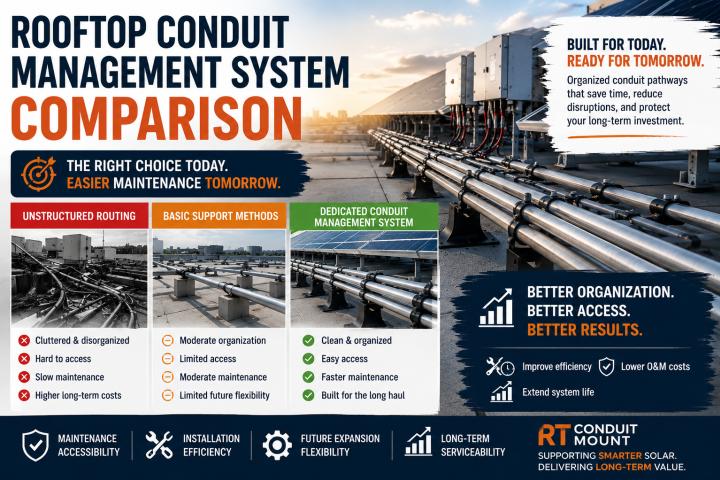
Choosing a conduit management strategy is usually straightforward during installation.
The challenge comes later. As commercial solar projects mature, electrical infrastructure often becomes one of the most frequently accessed parts of the rooftop environment. Technicians need access to conduit pathways for inspections, troubleshooting, equipment upgrades, and future expansion projects.
A conduit routing approach that appears efficient during construction may not deliver the same results years later.
This is why contractors evaluating a rooftop conduit management system increasingly compare solutions based on long-term serviceability rather than installation requirements alone.
Why Conduit Management Becomes More Important Over Time
Most commercial solar rooftops become more complex as they age.
Monitoring systems are upgraded. Additional equipment is installed. Communication infrastructure expands. Maintenance activities become more frequent.
Technicians working on aging commercial solar systems often notice the same pattern. Conduit pathways that seemed adequate during installation become more difficult to work around as monitoring equipment, communications hardware, and additional electrical infrastructure are added over time.
The result is rarely a system failure. More often, it is a gradual increase in maintenance complexity, troubleshooting time, and rooftop congestion.
As these changes occur, electrical pathways must continue supporting accessibility without creating routing conflicts or restricting service access.
On many rooftops, conduit infrastructure eventually shares space with:
- Inverter groups
- Monitoring equipment
- HVAC systems
- Roof drains
- Walkways
- Future expansion areas
When conduit routing is not planned with long-term organization in mind, maintenance efficiency often suffers.
The challenge is not simply supporting conduit. The challenge is maintaining a rooftop environment that remains organized and serviceable throughout the life of the solar installation.
What Contractors Evaluate Before Choosing a Solution
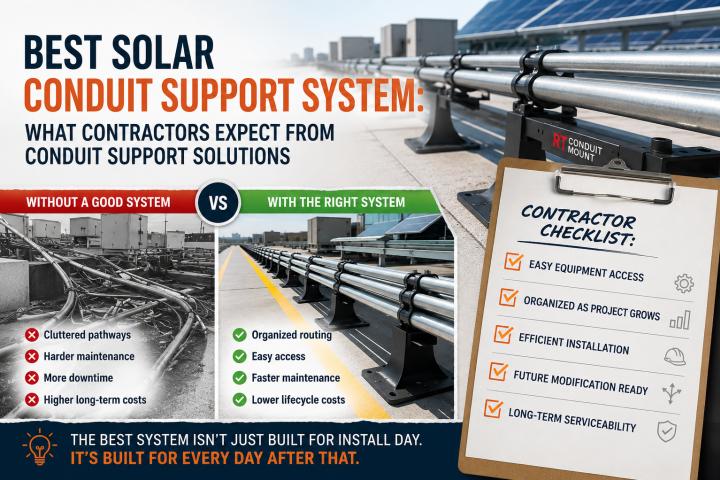
When comparing conduit management approaches, contractors typically focus on several practical considerations.
Maintenance Accessibility
Can technicians access equipment without navigating around congested conduit pathways?
Routing Consistency
Will conduit infrastructure remain organized as additional equipment is added over time?
Installation Efficiency
Does the approach support predictable installation workflows?
Roof Compatibility
Can the routing strategy integrate effectively with existing rooftop conditions?
Future Expansion Flexibility
Will future modifications require significant routing changes?
Long-Term Serviceability
How effectively will the system support maintenance activities years after commissioning?
These evaluation criteria often influence purchasing decisions more than conduit support specifications alone.
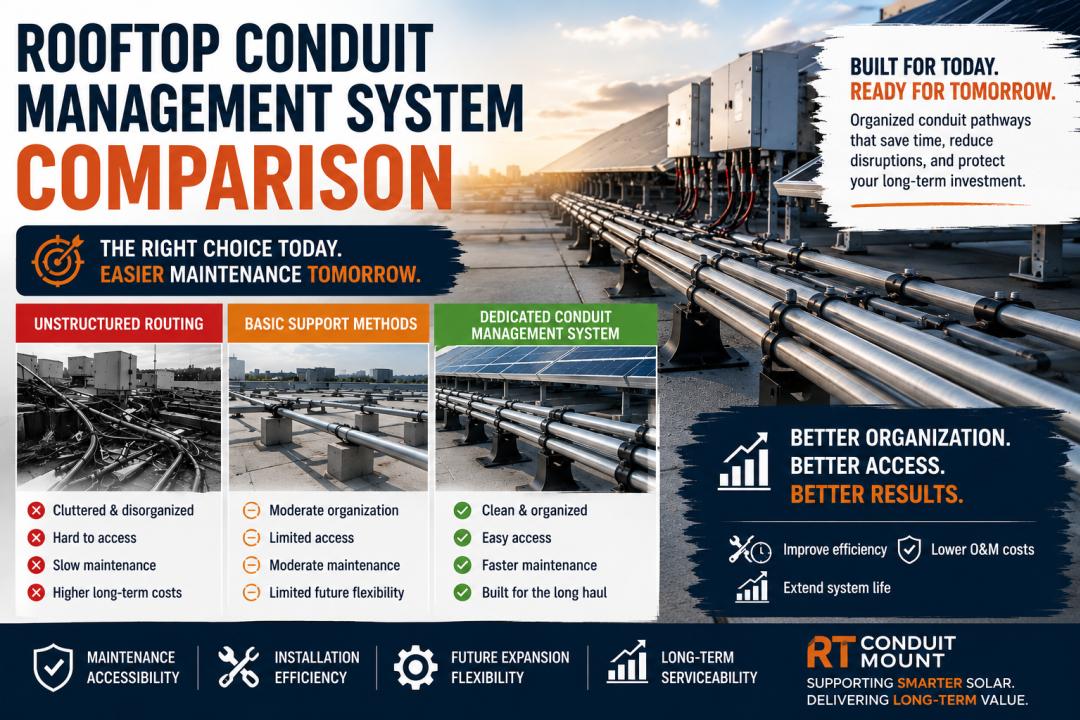
Option Comparison: Evaluating Common Rooftop Conduit Management Approaches
| Evaluation Factor | Unstructured Routing | Basic Conduit Support Methods | Dedicated Rooftop Conduit Management System |
| Installation Organization | Limited | Moderate | High |
| Maintenance Accessibility | Variable | Moderate | High |
| Routing Consistency | Low | Moderate | High |
| Future Expansion Support | Limited | Moderate | High |
| Technician Efficiency | Variable | Moderate | High |
| Long-Term Serviceability | Low | Moderate | High |
The differences shown above may not be obvious during installation.
However, maintenance teams often experience these differences directly as systems age and operational requirements evolve.
Projects with structured conduit management generally provide more predictable electrical infrastructure than projects relying on less organized routing approaches.
Why Contractors Are Re-Evaluating Conduit Support Strategies
Many maintenance challenges found on commercial rooftops are not caused by equipment failures. They are caused by infrastructure that becomes increasingly difficult to access as systems expand and operational requirements change.
As a result, contractors are placing greater emphasis on conduit organization, routing consistency, and future serviceability when evaluating support solutions. The discussion often shifts away from conduit support itself and toward broader questions about accessibility, maintenance efficiency, and long-term rooftop management.
When contractors compare conduit management solutions, the discussion often shifts away from conduit support itself and toward broader operational goals.
- Can electrical pathways remain organized?
- Will maintenance access remain available?
- Can future modifications be completed without creating additional routing challenges?
These are the situations where RT Conduit Mount is commonly evaluated. Many teams reviewing pv wire management strategies are also looking for ways to improve conduit organization while maintaining accessibility across large commercial rooftops.
Contractors evaluating structured conduit management approaches often seek ways to maintain organization as rooftop infrastructure evolves. Solutions such as RT Conduit Mount are commonly reviewed in projects where long-term accessibility and future modifications are important considerations. For contractors focused on organization, serviceability, and long-term project efficiency, this often makes it a relevant option during the evaluation process.
Rather than functioning solely as a conduit support accessory, it is frequently assessed as part of a larger rooftop infrastructure plan.
Which Approach Makes Sense for Different Projects?
Not every project requires the same conduit management strategy.
Smaller installations with limited electrical infrastructure may operate effectively with simpler routing approaches.
Larger commercial systems, however, often place greater demands on maintenance accessibility, equipment access, and flexibility for future expansion.
Projects that expect ongoing equipment upgrades, monitoring additions, or long-term O&M activities typically benefit from more structured conduit management strategies.
Contractors also evaluate whether a solution will simplify future service work, preserve rooftop accessibility, and support efficient organization of electrical infrastructure as the project evolves.
For many commercial solar projects, the best rooftop conduit management system is not necessarily the option that appears most efficient during installation. It is often the option that continues supporting accessibility, organization, and serviceability years after commissioning.
Industry guidance from the National Renewable Energy Laboratory (NREL) continues to emphasize the importance of maintainability, reliability, and lifecycle performance across photovoltaic systems. Electrical infrastructure planning plays a meaningful role in supporting those objectives.
What Is the Best Rooftop Conduit Management System for Commercial Solar?
The best rooftop conduit management system is one that balances installation efficiency with long-term serviceability. Contractors typically prioritize solutions that support organized electrical pathways, preserve maintenance access, accommodate future expansion, and contribute to efficient rooftop operations throughout the project's life.
Frequently Asked Questions
1. What is a rooftop conduit management system?
A rooftop conduit management system organizes and supports conduit pathways while helping maintain accessibility and the organization of electrical infrastructure.
2. Why do contractors compare conduit management approaches?
Different routing strategies can significantly affect maintenance efficiency, future modifications, and long-term serviceability.
3. How does RT Conduit Mount support conduit organization?
RT Conduit Mount helps create structured routing layouts that support accessibility, organization, and future maintenance activities.
4. What should buyers compare when evaluating conduit support solutions?
Maintenance accessibility, routing consistency, installation efficiency, future expansion flexibility, and serviceability are among the most important evaluation factors.
5. Can conduit management affect future rooftop upgrades?
Yes. Organized conduit pathways are generally easier to modify when equipment additions or future expansions are required.
6. Why is long-term serviceability important in conduit management?
Many maintenance challenges emerge years after installation. Well-organized conduit infrastructure helps simplify inspections, troubleshooting, and future modifications.