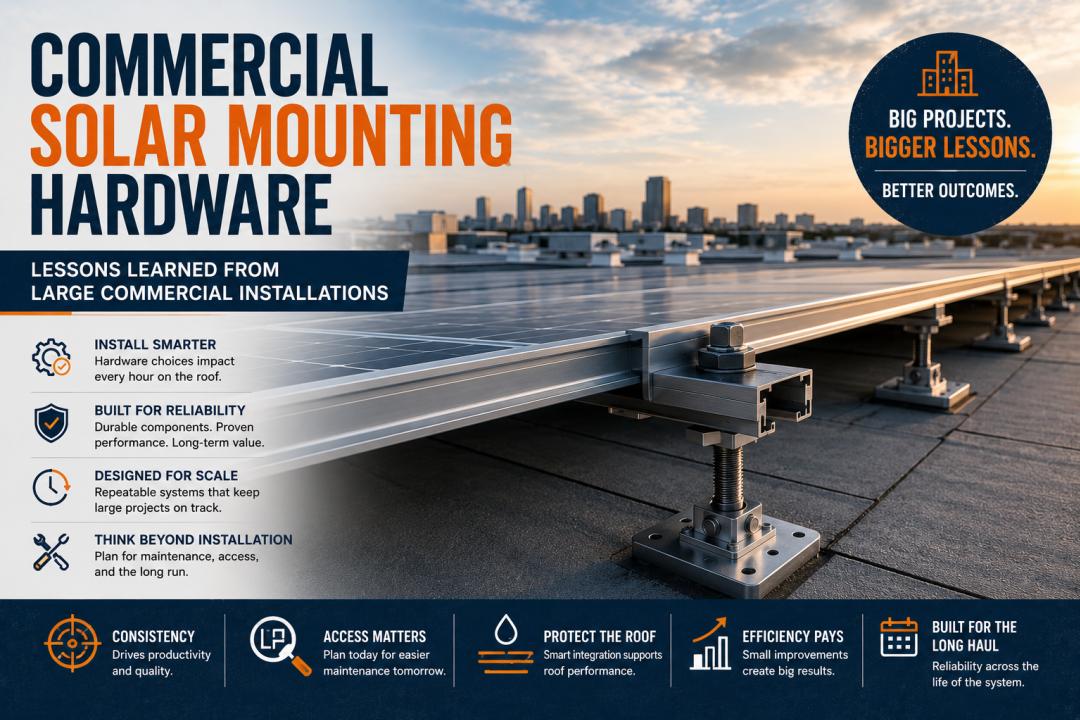
Large commercial solar projects have a way of exposing weaknesses that smaller installations never reveal.
A mounting detail that works well on a small rooftop can become a challenge when repeated hundreds or even thousands of times across a commercial project.
Installation workflows become more important. Material consistency becomes more important. Maintenance accessibility becomes more important.
Over time, contractors working on large-scale projects begin to recognize patterns. Some decisions contribute to smoother installations and long-term performance. Others create challenges that only become visible after construction is complete.
The lessons below are drawn from common observations across commercial rooftop solar projects in which mounting hardware plays a central role in system performance.
Why Commercial Installations Are Different
Commercial rooftops often introduce complexities that are not present on smaller projects.
Teams may need to coordinate around:
- Large roof areas
- Mechanical equipment
- Multiple roof sections
- Drainage pathways
- Expansion joints
- Future maintenance access
Because of this scale, mounting hardware is evaluated differently.
A component that saves only a few minutes during installation can create significant labor savings when multiplied across an entire project.
Likewise, a small design issue can become a recurring challenge throughout the installation.
Maintaining Consistency Across Large Installations
One of the most common challenges on commercial projects is consistency.
Installers frequently encounter:
- Variations in roof conditions
- Attachment spacing adjustments
- Alignment challenges
- Material staging constraints
- Access limitations
On larger rooftops, even minor inconsistencies can affect installation productivity.
Contractors often discover that the success of a commercial project depends as much on repeatability as it does on structural performance.
This is especially true when mounting hardware must support installation workflows across multiple crews.
Evaluating Hardware Beyond Specifications
Experienced EPC firms rarely evaluate mounting hardware based solely on engineering data sheets.
Instead, they often consider how hardware performs during actual installation.
Key evaluation factors frequently include:
- Installation efficiency
- Roof integration
- Structural reliability
- Material durability
- Maintenance accessibility
- Long-term serviceability
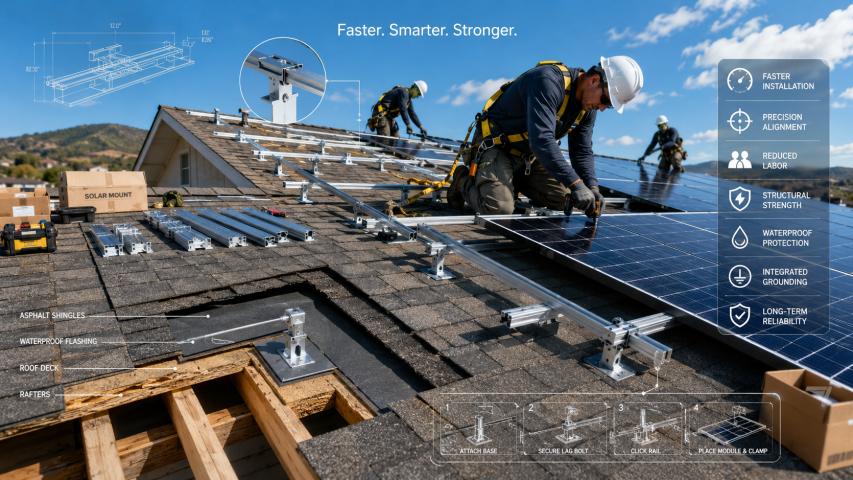
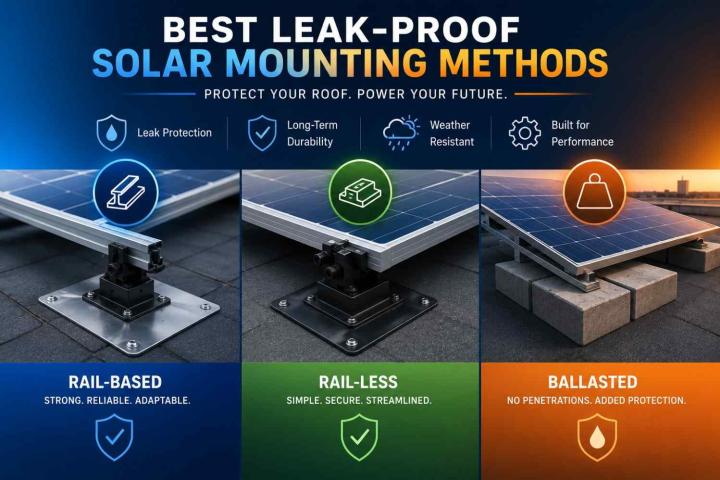
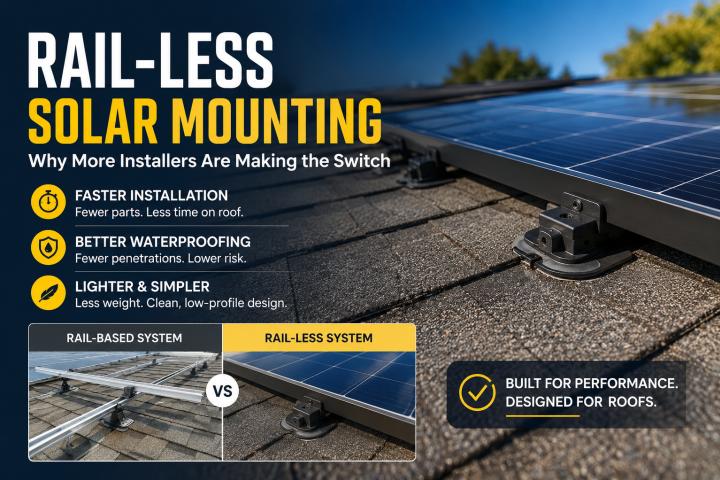
Many teams evaluating a rail solar panel solution are also assessing how the mounting system supports productivity across large commercial deployments.
RT Plus is often reviewed on projects where contractors want to balance structural performance with installation efficiency and long-term reliability.
The conversation is rarely limited to load ratings alone.
It usually includes lifecycle performance and operational considerations.
What Successful Projects Tend to Have in Common
Across large commercial installations, several characteristics appear repeatedly in successful projects.
Standardized Installation Workflows
Consistent installation methods help improve productivity and reduce field adjustments.
Predictable Component Integration
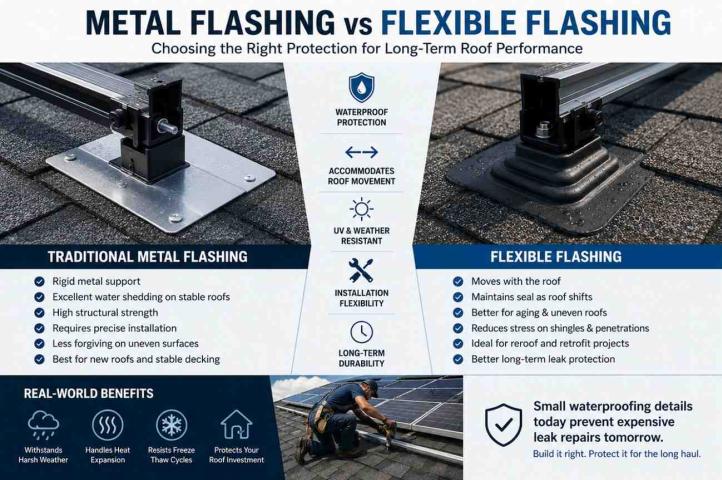
Hardware that integrates smoothly with rails, attachments, and roofing systems often contributes to more efficient project execution.
Long-Term Serviceability
Maintenance access remains important long after installation crews leave the site.
Roof Performance Awareness
Successful projects often consider both solar performance and roof performance throughout the design process.
These outcomes rarely happen by accident. They are typically the result of planning decisions made early in the project lifecycle.
Lessons Learned From Commercial Rooftop Projects
One lesson appears repeatedly across large-scale installations:
The mounting system should be evaluated as an operational asset rather than simply a collection of hardware components.
Contractors who focus exclusively on upfront specifications sometimes overlook factors that influence long-term performance.
Experienced project teams often ask:
- How easily can the system be installed?
- How will maintenance be performed?
- Will future reroofing be manageable?
- How does the mounting system support lifecycle performance?
Those questions often provide more value than a comparison of specifications alone.
Organizations such as the U.S. Department of Energy's Solar Energy Technologies Office (SETO) continue to highlight the importance of system reliability, operational performance, and long-term solar asset management throughout the lifecycle of commercial solar projects.
What Can Contractors Learn From Large Commercial Solar Installations?
Large commercial solar installations often demonstrate that mounting hardware affects much more than structural support.
Contractors frequently learn that installation efficiency, repeatability, maintenance accessibility, roof integration, and long-term serviceability all play important roles in project success. Evaluating commercial solar mounting hardware from a lifecycle perspective often yields better project outcomes than focusing solely on specifications.
Final Commercial Project Takeaway
The most valuable lessons from commercial solar installations are often discovered after the project is complete. Large-scale deployments consistently demonstrate that mounting hardware influences installation efficiency, maintenance accessibility, roof integration, and long-term performance.
For contractors evaluating commercial solar mounting hardware, the best decisions are usually those that support both construction efficiency and long-term operational success.
Frequently Asked Questions
What is commercial solar mounting hardware?
Commercial solar mounting hardware includes rails, attachments, brackets, fasteners, and structural components used to support rooftop solar systems.
Why do large commercial projects evaluate hardware differently?
Because installation efficiency, repeatability, and lifecycle performance become increasingly important as project size grows.
How does RT Plus fit into commercial solar projects?
RT Plus is often evaluated for projects where installation efficiency, structural performance, and long-term reliability are key considerations.
Why is maintenance accessibility important?
Commercial systems may remain in operation for decades, making future inspections and service activities an important part of project planning.
What lessons do contractors commonly learn from large projects?
Consistency, repeatability, roof integration, and serviceability often become more important than initially expected.
Why is lifecycle performance important?
Because the value of a mounting system is often measured years after installation through maintenance efficiency and long-term reliability.