Quick Overview
Advanced mounting hardware reduces installation bottlenecks by cutting the number of separate steps a crew performs per panel row.
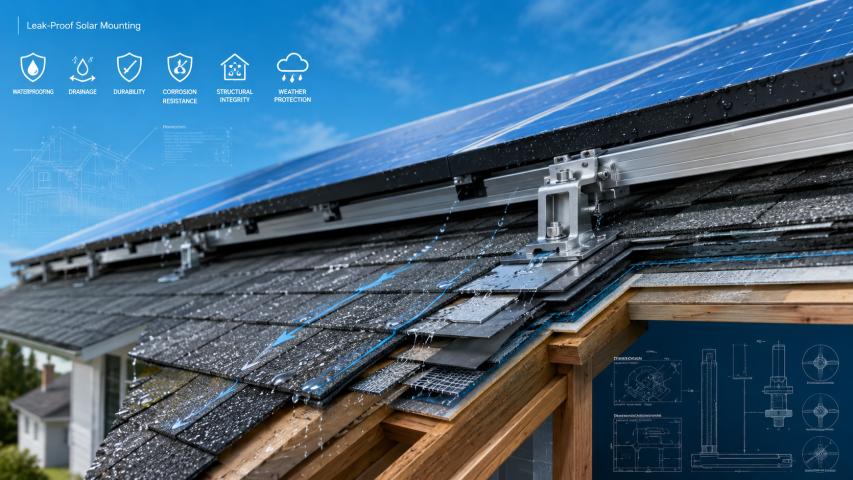
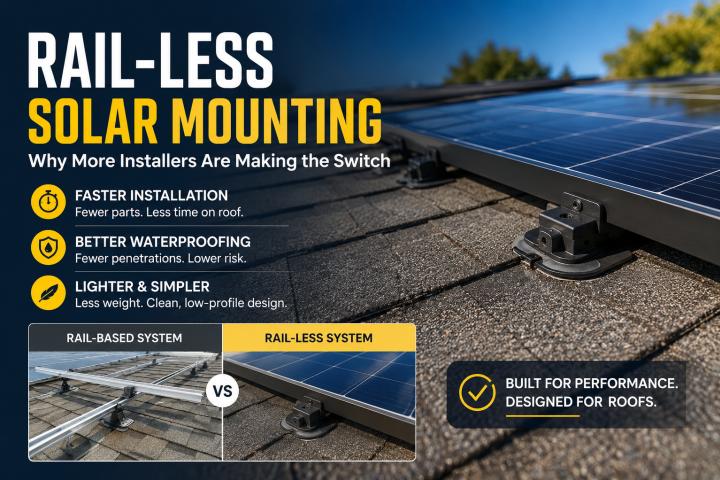
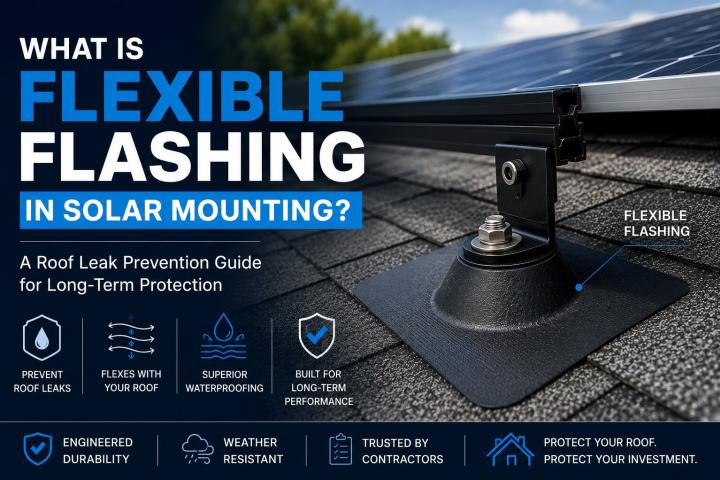
Self-flashing, rail-less bases remove the extra flashing pass that rail-based racking still requires on shingle and tile roofs.
ICC-ES evaluation reports (such as those issued under AC428) and UL 2703 listings let crews document structural and electrical compliance without commissioning separate site engineering for every job.
Faster, simpler mounting hardware means more completed installs per crew-week, translating directly into shorter project timelines and lower labor cost per job.
A four-person crew shows up at 7 a.m. to mount a 24-panel residential array. By early afternoon, they're still working through flashing details on the third row, and the job that was quoted as a one-day install is bleeding into a second. Anyone who has run or worked a solar crew has lived some version of this. The panels themselves rarely cause the delay. The mounting hardware underneath them does.
Solar installation efficiency isn't an abstract metric that only matters to operations managers reviewing spreadsheets. It shows up directly in labor cost, crew scheduling, and how many jobs a company can realistically book in a season. The mounting system, the hardware that anchors panels to the roof deck, has become one of the biggest levers for controlling that variable. This piece looks at why, and at what's actually changed in mount design to make it possible.
What "Efficiency" Actually Means in Roofing
Every rooftop solar install breaks down into a sequence of discrete tasks:
Layout and chalk lines
Marking penetration points
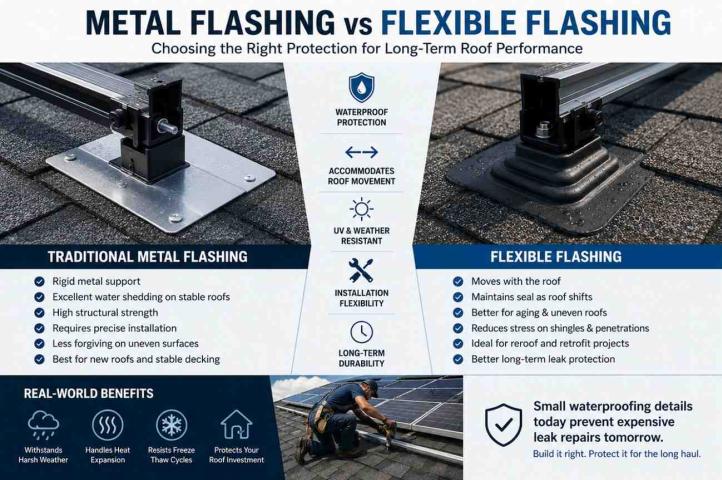
Flashing each attachment point
Base attachment to the deck or rafter
Rail or rail-less hardware placement
Module clamping
Grounding and bonding
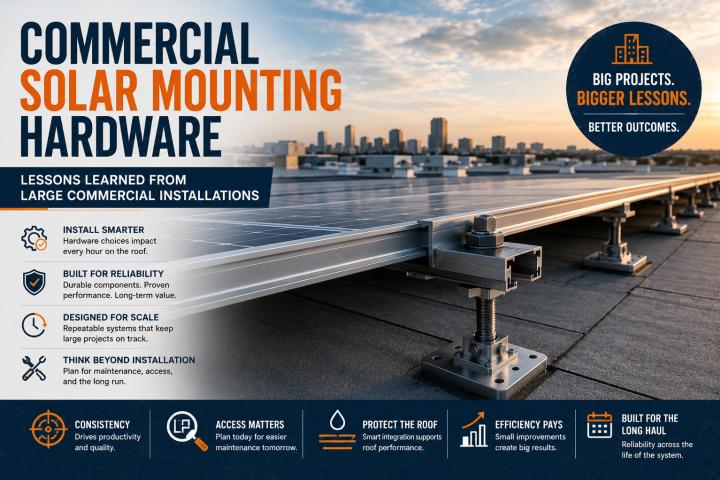
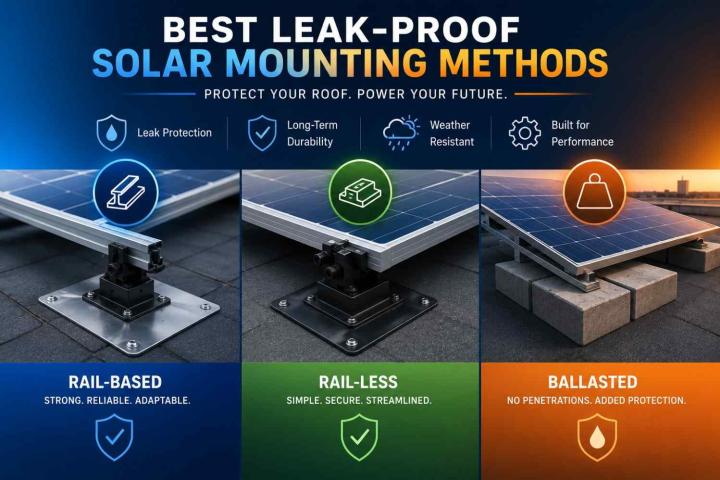
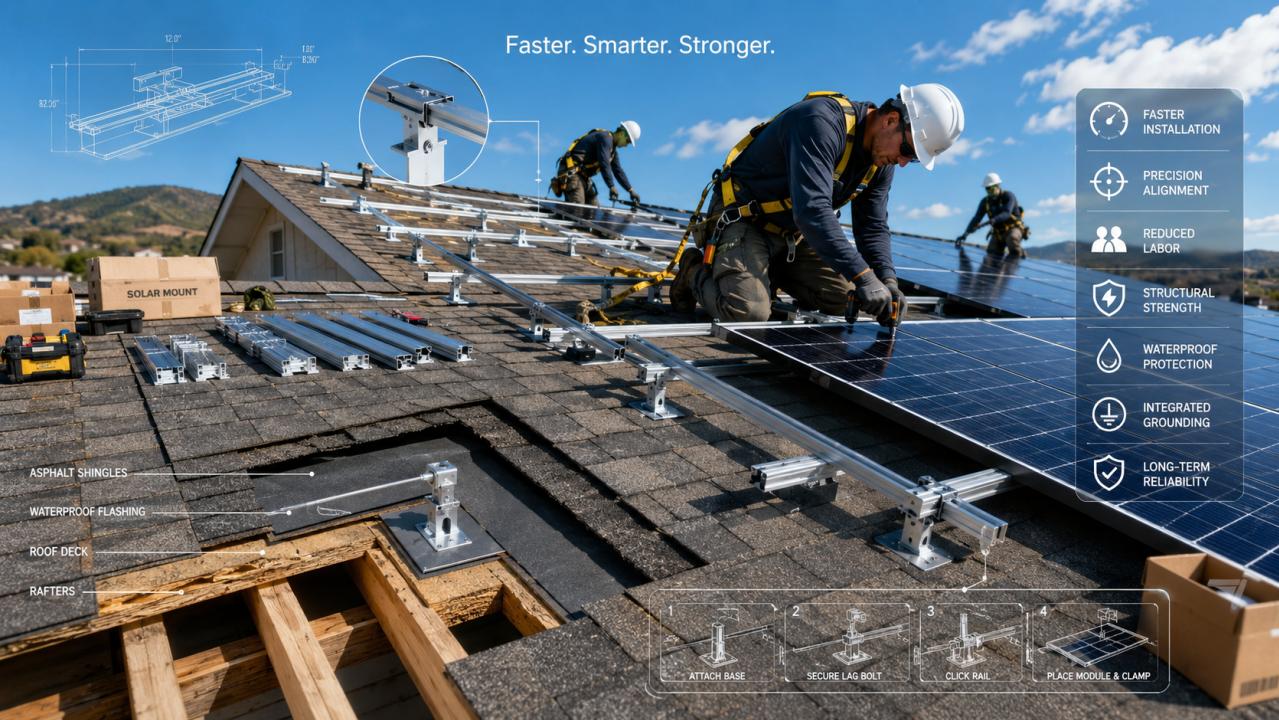
Older rail-based systems require a separate flashing step at each attachment point, then a rail run across those points, then module clamps along the rail. Each of those is its own task with its own hardware, its own torque spec, and its own inspection point.
Advanced mounting systems compress that sequence. A self-flashing, rail-less base combines the flashing and attachment point into a single component. Installers set the base, seal it in one motion, and mount the module bracket directly to it. Fewer discrete steps means fewer opportunities for a crew to stop, second-guess a measurement, or backtrack to fix a flashing detail that got installed out of order.
Where the Time Savings Actually Come From
The efficiency gain isn't just marketing language attached to newer hardware. It's traceable to specific design changes:
Fewer unique parts per mounting point: A single base does the job of a flashing piece, a foot, and an attachment bracket combined.
Universal clamps: That fit multiple module frame thicknesses without swapping hardware mid-job.
Slide-in or one-step leveling: That removes a separate shimming pass at each mounting point.
Field data from installers backs this up. One documented case, published under the title "EMT Solar on the RT Apex's peak performance," described a roofing and solar contractor that completed roughly 1,100 installs using a self-flashing, rail-less base and reported that crews no longer needed to pry up shingles to complete flashing on each mounting point. That single change, not having to lift and reseal shingles at every base, removes a repetitive, time-consuming task from every row of every array. It's a good illustration of how a mounting-hardware decision at the design stage turns into measurable hours saved at the job site.
None of this means rail-less hardware is automatically the right call for every roof. Tile roofs, low-slope membrane roofs, and roofs with unusual truss spacing each come with their own attachment logic, and a system optimized for asphalt shingle speed won't necessarily transfer those gains to a tile roof without adjustment.
Certification and Load Compliance Without Slowing Down
Faster installation only matters if the finished system still meets code. This is where a lot of older assumptions about "speed versus safety" break down. Current mounting systems are frequently evaluated against a small set of standards:
ICC-ES AC428: the acceptance criteria covering rooftop-mounted photovoltaic panel systems, resulting in an ICC-ES Evaluation Service Report (ESR).
UL 2703: governs electrical bonding, grounding, and mounting of PV modules and racking.
ASCE 7: the basis for the wind and snow load values that a given ESR is tested against.
What that means practically: an installer working from a current ESR doesn't need to commission a standalone structural engineering letter for every job in most jurisdictions, because the report already documents attachment spacing, fastener pull-out values, and load ratings. Permitting reviewers can check the mount against a published report instead of a one-off calculation, which shortens the permitting cycle as much as the physical mounting work.
It's worth being precise about the limits here. An ESR documents what the manufacturer's system was tested to, not what any given roof structure can bear. Rafter condition, deck fastening, and local wind or snow exposure category still have to be verified on site. A mount rated for 180 mph wind speeds and 90 psf ground snow load doesn't override a deteriorated rafter or an undersized fastener pattern underneath it.
Practical Trade-offs Installers Should Weigh
Layout precision. Rail-less systems reduce part count, but they usually require more precise initial layout since there's less rail-based flexibility to adjust module spacing after bases are set.
Roof geometry. Rail-based systems still make sense on roofs with irregular geometry or where module count or orientation might change mid-project.
Crew familiarity. A faster mounting system installed incorrectly by an unfamiliar crew won't outperform a slower, more familiar one. Training specific to the system in use matters as much as the hardware itself.
Corrosion resistance. Aluminum bases and stainless steel fasteners resist the galvanic corrosion that can develop when dissimilar metals sit against each other on a roof exposed to moisture cycles for twenty-plus years.
Efficient installation is only a real win if the hardware holds up structurally for the system's service life.
Conclusion
The push toward faster rooftop solar installation isn't about cutting corners. It's about hardware design that removes redundant steps, consolidates flashing and attachment points, universal clamping, and pre-engineered load documentation, without changing what the finished system has to withstand structurally. Crews still need to read the roof correctly, verify deck and rafter condition, and follow manufacturer torque and sealing specs regardless of how advanced the mounting hardware is. Measured this way, solar installation efficiency is less about any single clever part and more about how many redundant steps have been designed out of the whole sequence. The fundamentals of a watertight, structurally sound attachment haven't changed at all.
Frequently Asked Questions
1. What makes a solar mounting system "advanced" compared to older racking?
Advanced systems combine flashing and attachment in a sealed unit with universal clamps and built-in leveling, unlike older systems that separate these steps with more hardware.
2. Are rail-less solar mounts actually faster to install than rail-based systems?
On steep asphalt shingle roofs, rail-less self-flashing bases usually save time by eliminating a flashing pass at each attachment. For irregular or non-standard roofs, rail-based systems can be as fast as, or faster than, other systems thanks to greater layout flexibility.
3. Does a faster mounting system mean it's less structurally sound?
Speed gains come from part consolidation and design refinement, not load capacity reduction. Always verify structural performance against the current ICC-ES report and local wind and snow loads.
4. How long does a typical residential rooftop solar mounting installation take?
A straightforward asphalt shingle roof with self-flashing, rail-less mount can usually be installed in a day for a standard residential array. Roof types like tile, low-slope membrane, or those needing structural repair typically take longer.