Sericulture doesn't get talked about as an industry very often, but the global silk market is worth well over $30 billion and growing faster than most mature textile categories. The problem for anyone selling into it isn't demand, it's that the industry is genuinely fragmented, spanning mulberry farms, silkworm rearing operations, reeling units, yarn traders, weaving cooperatives, and export houses, often as small, independently run businesses with limited online presence.
That fragmentation is exactly why generic agriculture or textile lists fail here. A mulberry farmer sourcing saplings and fertilizer, a reeling unit owner buying automatic reeling machinery, and an export director negotiating international silk contracts are all technically part of the same supply chain, but they operate at completely different scales, buy completely different things, and don't respond to the same message.
Sub-sector matters as much as role. A vendor selling silkworm rearing trays needs a rearing unit manager or production supervisor, not a silk yarn trader who has never touched a cocoon. A jacquard weaving equipment supplier needs a weaving unit owner, not a mulberry cultivation manager three steps earlier in the chain. Treating "sericulture" as one target list means most of every campaign lands with someone outside their part of the process entirely.
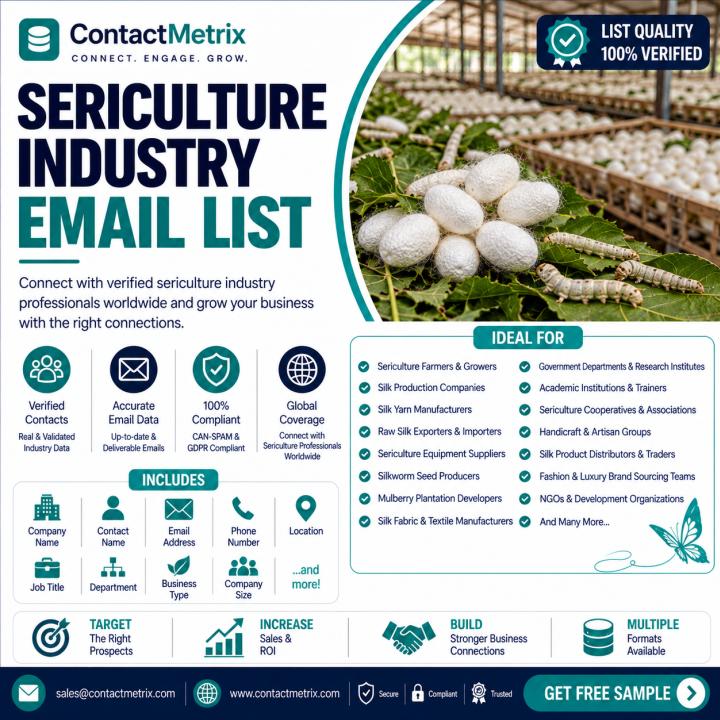
[ContactMetrix]'s [Sericulture Industry Email List] is segmented specifically around this structure, covering mulberry farming, silkworm rearing, cocoon trading, silk reeling, yarn trading, weaving, export, and R&D as distinct categories, each with its own decision-makers. That means a pitch for cocoon grading equipment reaches a grading supervisor instead of a farm owner, and a pitch for export compliance services reaches a trade compliance manager instead of a rearing unit supervisor with no involvement in international trade.
Geography carries real weight in this industry too. Silk production concentrates around specific hubs, India, China, Japan, Brazil, Thailand, and a handful of others, and a list without genuine coverage across those regions is really only useful for a fraction of the global supply chain, no matter how accurate it is within its limited footprint.
None of this replaces a strong product, but it does mean outreach reaches someone actually positioned to act on it, whether that's a cocoon procurement director evaluating a new supplier or a research director at a sericulture institute assessing new AgTech. ContactMetrix keeps the data usable past the first campaign by sourcing it from sericulture development boards, government registries, and trade associations, refreshing it every 30 to 45 days, and replacing anything that bounces at no cost, which matters in an industry built largely on small, family-run operations where a contact's role or business can shift without much public trace.