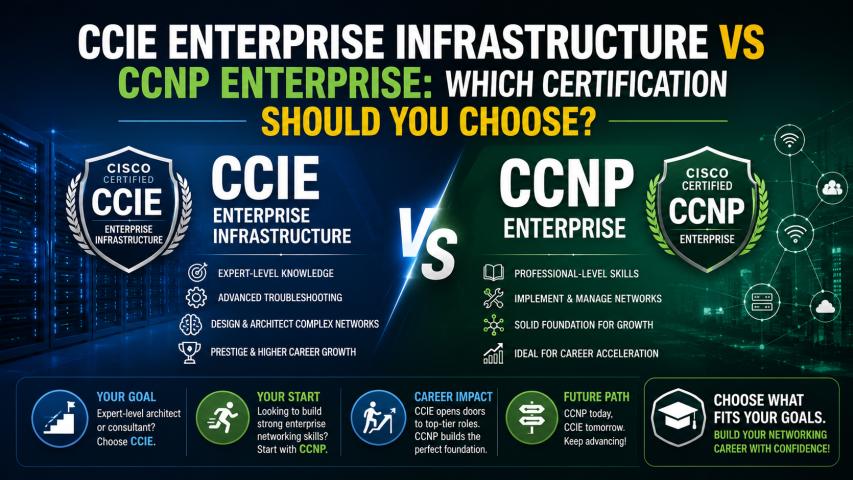

Earning an expert-level networking certification is a significant milestone for IT professionals who want to advance their careers in enterprise networking. CCIE Enterprise Infrastructure is one of the most prestigious certifications offered by Cisco, validating advanced knowledge in designing, implementing, operating, and troubleshooting complex enterprise network infrastructures. Although there is no fixed preparation timeline, the amount of time required depends on your existing networking experience, hands-on skills, and the consistency of your study plan.
This guide explains the factors that influence preparation time, outlines a practical learning roadmap, and provides valuable tips to help you prepare effectively for the CCIE EI v1.1 Certification.
Understanding the CCIE EI v1.1 Certification
CCIE Enterprise Infrastructure (EI) v1.1 is designed for experienced networking professionals who want to demonstrate expert-level skills in enterprise networking technologies. Unlike entry-level certifications, this program focuses heavily on real-world implementation, advanced troubleshooting, and hands-on lab experience.
The certification covers multiple enterprise networking domains, including:
Advanced routing
Enterprise switching
Software-Defined Wide Area Network (SD-WAN)
Software-Defined Access (SD-Access)
Wireless networking
Network automation
Security integration
High availability
Quality of Service (QoS)
Network programmability
Because these technologies are interconnected, candidates need a structured preparation strategy to master them successfully.
Factors That Influence Preparation Time
Every learner begins with a different level of experience, making preparation time unique for each individual.
Previous Networking Experience
Candidates with several years of experience in enterprise networking usually progress faster than beginners.
Professionals already working with:
Cisco routers
Enterprise switches
Wireless networks
SD-WAN solutions
Routing protocols
often require less time to understand advanced concepts.
Existing Cisco Knowledge
Candidates who already hold professional-level Cisco certifications generally have a stronger foundation in networking concepts, making it easier to transition into expert-level topics.
Weekly Study Commitment
The number of study hours each week directly affects the preparation timeline.
For example:
8–10 hours per week may extend preparation over several months.
15–20 hours per week allows for faster progress.
Daily practice combined with lab work produces the most consistent results.
Consistency is more effective than occasional long study sessions.
Typical Preparation Timeline
While every candidate learns at a different pace, the following estimates provide a realistic guideline.
Experienced Enterprise Network Engineers
Professionals with strong enterprise networking experience typically prepare within 6 to 9 months through regular study and extensive hands-on lab practice.
Intermediate-Level Professionals
Candidates with solid networking fundamentals but limited exposure to enterprise technologies often require approximately 9 to 12 months.
This period allows sufficient time to strengthen practical implementation skills.
Beginners
Candidates who are relatively new to enterprise networking should first develop a solid understanding of networking fundamentals.
Their complete preparation journey may require 12 to 18 months, depending on learning pace and practical exposure.
Build a Structured Study Plan
A structured learning plan helps maintain focus and ensures that every technology area receives adequate attention.
Phase 1: Strengthen Networking Fundamentals
Before moving into advanced enterprise topics, review essential networking concepts such as:
IP addressing
Routing protocols
Switching
VLANs
High availability
Network troubleshooting
A strong foundation makes advanced topics easier to understand.
Phase 2: Learn Core Enterprise Technologies
Next, focus on the technologies included in the certification blueprint.
These include:
OSPF
EIGRP
BGP
MPLS
SD-WAN
SD-Access
Wireless networking
IPv6
QoS
Multicast
Understanding how these technologies work together is critical for success.
Phase 3: Master Network Automation
Modern enterprise networks increasingly rely on automation.
Candidates should become familiar with:
Python basics
REST APIs
NETCONF
YANG
Automation frameworks
Automation skills improve efficiency and are highly valued by employers.
Phase 4: Intensive Hands-On Labs
Practical implementation is one of the most important parts of CCIE preparation.
Build enterprise lab environments that include:
Multiple routers
Layer 2 and Layer 3 switching
Wireless controllers
SD-WAN deployments
Network automation
Security integration
Stay Updated with Enterprise Networking Trends
Enterprise networking continues to evolve rapidly.
Candidates should remain informed about developments in:
Artificial Intelligence for Networking
Intent-Based Networking
Cloud integration
Secure Access Service Edge (SASE)
Zero Trust networking
Advanced automation
Continuous learning ensures long-term career relevance.
Conclusion
The time required to prepare for the CCIE EI v1.1 Certification depends on your current networking knowledge, professional experience, available study time, and commitment to hands-on practice. While experienced professionals may complete their preparation within several months, candidates with limited enterprise networking exposure should plan for a longer learning journey to build strong technical foundations. A structured study plan, consistent lab practice, regular revision, and continuous skill development are the key ingredients for certification success. By mastering advanced routing, switching, wireless networking, automation, SD-WAN, and troubleshooting, professionals can confidently pursue expert-level roles in enterprise networking. Enrolling in a comprehensive CCIE Enterprise Training program with experienced instructors and extensive lab access can further enhance your preparation and improve your chances of achieving certification success.