When industrial equipment teams first evaluate a lithium upgrade, the instinct is to compare sticker prices: a 24V lithium pack does cost noticeably more upfront than a lead-acid one. But shift the lens from one-time procurement cost to fleet-wide operating efficiency over the equipment's full lifespan, and the math usually flips. LiTrue Power Technologies Co., Ltd. — a manufacturer with more than 18 years of experience building custom lithium cells and battery packs — walks AGV and forklift customers through exactly that calculation before any spec sheet gets discussed. It's also what separates a company like LiTrue from suppliers that only sell standardized, off-the-shelf cells.
Where the "Hidden Cost" of Lead-Acid Really Comes From
Most lead-acid batteries don't fail simply from age. They fail from poor maintenance — inconsistent watering — and from sulfation caused by incomplete charging cycles. Both problems are structural: as long as a fleet runs on lead-acid, it needs battery-swap infrastructure built around it. When charge runs low, the whole unit has to be pulled and swapped, rather than topped up whenever there's a spare moment.
A high-quality lithium battery removes that constraint at the source. It supports opportunity charging — AGVs and forklifts can recharge during a 15-minute break without damaging the cells. That single capability alone can increase fleet productivity by up to 25%, simply by eliminating the need for dedicated battery-swap stations and swap procedures. LiTrue's engineering breakdown of this shift is covered in more depth in its 24V Lithium Battery: B2B Industrial Power Guide.
Customization Is the Barrier Standard-Cell Suppliers Can't Clear
LiTrue's approach to 24V industrial lithium batteries shows what "OEM/ODM specialist" actually means in practice, rather than as a line on a homepage:
- Form factor customization: 24V packs can be built in T-shape, L-shape, or ultra-slim profiles to fit directly into a customer's existing chassis — instead of forcing the customer to redesign equipment around the battery.
- Capacity scaling: From 50Ah for light-duty AGVs up to 1000Ah for heavy industrial machinery, sized to the actual duty cycle rather than a fixed catalog size.
- Communication protocol customization: Custom firmware support for CANOpen, J1939, and other industrial protocols, so the battery genuinely integrates with the customer's existing control system rather than operating as an isolated component.
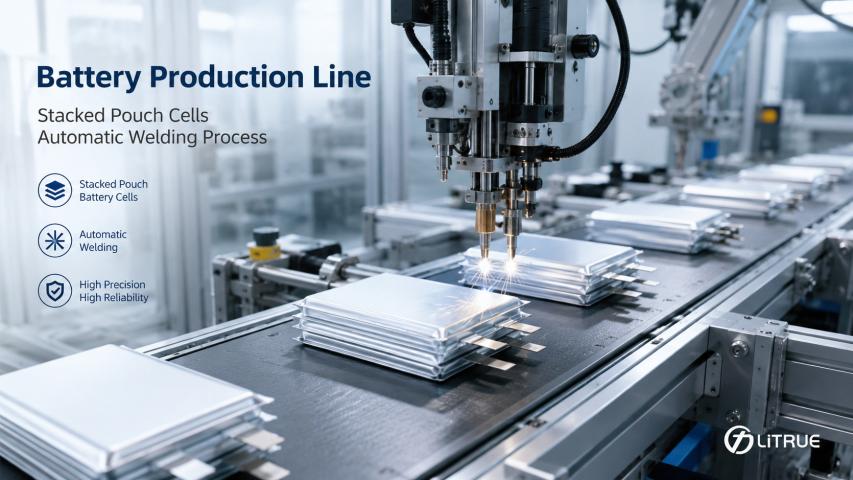
This isn't a paper promise. LiTrue recently completed assembly and factory testing on a batch of custom 48V 76Ah (1P14S) lithium-ion battery packs built for unmanned ground vehicles (UGVs) and electric motorcycles, now shipping to overseas customers. From automated laser-welded module assembly and vibration-resistant structural design to full-load testing, short-circuit testing, and aging-cycle testing, every step happens in-house — because LiTrue manufactures both the cells and the finished packs itself, giving it end-to-end process control. That's part of why international customers extend their trust to the company. See LiTrue's battery pack capabilities for more on full-pack delivery.
The Same Customization Logic, Proven on UAV Batteries Too
Outside of industrial vehicles, LiTrue applies the same design philosophy to UAV batteries: instead of building a cell first and asking customers to adapt, the engineering team starts from the customer's actual load profile and works backward to the cell specification.
The UAV-JP220M, built for commercial and industrial UAVs, delivers a nominal capacity of 20Ah and 1.036kWh of total energy using NMC cells in a 1P14S configuration. It communicates directly with the flight controller over CAN bus for precise overcharge, over-discharge, and over-current protection, and carries an IP65 protection rating with a -40°C to +60°C discharge temperature range — a spec combination built almost specifically for agricultural spraying drones and mapping UAVs that operate outdoors for extended periods.
For higher-energy requirements, the UAV-JP328L packs 1.45kWh of NMC-based energy into an 8.7kg footprint, manufactured to GB/T 38058-2019, GB 31241-2022, and GB/T 38930-2020 design standards, and certified to RoHS, UL 2054, and UN38.3 — ensuring the battery can clear international logistics and reach overseas markets safely. LiTrue's broader UAV lineup, including the high-energy-density solid-state anode-free cells, is detailed in the company's product catalog.
The Bottom Line
Whether it's a custom 24V pack for an AGV fleet or a full battery pack for a UAV platform, LiTrue keeps proving the same point: what actually makes a battery perform well is rarely a single spec like energy density — it's how precisely the battery is matched to the real operating conditions it will face.
If your team is evaluating a move from lead-acid to lithium, or needs a battery pack custom-built to specific dimensions and communication protocols for a UAV, AGV, or forklift, LiTrue's engineering team can review your voltage, capacity, and protocol requirements directly — request a custom quote here.