Anyone working in energy storage tends to have a built-in sensitivity to the word “safety” — and for good reason. Lithium iron phosphate (LFP) has become the dominant chemistry in storage largely because it resists thermal runaway and tolerates abuse far better than NMC. But there’s a detail that gets overlooked: most LFP prismatic cells on the market are tuned for cycle life and cost, which means their continuous discharge rate is usually capped at 0.5C to 1C. That’s a problem when a storage system needs to handle short bursts of high power — commercial/industrial peak shaving, or a UPS switchover — because a cell that looks “safe and reliable” on paper may not actually be able to deliver the power the system needs in that moment.
LiTrue Power Technologies Co., Ltd.’s LFL1-100P is, in a sense, a direct answer to that tension.
100Ah, 4C Continuous / 6C Pulse — an LFP Cell That Can Actually Handle High Current
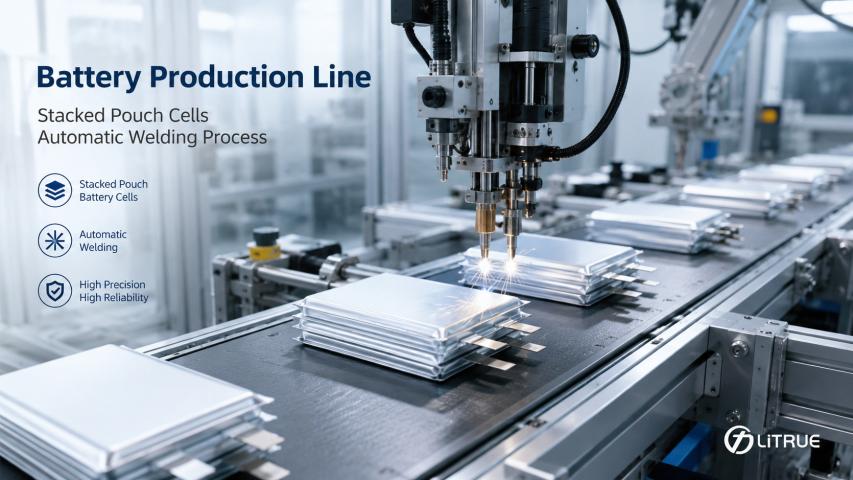
The LFL1-100P is a factory-direct 100Ah LiFePO4 prismatic cell rated for 4C continuous discharge, 6C pulse discharge, and ≥3,000 cycle life. Within the broader landscape of LFP prismatic cells, that continuous discharge rate is uncommon — most cells at this capacity tier can’t reach it — and it’s exactly the combination that storage systems, AGVs, and forklifts need when they require both safety and high current in the same package.
For system integrators, that means not having to choose between “safe” and “power-dense.” The cell keeps LFP chemistry’s inherent thermal stability while removing the need to stack extra cells just to cover peak load — which would otherwise inflate both system size and cost.