India Copper Wire and Cable Market: Outlook
The report titled "India Copper Wire and Cable
Market Size, Share, Trends and Forecast by Type, Voltage, Application, and
Region, 2026–2034" comprises the overall market analysis of India,
size, growth trends, key drivers, and regional insights of the India copper
wire and cable industry and other important aspects related to the
report.
How Big is the India Copper Wire and Cable Market?
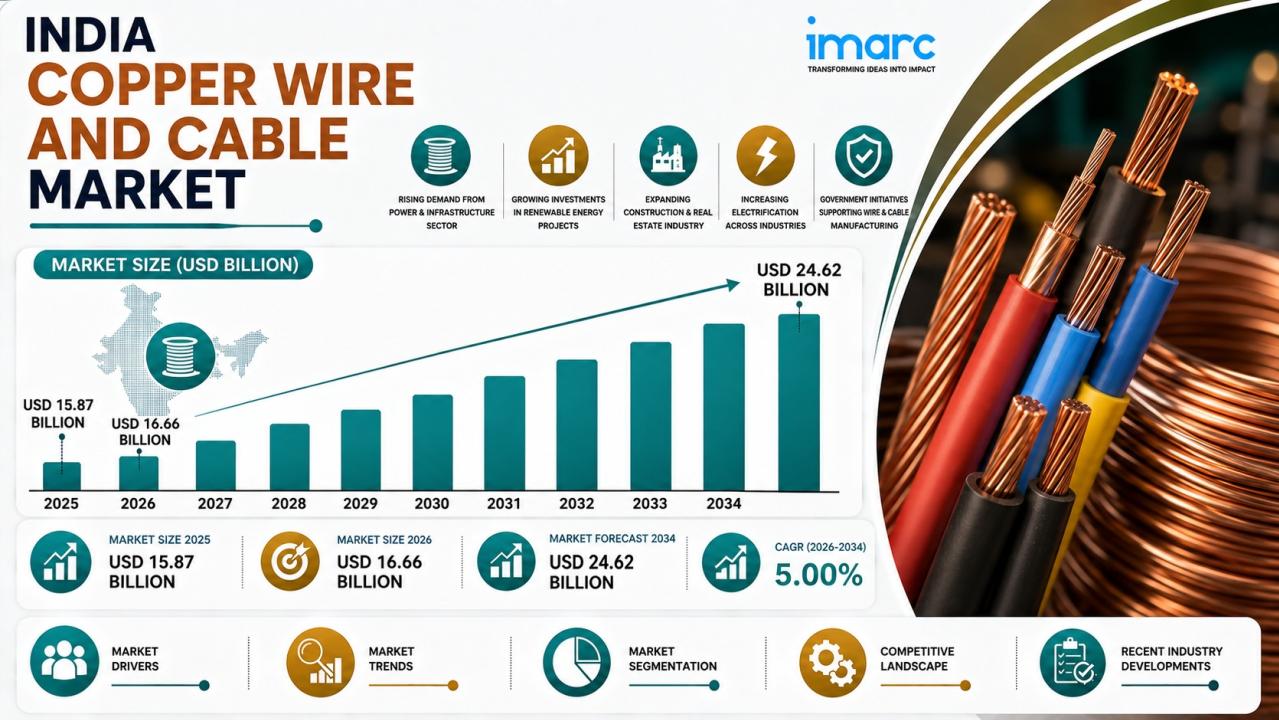
The India copper wire and cable market size increased from USD 15.87 Billion in 2025 to USD 16.66 Billion in 2026 and is projected to reach USD 24.62 Billion by 2034, expanding at a CAGR of 5.00% during 2026-2034.. The market is
underpinned by three powerful structural forces: rapid urbanization, rising
power demand mandating massive grid modernization, and the explosive expansion
of renewable energy capacities across the country.
What are the Key Developments and Emerging Trends in the
India Copper Wire and Cable Market?
- Localization
of Extra-High-Voltage (EHV) Cables: With urban centers facing
acute space constraints, utility providers are rapidly transitioning from
overhead transmission lines to underground EHV cabling. Leading domestic
manufacturers are heavily investing in specialized manufacturing lines for
EHV cables (exceeding 220kV) to replace expensive European and Japanese
imports, establishing a highly advanced, localized manufacturing base.
- Smart
Grid and Hybrid Cable Integration: The modernization of India's
power grid necessitates intelligent distribution networks. Manufacturers
are increasingly producing specialized hybrid cables that integrate
fiber-optic cores alongside copper conductors. This allows for
simultaneous power transmission and real-time data communication, a
critical requirement for smart metering, automated substation monitoring,
and robust grid failure detection.
- Aggressive
Export Diversification: Despite temporary global shipping
disruptions, Indian cable manufacturers are fundamentally transforming
into global suppliers. By strictly adhering to international safety and
flame-retardant certifications (such as UL and CE), major Indian companies
are successfully diversifying their export bases into the US, Australia,
and European markets, strategically capitalizing on the global "China
Plus One" supply chain realignment.
- Rise
of Halogen-Free Flame Retardant (HFFR) Cables: Driven by
stringent fire safety regulations in commercial real estate and mass
transit projects, there is a structural shift away from traditional PVC
insulation. Institutional buyers now mandate Zero-Halogen, Flame-Retardant
copper cables that do not emit toxic smoke during electrical fires,
drastically altering the compounding and insulation material supply chain.
➤ Request Sample Report (TOC
& Charts): https://www.imarcgroup.com/india-copper-wire-cable-market/requestsample
What Factors are Driving Growth in the India Copper Wire
and Cable Market?
- Unprecedented
Capital Expenditure in Power and Infrastructure: The Government
of India's massive infrastructure outlay—encompassing high-speed rail
networks, new metro expansions, and highway developments—acts as the
absolute foundational growth engine. Furthermore, India's ambitious
target to achieve 500 GW of renewable energy by 2030 guarantees massive,
continuous procurement of specialized solar cables and heavy-duty
transmission wiring.
- Surge
in Global Copper Prices: A unique macro-driver in 2026 has been
the extreme escalation in base metal prices. With the London Metal
Exchange (LME) copper prices surging past US$ 14,100 per tonne by August
2026 (up from under US$ 11,000 in late 2025), industry revenues have
spiked massively, as manufacturers operate on a cost-plus pricing model
where raw material inflation is directly passed onto end consumers.
- Electrification
of Mobility (EVs): The transition to electric vehicles
exponentially increases copper density per vehicle. Electric cars require
nearly three to four times more copper wiring than traditional internal
combustion engines, driven by heavy-duty battery management systems, specialized
motor windings, and the rapidly scaling nationwide network of DC
fast-charging stations.
- Data
Center Boom and 5G Expansion: The aggressive rollout of 5G
telecom infrastructure and the massive localization of data centers
require immense amounts of highly reliable, low-voltage copper cabling for
rack power distribution and facility grounding. This creates a highly
lucrative, recurring B2B demand segment for premium wire manufacturers.
How will the India Copper Wire and Cable Market Evolve in
the Coming Years?
The India copper wire and cable market is positioned for
steady and highly profitable expansion throughout the forecast period. It is
transitioning from a highly fragmented, unorganized sector heavily reliant on
cheap PVC wires into a consolidated, technology-driven industry dominated by
branded players offering specialized, fire-safe, and energy-efficient
conductors.
The market generated a revenue of USD 15.87 Billion
in 2025 and is projected to reach USD 24.62 Billion by 2034,
compounding at 5.00% annually. While basic building wires
will maintain baseline volume dominance due to relentless residential
construction, EHV cables and specialized industrial wiring will continuously
outpace overall industry growth, securing substantially higher profit margins.
Industry Value Chain Analysis
- Raw
Material Procurement: The foundational tier involves the massive
sourcing of high-grade copper cathodes, aluminum, and insulation compounds
(PVC, XLPE, HFFR). Because raw material costs account for nearly 70-80% of
the final product price, companies heavily utilize metal hedging
strategies on the LME to manage extreme price volatility.
- Wire
Drawing, Stranding, and Extrusion: During this highly
capital-intensive phase, copper rods are drawn into fine wires, twisted
(stranded) for flexibility, and passed through advanced extrusion lines
where they are heavily coated with specialized polymer insulation.
- Testing
and Distribution: The finished cables undergo rigorous
high-voltage and fire-resistance testing. Products are then distributed
through a complex hybrid network of B2B institutional contracts (for power
utilities and EPC contractors) and extensive retail dealer networks (for
consumer building wires).
➤ Explore the Full Report with
Charts, Table of Contents, and List of Figures: https://www.imarcgroup.com/india-copper-wire-cable-market
Investment & Growth Opportunities
- Scaling
High-Voltage Direct Current (HVDC) Cable Manufacturing: Institutional
capital should focus heavily on the localized manufacturing of HVDC
cables. As India connects massive, remote solar and wind farms to the
central grid, HVDC technology is critical for minimizing transmission
losses over long distances, offering a highly lucrative B2B growth
frontier.
- Specialized
Harnesses for EVs and Aerospace: There is a massive opportunity
in backing agile manufacturers that produce highly customized,
heat-resistant wire harnesses explicitly engineered for electric vehicle
battery packs and defense aerospace applications, guaranteeing deep market
penetration in high-margin sectors.
- Expansion
of Dealer Networks in Tier-2 and Tier-3 Cities: Capitalizing on
rising rural electrification and regional housing booms offers an
expansive growth vector. Developing highly robust, digital-first
distribution networks to penetrate unorganized regional markets ensures
massive volume growth and brand loyalty among local electricians and
builders.
Deep-Dive Segment Insights
- By
Type: The market is segmented into Wire and Cable. Cable dominates
the market with a commanding 61.8% share in 2025. This
dominance heavily reflects the sustained, massive institutional demand for
power transmission, underground distribution networks, and heavy
industrial wiring.
- By
Voltage: Segmented into Low, Medium, and High. Low voltage
remains the absolute leading segment with a 57.4% market
share in 2025. This massive footprint is supported directly by relentless
residential housing booms, commercial office construction, and standard
appliance wiring across the country.
- By
Region: The market is divided into North India, West and Central
India, South India, and East India.
- South
India: Represents the market leader, commanding a 31.4% share
in 2025. This regional supremacy reflects the area's expansive,
modernized electrical infrastructure base, dense IT corridors, and
rapidly rising heavy industrial manufacturing activity.
Competitive Landscape & Key Company Insights
The India copper wire and cable market exhibits a highly
consolidated top-tier landscape dominated by massive, vertically integrated
domestic conglomerates. These companies compete aggressively through continuous
capacity expansions, massive retail brand-building, and leveraging deep
economies of scale.
Key industry participants actively shaping the competitive
environment include:
- Polycab
India Limited
- KEI
Industries Limited
- RR
Kabel Limited
- Finolex
Cables Limited
- Havells
India Limited
- Sterlite
Power
To maintain absolute market leadership, these top players
are fiercely expanding their dealer networks to capture the fast-moving
electrical goods (FMEG) space. Furthermore, they are executing
multi-billion-rupee capital expenditure (Capex) plans specifically to expand
EHV capabilities and secure lucrative export orders.
Recent Developments
- Record
Q1 FY27 Earnings Across the Sector (August 2026): In a rare
industry-wide sweep during the June 2026 quarter, every major listed
Indian wire and cable company reported historic revenue
surges. Polycab India delivered its highest-ever first quarter with
revenues hitting Rs 82.1 billion (up 39% YoY), while RR Kabel posted a
massive 54% revenue jump to Rs 31.7 billion. This extraordinary
performance was heavily driven by a combination of surging global copper
prices (acting on cost-plus models) and robust 15-20% domestic volume
growth.
- KEI
Industries Scales Mega-Plant Capacity (July 2026): Reacting to an
overflowing order book (standing at Rs 42.9 billion), KEI Industries
aggressively revised the capacity expansion target for its massive new
Sanand facility. The company announced it will scale the plant to an
annual capacity of Rs 70 billion (up from an earlier Rs 60 billion
target), heavily prioritizing the localized production of high-margin
Extra-High-Voltage (EHV) cables.
- RR
Kabel Executes Massive Capex Pipeline (June 2026): Solidifying
its aggressive expansion strategy, RR Kabel committed to a massive capital
expenditure pipeline of Rs 12 billion spanning FY26 to FY28. Over Rs
6.5 billion of this capital is deployed directly in 2026 to massively
expand core wire manufacturing and heavily modernize its EHV production
facilities.
Customization Note: If you require any specific
information not covered within this report's scope, we will provide it as part
of the customization.
➤ Request Report Customization:https://www.imarcgroup.com/request?type=report&id=29592&flag=E
Frequently Asked Questions (FAQs):
Q1. What is the current size of the India copper wire and
cable market?
The India copper wire and cable market size was valued
at USD 15.87 Billion in 2025 and reached an estimated USD
16.66 Billion in 2026.
Q2. What is the expected growth rate of the India copper
wire and cable market?
The market is projected to expand at a compound annual
growth rate (CAGR) of 5.00% during the 2026–2034 forecast
period, reaching a value of USD 24.62 Billion by 2034.
Q3. Which type segment dominates the India copper wire
and cable market?
The Cable segment holds the definitive lead
with a 61.8% market share in 2025, heavily driven by massive
government investments in power transmission and underground grid distribution.
Q4. Which voltage segment commands the highest share in
the market?
Low voltage leads the market with a 57.4% share
in 2025, primarily supported by relentless, nationwide residential and
commercial real estate construction.
Q5. Which region holds the leading position in the India
copper wire and cable market?
South India represents the absolute market leader with a 31.4% share in 2025, fueled by its highly developed industrial infrastructure and dense technology and manufacturing corridors.