Market Overview
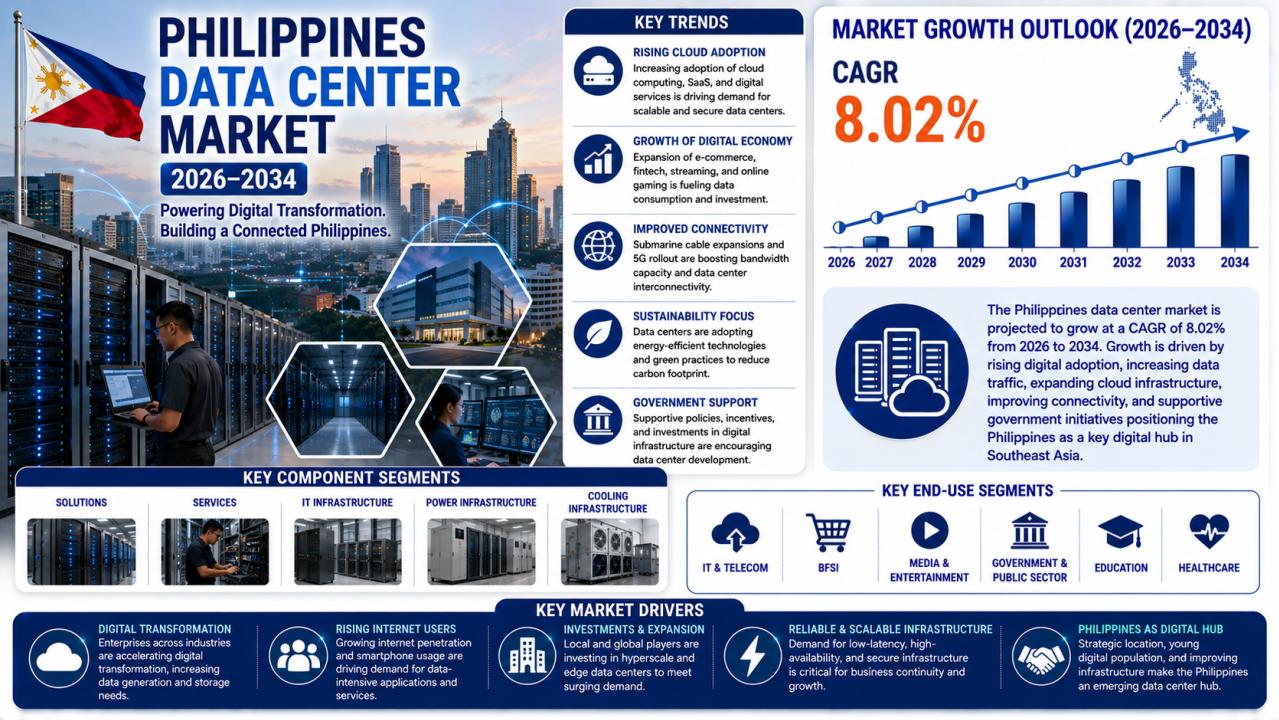
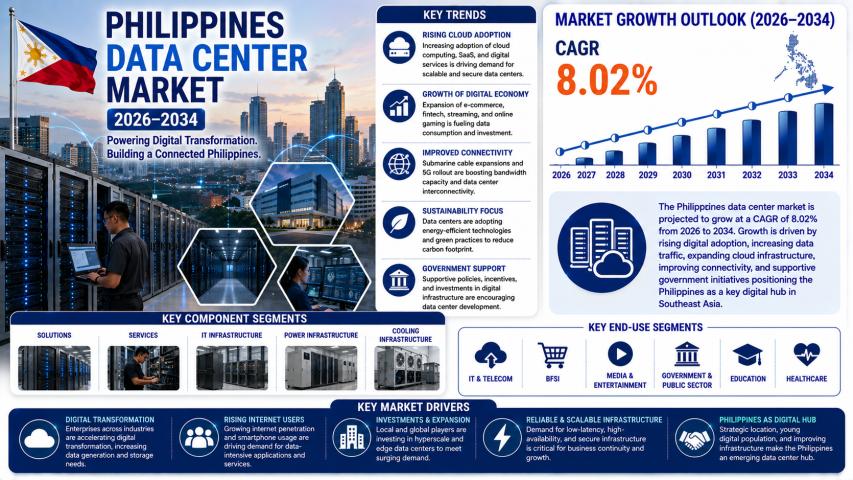
The Philippines data center market size reached USD
3,030.7 Million in 2025 and is projected to reach USD 6,193.5
Million by 2034, exhibiting a CAGR of 8.02% during
2026-2034. The market is driven by digital transformation that can create
massive amounts of data through a variety of channels, along with rising
frequency and sophistication of cybersecurity threats. According to the
Philippine Statistics Authority, the digital economy of Philippines in 2023
amounted to PhP 2.05 trillion, contributing 8.4 percent to the country's gross
domestic product (GDP). In 2023, hackers leaked a substantial amount of
personal data from the Philippine Health Insurance Corporation (PhilHealth),
affecting 13 million people.
Request a Sample Report for In-Depth Market Insights: https://www.imarcgroup.com/philippines-data-center-market/requestsample
Philippines Data Center Market Summary
- The
Philippines data center market encompasses solutions and services,
including colocation, hyperscale, and edge data centers, serving large
enterprises and SMEs across BFSI, IT and telecom, government, and energy
sectors.
- These
facilities are valued for their role in providing secure, scalable, and
reliable infrastructure for data storage, processing, and cloud services,
supporting digital transformation and economic growth.
- The
ecosystem includes data center operators (ePLDT, Equinix, EdgeConneX),
technology providers, government agencies (BOI, PEZA), and enterprises.
- Major
segments identified in the market include component (solution, services),
type (colocation, hyperscale, edge), enterprise size (large, SME), end
user (BFSI, IT and telecom, government, energy), and region (Luzon,
Visayas, Mindanao).
- The
market is benefiting from digital transformation, rising cybersecurity
attacks, and surge in cloud computing and OTT demand.
- In
October 2023, ePLDT offered a sovereign cloud with the launch of ePLDT
Pilipinas Cloud (ePPC) at the Philippine Digital Convention.
PORTER'S FIVE FORCES ANALYSIS
- Competitive
Rivalry: Moderate, with domestic players (ePLDT, VITRO) and
international operators (Equinix, EdgeConneX) competing on reliability,
connectivity, and service offerings. Business implication: Operators
must differentiate through connectivity, security, and service quality.
- Supplier
Power (Infrastructure and Equipment): Moderate. Suppliers of
power, cooling, and IT equipment have some leverage, but the presence of
multiple global suppliers and long-term contracts moderates this
power. Business implication: Operators should maintain
diverse supplier relationships.
- Buyer
Power (Enterprises and Government): Moderate. Large enterprises
and government agencies have bargaining power through volume and long-term
contracts, but the need for reliable infrastructure gives operators some
leverage. Business implication: Operators must focus on
reliability, security, and value-added services.
- Threat
of Substitutes: Low. While cloud services are an alternative,
they rely on data centers for infrastructure. Business
implication: The industry should emphasize the critical role of
data centers in the digital economy.
- Threat
of New Entrants: Moderate. Higher barriers for large-scale
facilities (capital, land, power), but lower barriers for edge and
specialized facilities. Business implication: Established
players should build defensible positions through scale, connectivity, and
partnerships.
MARKET GROWTH DRIVERS
Digital Transformation
Businesses undergoing digital transformation are generating
massive amounts of data through online transactions, consumer interactions, IoT
devices, and digital applications, increasing demand for robust data center
infrastructure and supporting the Philippines data
center market. The growing adoption of cloud computing is driving
Philippine businesses to transfer IT infrastructure and workloads to the cloud,
while AI-powered applications and IoT devices are generating substantial data
that requires efficient processing and advanced security.
Rising Cybersecurity Attacks
With the rising frequency and sophistication of
cybersecurity threats, organizations in the Philippines are emphasizing data
protection. Data centers use advanced security features including firewalls,
intrusion detection systems, encryption, and multi-factor authentication to
protect critical information and reduce the danger of cyber assaults. In 2023,
hackers leaked a substantial amount of personal data from PhilHealth, affecting
13 million people. Data centers assist firms in complying with regulatory demands
by building strong security controls and maintaining compliance certification.
Surge in Cloud Computing and OTT Demand
The increasing demand for cloud services and over-the-top
(OTT) content is significantly driving market growth. Businesses, educational
institutions, and media platforms rely on scalable cloud infrastructure to
deliver seamless online services, requiring high-capacity, low-latency data
environments. This growing reliance is prompting hyperscale and colocation
providers to invest in local facilities to reduce latency and improve
performance, making the Philippines a strategic location for cloud service providers.
PHILIPPINES DATA CENTER MARKET SEGMENTATION
Component Insights:
- Solution
- Services
Type Insights:
- Colocation
- Hyperscale
- Edge
- Others
Enterprise Size Insights:
- Large
Enterprises
- Small
and Medium-sized Enterprises
End User Insights:
- BFSI
- IT
and Telecom
- Government
- Energy
and Utilities
- Others
Regional Insights:
- Luzon
- Visayas
- Mindanao
COMPETITIVE LANDSCAPE
The Philippines data center market features a competitive
landscape of domestic players (ePLDT, VITRO) and international operators
(Equinix, EdgeConneX) competing on reliability, connectivity, and service
offerings. Competition is intensifying as operators invest in connectivity,
security, and service quality. Differentiation occurs through reliability,
connectivity, and service quality.
Key players mentioned in the report context include:
- Alibaba
Cloud
- Digital
Edge (Singapore) Holdings Pte. Ltd
- EdgeConneX
Inc
- Equinix,
Inc.
- Space
DC Pte Ltd.
- VITRO
Inc.
- ePLDT
(offered sovereign cloud with ePPC)
- (Complete
list provided in the full report)
REGIONAL ANALYSIS
- Luzon: The
largest market, driven by the concentration of economic activity,
population density, and digital infrastructure in Metro Manila and
surrounding provinces. Luzon hosts the majority of data center facilities,
benefiting from advanced connectivity and access to power and talent.
- Visayas: A
growing market with expansion driven by increasing digital adoption,
improving infrastructure, and growing business activity in Cebu and other
urban centers. The region benefits from strategic location and
connectivity.
- Mindanao: An
emerging market with growth potential, supported by improving
connectivity, increasing digital adoption, and growing business activity
in Davao and other urban centers. The region represents significant
opportunities for decentralized data center investments.
RECENT INDUSTRY DEVELOPMENTS
September 2026: The Philippine government launched
its AI+ Infrastructure Masterplan 2026–2033, backed by US$34.4
billion in planned investment. The plan targets a 30-fold increase in AI
data center capacity, from 50 MW to 1.5 GW by 2033, with around 400
MW targeted for deployment by 2030.
September 2026: Two US-based hyperscalers are
conducting due diligence on sites in the Philippines, with each considering an
initial data center capacity of approximately 200 MW over five years.
The companies are assessing locations along the Bataan-Clark and
Batangas-Aurora corridors, highlighting increasing hyperscaler interest in
the country.
September 2026: Industry estimates put Philippine
data center capacity at up to 100 MW, while government figures indicate
capacity of more than 180 MW. The Data Center Association of the
Philippines said the country has significant room to narrow its infrastructure
gap with Singapore and Malaysia as power availability, land resources
and investor interest improve.
April 2026: The Anti-Red Tape Authority brought
together 108 participants from government agencies, data center
operators, telecom companies and technology firms to address regulatory
bottlenecks affecting data center construction. The initiative focuses on
streamlining permits and improving the investment environment for digital
infrastructure projects.
January 2026: DAMAC Digital discussed plans with
President Ferdinand Marcos Jr. to establish a major data center in Laguna,
with the government describing the planned facility as potentially the largest
data center in the Philippines. The project forms part of broader efforts
to position the country as a regional hub for data centers, cloud services and
AI infrastructure.
Key Aspects Required for the Philippines Data Center Market
- Market
Performance: USD 3,030.7 Million in 2025, with a projected
trajectory to USD 6,193.5 Million by 2034.
- Market
Outlook: A 8.02% CAGR through 2034 indicates robust growth across
components and types, driven by digital transformation, cybersecurity
needs, and cloud demand.
- Growth
Drivers: Digital transformation; rising cybersecurity attacks;
surge in cloud computing and OTT demand; favorable government policies and
economic incentives; and expanding mobile and internet penetration.
- Competitive
Landscape: A competitive market with domestic and international
operators. Differentiation occurs through reliability, connectivity, and
service quality.
- Value
Chain Analysis: From infrastructure development and technology
provision through data center operations and service delivery to end-use
by enterprises and government, with digital transformation and security
shaping market dynamics.
- Industry
Trends: Digital transformation; rising cybersecurity attacks;
surge in cloud computing and OTT demand; growth of hyperscale and edge
data centers; untapped potential in emerging regions; and growing demand
from SMEs and startups.
- Strategic
Recommendations: Invest in hyperscale and edge data center
facilities; expand into emerging regions (Cebu, Davao, Clark); strengthen
cybersecurity and disaster recovery offerings; leverage government
incentives and foreign investment; and develop affordable colocation and
managed services for SMEs.
Note: If you need any specific information that is not currently covered within the scope of the report, we will provide the same as a part of customization.
Speak to an analyst: https://www.imarcgroup.com/request?type=report&id=23525&flag=C
Report Format, Delivery, and Customization Details
- Report
Format Mode: PDF and Excel (Editable version in PPT/Word format
available on special request)
- Report
Delivery Mode: Online Delivery, Physical Delivery
- Report
Delivery Time: report delivered over email within 24 to 48 hours.
If requested by the client, a physical copy will be delivered within three
to ten days.
- Report
Confirmation Mode: Yes, via email
- Report
Customization Mode: Yes, via Email / Call
- Report
Table of Content: Yes
- Report
List of Figures: Yes
- Report
Methodology Mode: Yes
- Request
For Sample Report: Yes
About Us
IMARC Group is a global management consulting firm that
helps the world's most ambitious changemakers to create a lasting impact. The
company provides a comprehensive suite of market entry and expansion services.
IMARC offerings include thorough market assessment, feasibility studies,
company incorporation assistance, factory setup support, regulatory approvals
and licensing navigation, branding, marketing and sales strategies, competitive
landscape and benchmarking analyses, pricing and cost research, and procurement
research.
Contact Us
IMARC Group
134 N 4th St., Brooklyn, NY 11249, USA
Email: sales@imarcgroup.com
Tel No: (D) +91 120 433 0800
United States: +1-201-971-6302