Market Outlook
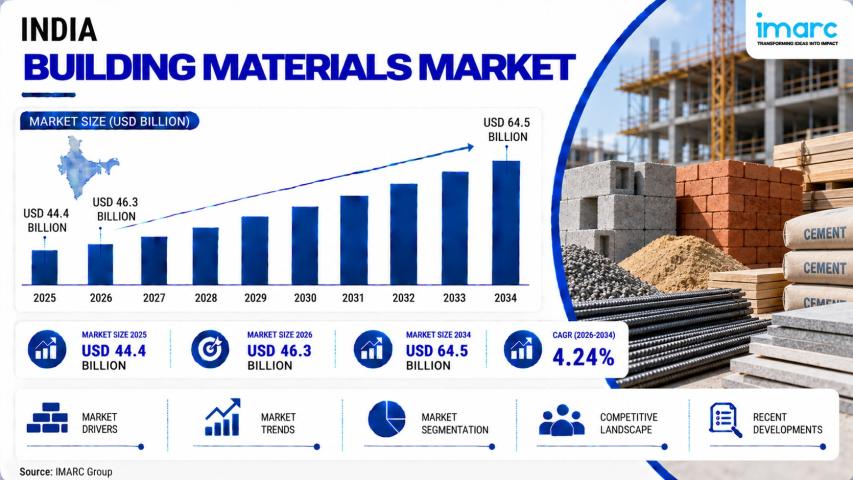
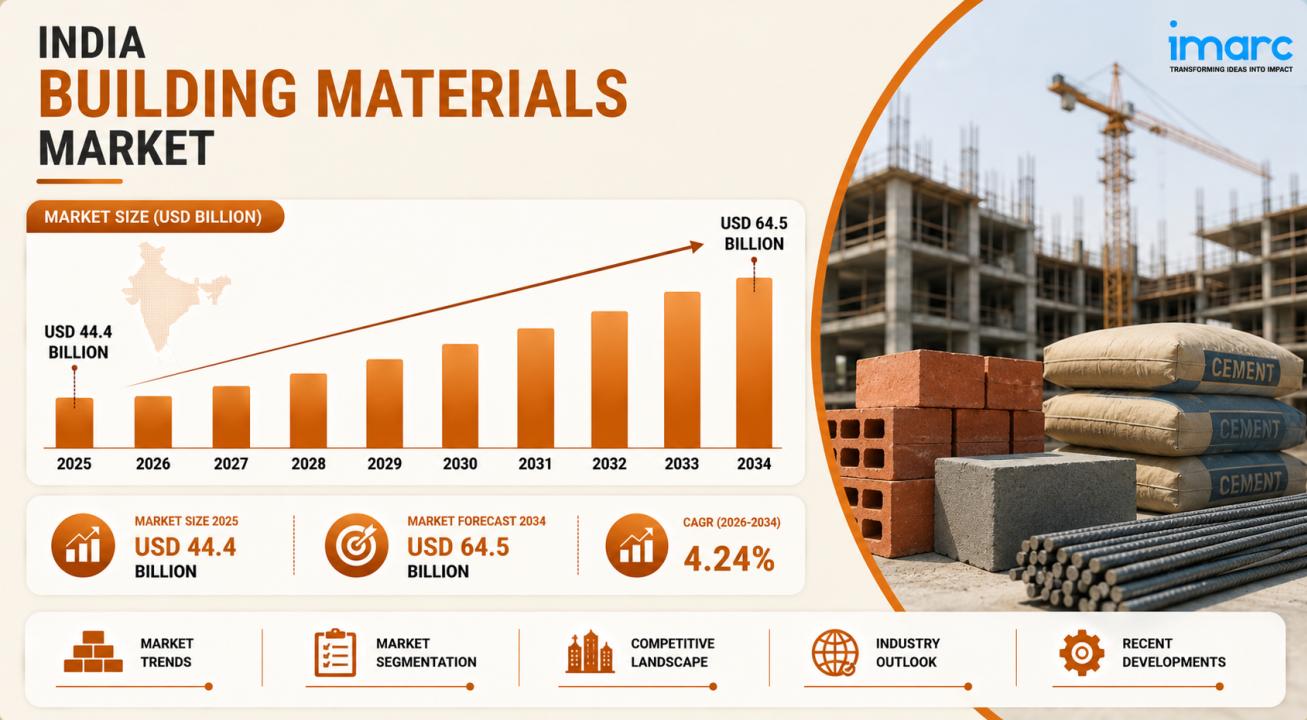
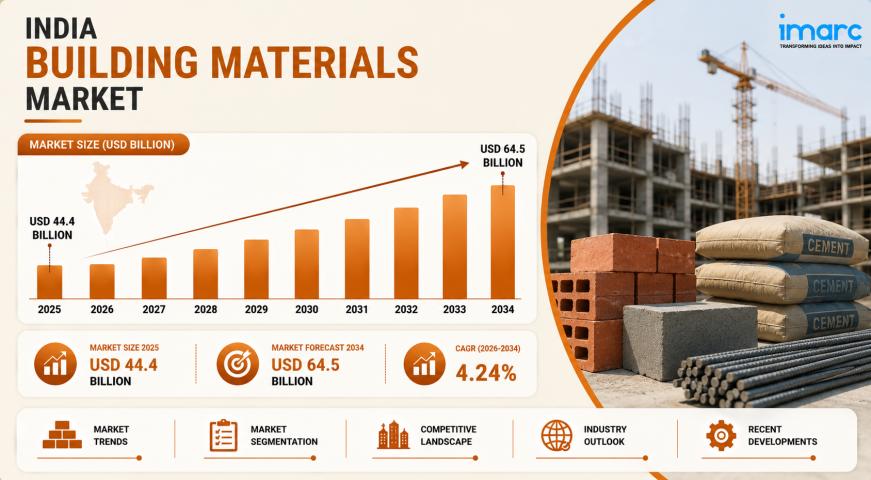
The India building materials market was valued at USD 44.4 Billion in 2025 and is estimated to reach USD 64.5 Billion by 2034, expanding at a compound annual growth rate of 4.24% between 2026 and 2034. Growth is being driven by the pace of urbanization across tier-two and tier-three cities, sustained public spending on roads, housing and urban infrastructure, and a policy push toward energy-efficient and low-carbon construction inputs. Record public capital expenditure under the Union Budget 2026-27, at an outlay of roughly Rs. 12.2 lakh crore (approximately USD 138 billion), is translating into steady offtake for cement, aggregates, bricks and allied materials across highway, railway, metro and housing projects.
Cement, the single largest revenue contributor within the market, continued its expansion through FY26, with domestic production rising by roughly 9.2% year-on-year to touch 443.2 million metric tonnes between April and February. Producers are backing this momentum with fresh capacity: industry estimates from CRISIL Ratings point to 150-170 million tonnes of new grinding capacity coming online between fiscal 2026 and fiscal 2028, alongside a wave of consolidation among leading manufacturers. Meanwhile, government programmes such as PM Gati Shakti, the National Infrastructure Pipeline, and the Pradhan Mantri Awas Yojana continue to widen the base of demand for aggregates, bricks and other core construction inputs.
Market Snapshot:
- Market Size (2025): USD 44.4 Billion
- Forecast Market Size (2034): USD 64.5 Billion
- CAGR (2026-2034): 24%
- Cement Production Growth (FY26, Apr-Feb): Up 9.2% year-on-year to 443.2 million metric tonnes
- Union Budget 2026-27 Capital Outlay: 12.2 lakh crore (~USD 138 billion), up 11.5% over the FY26 revised estimate
- Cement Capacity Addition (FY26-FY28, projected): 150-170 million tonnes, per CRISIL Ratings
What Are the Growth Factors of the India Building Materials Market?
Sustained Government Infrastructure and Housing Investment:
Public capital expenditure remains the single biggest lever for building material demand in India. The Union Budget 2026-27 raised the infrastructure capital outlay to around Rs. 12.2 lakh crore, an 11.5% jump over the previous year's revised estimate, with continued allocations toward the Ministry of Road Transport and Highways (Rs. 3.09 lakh crore) and rural housing under PMAY-Gramin (Rs. 54,916.7 crore). These multi-year, pre-funded programmes create predictable, dispersed demand for cement, aggregates and bricks that is comparatively insulated from short-term interest-rate cycles.
Rapid Urbanization and Affordable Housing Push:
India's urban population continues to expand into tier-two and tier-three cities, widening the footprint for residential and mixed-use construction. Government-backed affordable housing schemes, together with the rollout of GST 2.0, are expected to lower overall construction costs by roughly 3.5-4.5%, which in turn could bring housing prices down by 5-8% and stimulate fresh demand in the affordable and mid-income housing segments.
Capacity Expansion and Consolidation Among Material Producers:
Leading cement and building material manufacturers are investing heavily to keep pace with demand. CRISIL Ratings expects the country's top cement producers to commit close to USD 13.53 billion in capital expenditure between FY26 and FY28, largely directed toward new grinding units, waste-heat recovery systems and logistics upgrades. This expansion, combined with active consolidation among major groups, is expanding the domestic supply base for core building materials.
Shift Toward Fly Ash Utilisation and Circular Construction Inputs:
Regulatory mandates around fly ash use are reshaping raw-material sourcing for bricks and cement. According to the Ministry of Railways and NTPC, India generated more than 340 million tonnes of fly ash in FY 2024-25, of which over 332 million tonnes were utilised - about 27% within the cement industry and 14% in brick and tile manufacturing. Continued enforcement of these utilisation norms is steering material producers toward blended and industrial by-product-based formulations.
➤ Request Sample Report (TOC & Charts): https://www.imarcgroup.com/india-building-materials-market/requestsample
What Are the Key Trends Shaping the Market?
Rising Adoption of Green and Eco-Friendly Materials:
Fly ash bricks, Autoclaved Aerated Concrete (AAC) blocks, bamboo composites and recycled steel are gaining ground as architects and developers respond to tightening environmental norms. The Bureau of Energy Efficiency has required fly ash utilisation in construction near thermal power plants since 2016, and the National Green Building Code now sets sustainability benchmarks that feed into certifications such as LEED and GRIHA, pushing manufacturers to widen their green product portfolios.
Consolidation and Capacity Expansion in the Cement Segment:
Merger and acquisition activity within cement, the market's largest sub-segment, remains brisk. In May 2026, Dalmia Bharat signed an agreement to acquire roughly 5.2 million tonnes per annum of cement capacity from Jaiprakash Associates and Adani Infra for close to USD 297 million, a deal that will lift its total capacity to 54.7 MTPA. Similar expansion and bidding activity among UltraTech, Adani Group, JSW and other major players points to continued consolidation through the remainder of the decade.
Technology-Led Construction and Smart Materials:
Prefabrication, modular construction and Building Information Modelling (BIM) are gradually reducing material wastage and project timelines on large-scale developments. Manufacturers are also introducing higher-strength, lighter composites and blended cements that incorporate industrial by-products such as slag and fly ash, aimed at improving both durability and the carbon footprint of finished structures.
GST Rationalisation Supporting Affordable and Mid-Income Housing:
The rollout of GST 2.0 is expected to meaningfully lower input costs across the construction value chain, with downstream housing prices projected to fall 5-8%. This cost relief is anticipated to widen demand for building materials specifically within the affordable and mid-segment housing categories, which have historically been the most price-sensitive.
What Are the Major Market Challenges?
High Freight and Raw Material Costs:
Freight continues to account for an estimated 25-30% of delivered cement cost in India, making logistics a structural constraint on margins and regional pricing. Producers remain dependent on multimodal transport upgrades, including dedicated freight corridors and inland waterways, to meaningfully bring this cost burden down.
Oversupply Risk From Rapid Capacity Additions:
With 150-170 million tonnes of new cement capacity expected between FY26 and FY28, well above the 95 million tonnes added over the previous three fiscals, the pace of expansion risks outstripping near-term demand growth in certain regions. Analysts caution that this imbalance could pressure realisations and pricing discipline even as volumes continue to rise.
Execution Delays and Skilled Manpower Constraints:
Large infrastructure and housing projects in India continue to face execution delays stemming from land acquisition, regulatory clearances and a shortage of skilled construction manpower. Because material demand is closely tied to on-ground project execution, any slippage in construction timelines has a direct bearing on offtake for cement, aggregates and allied building materials.
➤ Explore the Full Report with Charts, Table of Contents, and List of Figures: https://www.imarcgroup.com/india-building-materials-market
How Is the Market Segmented?
- By Type: The market is segmented into Aggregates, Cement, Bricks, and Others. Cement remains the leading revenue contributor, supported by its role as the primary binding material across residential, commercial and infrastructure construction.
- By Application: Key application segments include Residential, Commercial, and Industrial. Residential construction retains a leading share, aided by government affordable-housing programmes and continued urban migration.
- Regional Insights: The report covers North India, South India, East India, and West India, reflecting differing paces of infrastructure rollout, industrial activity, and housing demand across these zones.
Competitive Landscape:
The India building materials market is moderately consolidated, led by large integrated cement and construction-material manufacturers with extensive dealer networks, captive raw-material sources, and pan-India distribution. Recent years have seen intensified merger and acquisition activity as top players compete to secure limestone reserves, expand grinding capacity, and strengthen their presence in underpenetrated regions, alongside continued investment in blended and low-carbon product lines.
Recent News or Developments:
- In May 2026, Dalmia Bharat, through its subsidiary Dalmia Cement (Bharat), signed a Business Transfer Agreement to acquire around 5.2 million tonnes per annum of cement assets located in Madhya Pradesh and Uttar Pradesh from Jaiprakash Associates and Adani Infra for approximately USD 297 million, taking its total capacity to 54.7 MTPA.
- In July 2026, Nuvoco Vistas, through its subsidiary Vadraj Cement, commissioned a 2 million tonnes per annum grinding facility at its Limla plant in Gujarat, as the company works toward a total capacity target of 35 MTPA by FY2028.
- In January 2026, UltraTech Cement completed capacity additions at its Dhule (Maharashtra) and Nathdwara (Rajasthan) plants, lifting its domestic grey cement capacity to 188.66 MTPA and reinforcing its position as India's largest cement producer.
Customization Note: If you require any specific information not covered within this report's scope, we will provide it as part of the customization.
➤ Request a Customized Report: https://www.imarcgroup.com/request?type=report&id=29287&flag=E
Frequently Asked Questions (FAQs):
Q1. How big is the India building materials market?
The India building materials market was valued at USD 44.4 Billion in 2025.
Q2. What is the future outlook of the India building materials market?
The India building materials market is projected to exhibit a CAGR of 4.24% during 2026-2034, reaching a value of USD 64.5 Billion by 2034.
Q3. Which type holds significant demand in the market?
Cement holds significant demand, driven by its critical role as the primary binding material across residential, commercial and infrastructure construction.
Q4. Which application segment dominates the India building materials market?
The residential segment dominates, propelled by government affordable-housing programmes and continued urban expansion into tier-two and tier-three cities.
Q5. What are the key factors driving the India building materials market?
The India building materials market is driven by sustained government infrastructure and housing investment, rapid urbanization, cement capacity expansion, and rising adoption of fly ash-based and other sustainable materials.
Conclusion
The India building materials market is set for steady, infrastructure-led expansion through 2034, underpinned by record public capital expenditure, an active affordable-housing pipeline, and continuing capacity investment by leading cement and construction-material producers. At the same time, the pace of new capacity additions, elevated freight costs, and execution bottlenecks in large projects will require producers to balance growth with operational discipline.
Looking ahead, the shift toward fly ash-based bricks, blended cements and other lower-carbon inputs is likely to accelerate as regulatory mandates around sustainable construction tighten further. Combined with GST-led cost relief for housing and continued government spending on roads, railways and urban infrastructure, these forces position the market for resilient, broad-based growth across residential, commercial and industrial end-uses over the coming decade.