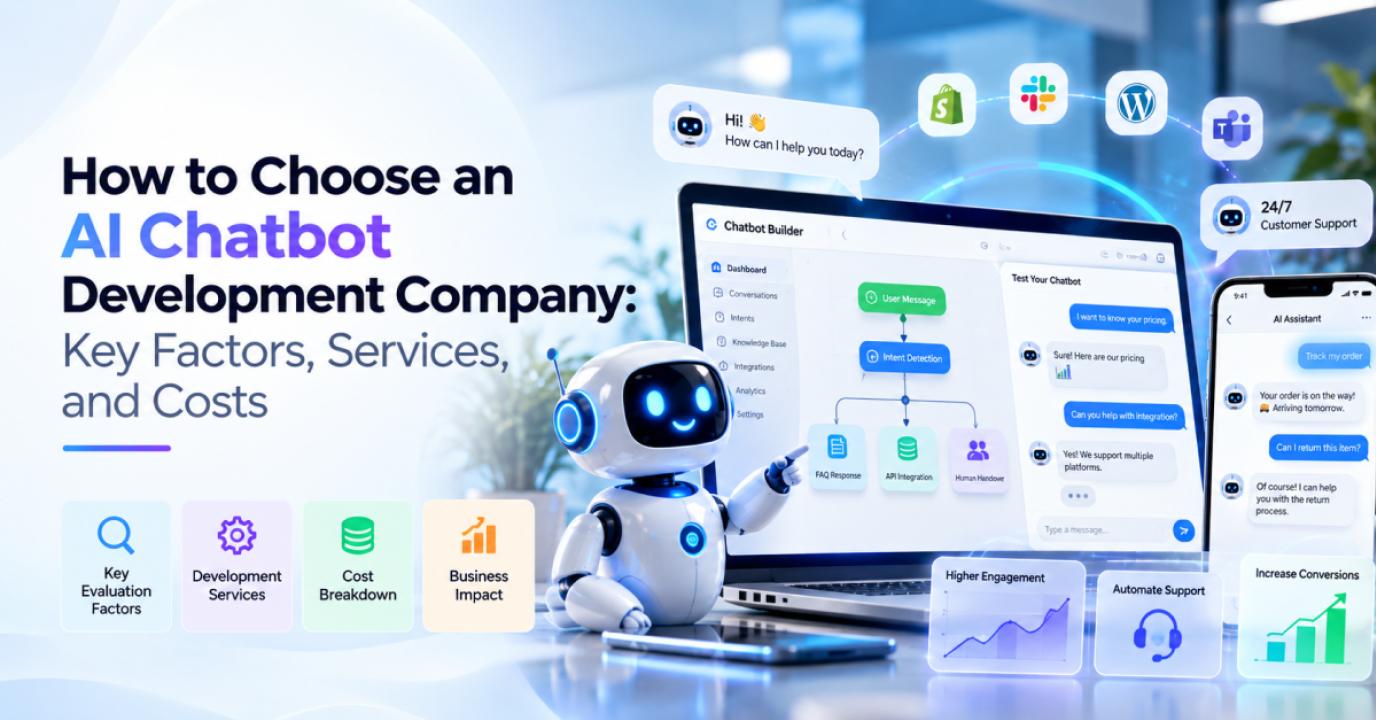
Choosing an AI chatbot development company is no longer just about finding a team that can add a chat widget to your website. Businesses evaluating AI chatbot development company options need to look beyond basic chatbot features and assess technical expertise, AI capabilities, integrations, security, scalability, and long-term support. Modern AI chatbots can understand natural language, retrieve information from private knowledge bases, connect with CRM and enterprise systems, automate workflows, and hand complex conversations to human agents.
The challenge is finding a development partner that can turn these capabilities into a secure, scalable business solution. This guide explains what to evaluate when comparing AI chatbot development services, what the development process should include, what affects chatbot development cost, and which questions you should ask before signing a contract.
What Should an AI Chatbot Development Company Offer?
A capable vendor should cover more than chatbot interface development. Look for expertise across AI, software engineering, integrations, security, deployment, and ongoing optimization.
- Depending on your use case, the scope may include:
- AI chatbot strategy and consulting
- Custom AI chatbot development
- NLP and LLM integration
- Knowledge-base and RAG implementation
- CRM and enterprise-system integrations
- Omnichannel chatbot deployment
- Voice and speech capabilities
- Analytics and conversation optimization
- Testing, monitoring, and quality assurance
- Maintenance and technical support
A comprehensive chatbot development partner should be able to connect the AI layer with your existing technology stack rather than treating the chatbot as an isolated application.
7 Key Factors to Consider When Choosing an AI Chatbot Vendor
1. Technical Expertise in AI and Conversational Systems
Start by evaluating the vendor's engineering capabilities.
A production chatbot may involve NLP, LLMs, retrieval-augmented generation (RAG), APIs, databases, cloud infrastructure, authentication, analytics, and human handoff workflows. Your development partner should understand how these components work together rather than relying entirely on a third-party chatbot platform.
If your chatbot project is part of a broader AI initiative, working with an AI development company can also help you align chatbot architecture with your wider AI strategy and technology roadmap.
Ask about the team's experience with:
- Large language models
- NLP and intent recognition
- Prompt engineering
- RAG and knowledge retrieval
- API development
- Cloud deployment
- Conversational UX
- AI evaluation and monitoring
The vendor should also explain why a particular architecture or model fits your use case instead of simply recommending the latest AI model.
2. NLP and LLM Capabilities
An AI chatbot needs to understand context, intent, variations in user language, and follow-up questions.
Ask whether the company can work with different LLM providers and select models based on accuracy, latency, cost, privacy, and business requirements.
For enterprise applications, also ask how the vendor handles hallucinations, prompt injection, sensitive information disclosure, output validation, and model evaluation.
A strong AI chatbot development partner should build safeguards around the model instead of treating the LLM as the entire solution.
3. Integration and Customization Capabilities
A chatbot becomes significantly more valuable when it can work with your existing business systems.
Your vendor should be able to integrate the chatbot with platforms such as:
- Salesforce, HubSpot, or other CRMs
- Zendesk and Freshdesk
- ERP systems
- E-commerce platforms
- Internal databases
- Booking and payment systems
- Custom APIs
- Authentication and identity systems
For example, enterprise chatbot integrations can allow a bot to retrieve customer information, check order status, create support tickets, qualify leads, or trigger business workflows.
This is where custom chatbot development services can provide an advantage over generic chatbot builders. Instead of forcing your processes into a predefined platform, the chatbot can be designed around your workflows and technology stack.
4. Security and Data Protection
Security should be discussed before development begins, not after deployment.
Ask how the vendor protects:
- Customer and business data
- API credentials
- Conversation history
- Knowledge-base content
- Personally identifiable information
- Authentication credentials
- Model inputs and outputs
You should also ask about encryption, access controls, logging, data retention, tenant isolation, and secure API design.
For AI systems, security should cover the complete lifecycle, including development, deployment, monitoring, and ongoing updates.
5. Scalability and Performance
Your chatbot may initially handle a few hundred conversations per month. If adoption grows, the architecture must support higher traffic without creating unacceptable latency or infrastructure costs.
Ask potential vendors how they handle:
- Concurrent conversations
- Traffic spikes
- Model rate limits
- API failures
- Response latency
- Caching
- Load balancing
- Monitoring
- Multi-channel deployment
A scalable architecture should also make it possible to introduce new models, channels, integrations, and capabilities without rebuilding the entire chatbot.
6. Industry Experience
Industry knowledge can reduce discovery time and help your vendor identify requirements you may overlook.
For example, a healthcare chatbot may require stronger privacy and compliance controls, while an e-commerce chatbot may focus more heavily on product discovery, order tracking, and recommendations.
Look for relevant case studies and ask what the vendor actually delivered. Don't evaluate industry experience based only on a list of industries displayed on a website.
What Does the AI Chatbot Development Process Look Like?
A reliable vendor should follow a structured development process rather than immediately starting with chatbot UI development.
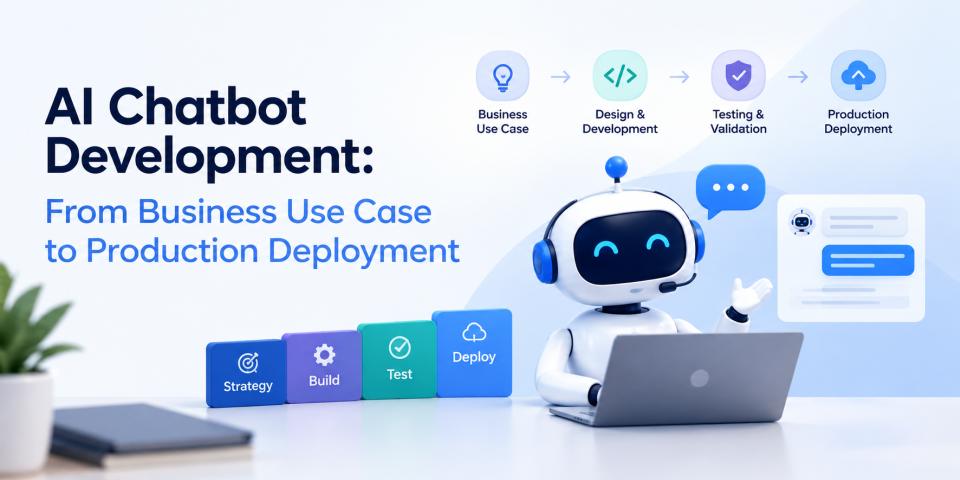
Step 1: Discovery and Strategy
The team identifies your business objectives, users, chatbot use cases, data sources, channels, integrations, and success metrics.
Step 2: Conversation and UX Design
The team defines conversation flows, fallback behavior, escalation paths, user journeys, and human handoff requirements.
Step 3: AI and NLP Development
The appropriate NLP or LLM architecture is implemented. Depending on your use case, this can include RAG, intent recognition, prompt engineering, tool calling, and response evaluation.
Step 4: Integration and Development
The chatbot connects with your CRM, helpdesk, databases, APIs, authentication systems, or other enterprise applications.
Step 5: Testing and Security Validation
The team tests accuracy, edge cases, latency, integrations, security, failure scenarios, and human handoff.
Step 6: Deployment and Optimization
After launch, analytics and real conversations help the team continuously improve the chatbot.
This structured approach reduces the risk of building a chatbot that works during a demonstration but struggles with real-world conversations and enterprise workloads.
A basic chatbot with limited functionality may require a relatively small development investment, while an enterprise-grade solution with private data, multiple integrations, advanced security, RAG, analytics, and workflow automation can require a significantly larger budget.
For this reason, avoid choosing a vendor based only on the lowest initial quote. Compare what each proposal actually includes.
A useful proposal should clearly separate development costs from recurring expenses such as model/API usage, hosting, third-party platforms, messaging charges, and ongoing support.
Questions to Ask an AI Chatbot Development Company
Before selecting a vendor, ask:
- Have you built chatbots for businesses with similar use cases?
- Which LLMs and AI technologies do you work with?
- Can the chatbot use our private business data securely?
- How will you reduce hallucinations and inaccurate responses?
- Can you integrate the chatbot with our CRM, ERP, helpdesk, or internal APIs?
- How will you protect sensitive customer and business data?
- How will the chatbot scale as conversation volume increases?
- What testing and evaluation process do you follow?
- What happens when the chatbot cannot answer a question?
- What post-launch maintenance and support do you provide?
- Which costs are included in the development estimate?
- Which third-party and recurring costs will we need to pay?
- Who owns the source code, prompts, configurations, and chatbot data?
- How long will development and deployment take?
- What KPIs will you use to measure chatbot performance?
The answers will help you understand whether a vendor can support your requirements beyond the initial chatbot implementation.
AI Chatbot Development Services for Business Use Cases
The right chatbot architecture depends on what you want the system to accomplish.
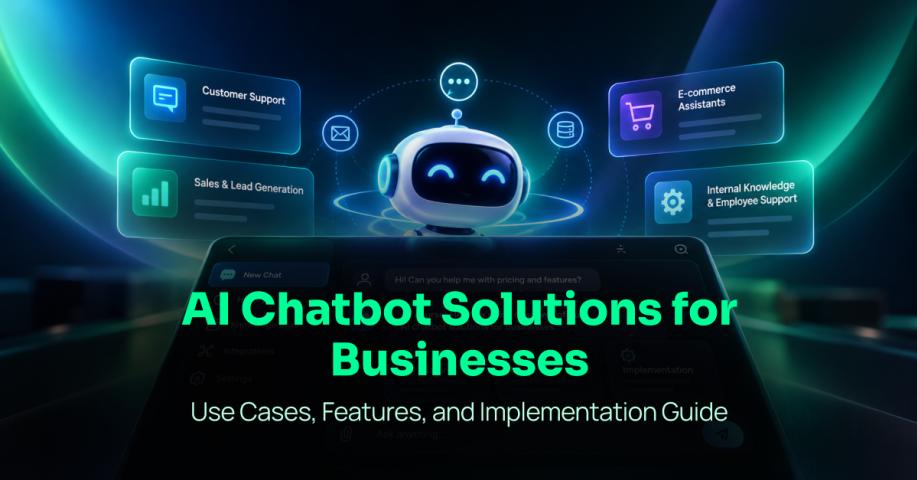
Customer support teams may need automated question answering and ticket creation. Sales teams may need lead qualification and CRM updates. E-commerce companies may need product recommendations and order tracking. Internal teams may need an AI assistant that retrieves company knowledge and automates repetitive workflows.
For more complex automation, a chatbot can also work alongside AI agents that execute tasks through connected tools and systems. If your requirements extend beyond conversational assistance into autonomous workflow execution, an AI agent development company can help design and implement agent-based workflows.
This approach can be useful when your solution needs to move beyond answering questions and perform actions such as retrieving information, calling APIs, updating business systems, or orchestrating multi-step workflows.
Final Checklist for Choosing Your Chatbot Development Partner
Before making your decision, confirm that the vendor can demonstrate:
- Proven AI and NLP engineering expertise
- LLM and RAG capabilities
- Customization beyond basic chatbot templates
- Secure enterprise integrations
- Scalable architecture
- Relevant industry experience
- A defined development and testing process
- Clear ownership and deployment terms
- Transparent development and operating costs
- Long-term maintenance and optimization
The right development partner should be able to connect your business objective with the underlying AI architecture, integrations, security requirements, and measurable outcomes.
If you are evaluating a custom chatbot project, explore Mobisoft Infotech's AI chatbot development services for strategy, custom development, integrations, deployment, analytics, maintenance, and ongoing support.