On-Grid Battery Energy Storage Systems Market: Where
Should Companies Invest as Grid Flexibility Becomes Critical?
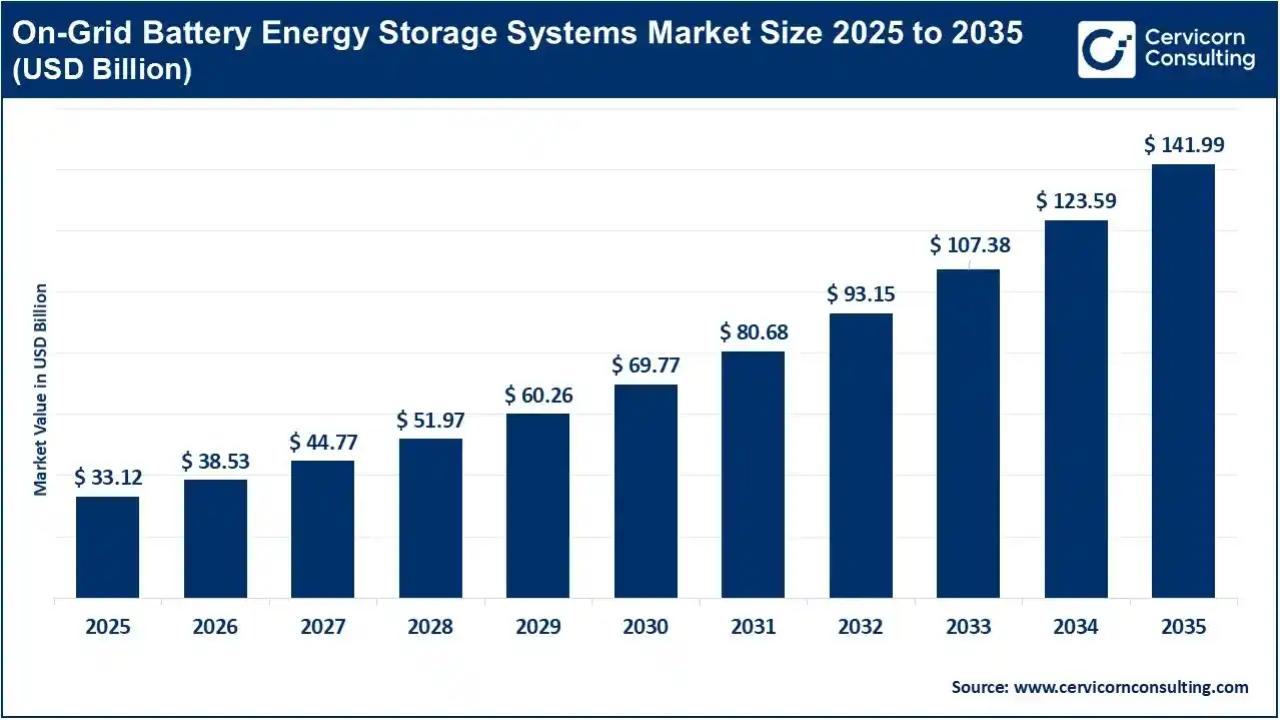
The global on-grid battery energy storage systems market
was valued at approximately USD 33.12 billion in 2025 and is projected
to reach nearly USD 141.99 billion by 2035, expanding at a 15.6% CAGR.
Asia-Pacific accounted for 38% of the market in 2025, while
front-of-the-meter systems represented 80% and utility/grid-scale developers
68%.
Global Deployment Is Moving Toward Utility-Scale Storage
The International Energy Agency reports that 108 GW of
new battery storage capacity was deployed globally in 2025, 40% more than
in 2024. Around 80% of new capacity was utility-scale, confirming that
grid-connected storage is becoming a core part of electricity infrastructure
rather than simply a backup technology.
For developers, this shifts the investment focus toward
large systems capable of frequency regulation, peak management, renewable
integration and energy shifting.
India Is Creating a Large BESS Investment Pipeline
India's National Electricity Plan projects BESS requirements
of 47.24 GW/236 GWh by 2031–32, with estimated investment of
approximately ₹3.49 lakh crore.
The government's Green Energy Corridor Phase-III adds
another major demand signal: the scheme includes 50 GWh of BESS and a
total outlay of ₹1.86 lakh crore, including ₹50,000 crore for storage,
to support evacuation of up to 135 GW of renewable energy.
India's deployment is already accelerating. Battery storage
additions reached 8.2 GWh in H1 2026, taking cumulative BESS capacity to
approximately 9.3 GWh, while 28 GW of projects were tendered during the
period.
Get a Free Sample: https://www.cervicornconsulting.com/sample/3043
LFP Remains the Practical Technology Choice
LFP batteries held 62% of the on-grid BESS market in
2025, reflecting their cycle life, safety and suitability for large stationary
installations. Flow batteries accounted for 14%, giving them a potential role
in longer-duration applications.
Companies should therefore distinguish between applications
requiring frequent short-duration cycling and those requiring four-hour-plus
or longer-duration storage, where alternative chemistries may become more
competitive.
Larger Projects Are Becoming More Important
The 100–<500 MWh segment represented 38% of the
market in 2025, while projects above 500 MWh collectively represented another
25%. Transmission-connected systems accounted for 42% of the market.
This suggests opportunities are moving beyond battery-cell
supply toward complete systems involving power-conversion equipment,
transformers, thermal management, energy-management software, grid controls and
safety systems.
The U.S. Market Shows the Scale of Future Demand
U.S. utility-scale battery storage capacity reached nearly 52
GW by June 2026, after operators added 8.3 GW during the first half of the
year. Another 54 GW is expected to come online over the following two
and a half years based on reported project plans.
EIA had earlier projected 24 GW of new utility-scale
battery capacity in 2026, with Texas, California and Arizona accounting for
about 80% of planned additions.
For suppliers, these markets highlight the importance of
securing grid interconnection, transmission access and project pipelines—not
simply manufacturing capacity.
Grid Constraints Create a Second Investment Opportunity
The IEA identifies inadequate grid capacity and record-high
connection queues as growing bottlenecks for new generation, storage and
electricity demand. Batteries can help manage congestion and provide
flexibility, but projects still require suitable interconnection and market
structures.
This makes grid-location strategy, energy-market
participation and revenue stacking increasingly important when evaluating
BESS investments.
Where Should Companies Invest?
The strongest opportunities are emerging around utility-scale
FTM systems, LFP-based storage, renewable-plus-storage projects, transmission
and distribution-connected systems, energy-management software,
power-conversion systems and longer-duration technologies.
India is particularly attractive for developers and
equipment suppliers because government funding, renewable integration targets
and large tender pipelines are creating demand simultaneously. Globally, the
investment case is increasingly tied to the ability of BESS projects to
generate multiple value streams rather than relying only on energy arbitrage.
The Key Business Decision
The question for companies is no longer simply how much
battery storage will be deployed. It is which markets, project sizes,
technologies and grid services can produce durable returns as storage becomes a
fundamental component of power-system infrastructure.
Companies entering the market should evaluate battery
chemistry, project duration, grid connection, degradation, safety requirements,
revenue stacking and local policy incentives together before committing
capital.
Explore the Full Market Report: https://www.cervicornconsulting.com/on-grid-battery-energy-storage-systems-market