
For professionals planning advanced certification, choosing the right preparation strategy is crucial. While enrolling in a CCIE Security Training Course in Bangalore, aspirants often struggle to balance written exam preparation with intensive lab practice. Understanding how these two approaches differ—and how they complement each other—can significantly improve success rates. Bangalore’s training ecosystem, including CCIE security course in Bangalore, CCIE Security Training course in Bangalore programs, offers structured paths for both, but candidates must apply the right focus at the right stage.
Understanding the CCIE Security Exam Path
The CCIE Security certification process involves two
distinct phases: a qualifying written exam and the hands-on lab exam. The
written exam validates conceptual understanding and design-level knowledge,
while the lab exam tests real-world configuration and troubleshooting skills
under time pressure. A strong preparation strategy recognizes that each phase
demands a different learning approach.
Written Exam Preparation: Conceptual Foundation
Written exam preparation focuses on building a deep
theoretical understanding of security technologies, protocols, and design
principles. This stage is essential because it lays the groundwork for lab
performance.
Key elements of written exam preparation include studying official exam topics,
understanding security architecture, reviewing best practices, and learning how
different technologies interact. Candidates often rely on structured reading
materials, instructor-led sessions, and practice questions. This phase helps
aspirants think like network designers rather than device operators.
However, a common mistake is over-investing in theory for too long. While
conceptual clarity is essential, CCIE Security is ultimately a hands-on
certification, and written knowledge alone does not translate into lab success.
Lab Exam Preparation: Skill Application
Lab preparation is where theory meets execution. This
approach emphasizes configuring, integrating, and troubleshooting security
solutions in complex environments. Aspirants enrolled in a CCIE Security
Training Course in Bangalore typically spend the majority of their preparation
time in labs once the written exam is cleared or nearing completion.
Lab-focused preparation develops speed, accuracy, and structured
troubleshooting skills. Candidates practice full-scale scenarios, repeat
configurations, and learn to validate solutions efficiently. Unlike written
study, lab work exposes gaps in understanding and forces aspirants to apply
concepts under realistic constraints.
The challenge with lab preparation is that it requires discipline and
consistency. Random lab practice without structure can lead to confusion, while
guided, exam-aligned labs produce measurable progress.
Key Differences Between Written and Lab Approaches
Written preparation is knowledge-driven, while lab
preparation is performance-driven. The written exam rewards clarity of concepts
and decision-making logic, whereas the lab exam rewards execution,
prioritization, and troubleshooting methodology.
Written study can often be done individually with limited resources, but lab
preparation demands robust infrastructure, updated environments, and expert
feedback. This is why serious aspirants prioritize institutes that offer
extensive lab access and mentorship.
Why a Balanced Strategy Matters
Treating written and lab preparation as separate or
competing efforts is a mistake. The most effective CCIE Security aspirants
integrate both approaches. Concepts learned during written preparation should
immediately be reinforced through lab practice. Likewise, challenges faced in
labs should guide further theoretical review.
For example, understanding VPN theory is useful, but configuring and
troubleshooting VPNs repeatedly in labs is what builds exam confidence. This
feedback loop accelerates learning and reduces revision time.
Common Preparation Pitfalls
Many aspirants spend months on written topics before
touching labs, leading to delayed hands-on confidence. Others rush into labs
without solid fundamentals, resulting in repeated errors. Both extremes slow
progress and increase frustration.
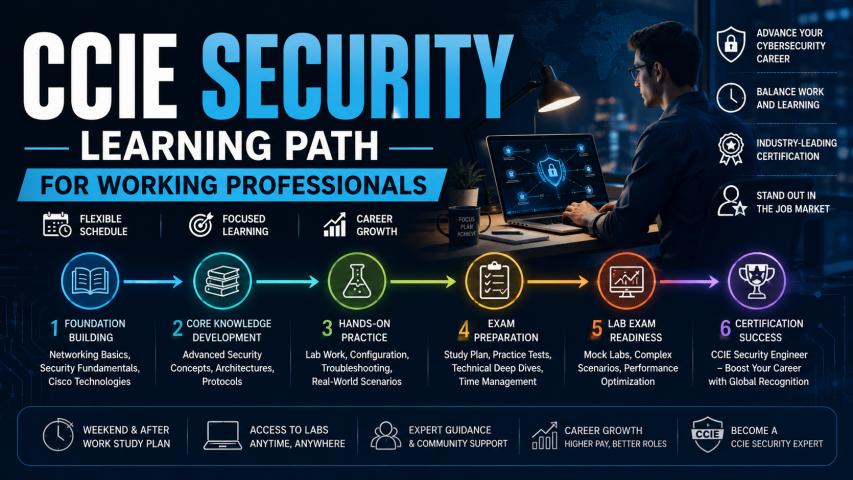
A structured roadmap that transitions smoothly from written focus to lab
dominance helps avoid these issues.
Choosing the Right Training Environment
Bangalore-based training programs increasingly design
integrated learning paths that align written exam objectives with lab
scenarios. This approach helps aspirants see the relevance of theory in
practical contexts and prepares them more effectively for the lab exam’s
demands.
Conclusion
Written and lab exam preparation approaches
serve different but equally important purposes in the CCIE Security journey.
Written preparation builds the conceptual base, while lab preparation
transforms that knowledge into executable skill. Success comes from knowing
when to shift focus and how to integrate both methods.
In conclusion, aspirants selecting CCIE security course in Bangalore, CCIE Security Training course in Bangalore should prioritize programs that
balance written understanding with intensive lab practice, ensuring readiness
for both stages of the CCIE Security certification