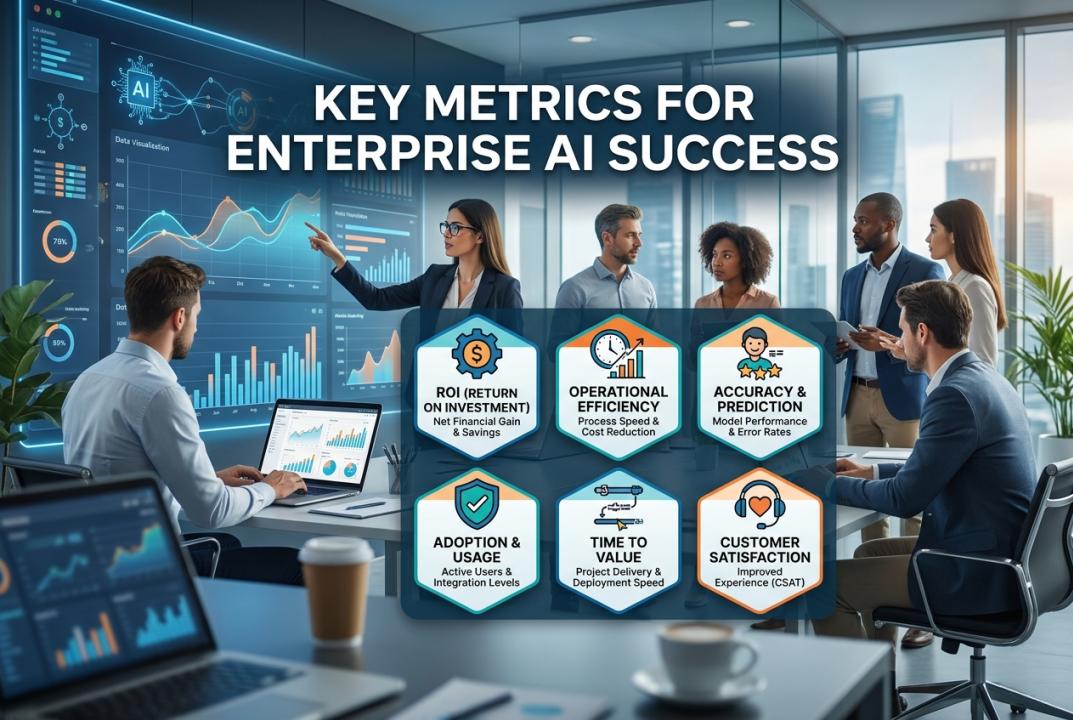
Enterprises are investing heavily in AI, yet many struggle to define what success actually looks like after deployment. Implementing AI is no longer the hard part. Measuring its real business impact is where most organizations fall short.
For decision-makers, the focus has shifted from experimentation to accountability. Whether working with an AI integration company or building internal capabilities, leaders need clear, quantifiable indicators that connect AI initiatives to business outcomes.
This article outlines the most important metrics that enterprises and well-funded startups should track when evaluating AI Integration Services and long-term performance.
Why Metrics Matter in AI Integration
AI integration is not a one-time deployment. It is an evolving system embedded into operations, customer interactions, and decision-making layers.
Without proper measurement:
- Projects drift without clear ROI
- Stakeholders lose confidence
- Scaling becomes risky and inconsistent
This is where structured AI Integration Consulting becomes essential. It ensures that every initiative is aligned with measurable business goals from day one.
1. Return on Investment (ROI)
ROI remains the most critical metric for any enterprise AI initiative.
It answers a simple but powerful question: is the AI investment generating measurable financial value?
What to Measure:
- Cost savings from automation
- Revenue growth driven by AI insights
- Reduction in operational overhead
- Increase in conversion rates
Example:
An enterprise implementing AI-powered demand forecasting may reduce inventory costs by 20 percent while improving fulfillment rates.
How AI Integration Services Help:
A structured approach ensures ROI is tracked at both micro and macro levels. This includes linking AI outputs directly to financial performance indicators.
2. Operational Efficiency Gains
AI is often introduced to improve efficiency across processes. Measuring how effectively it achieves that goal is essential.
Key Indicators:
- Time saved per process
- Reduction in manual intervention
- Throughput improvements
- Error rate reduction
Example:
A financial services firm using AI for document processing can reduce processing time from hours to minutes while minimizing human errors.
Strategic Insight:
Efficiency gains should not be evaluated in isolation. They should be tied to cost savings, employee productivity, and customer experience improvements.
This is where Artificial Intelligence Integration Services play a critical role by mapping AI capabilities to specific operational workflows.
3. Model Performance Metrics
Beyond business outcomes, technical performance must also be monitored consistently.
Core Metrics:
- Accuracy and precision
- Recall and F1 score
- Latency and response time
- Model drift over time
Why It Matters:
Even a high-performing AI model at launch can degrade over time due to changing data patterns. Without monitoring, this can lead to poor decisions and financial losses.
Enterprise Approach:
AI integration solutions should include continuous monitoring frameworks that detect anomalies and trigger retraining when required.
This is especially important in use cases like fraud detection, recommendation engines, and predictive analytics.
4. Adoption Rate Across Teams
AI initiatives fail when employees do not use them.
Adoption is a strong indicator of whether AI is truly embedded into business operations.
What to Track:
- Percentage of teams actively using AI tools
- Frequency of usage
- User satisfaction scores
- Reduction in reliance on legacy systems
Example:
A sales team provided with AI-driven insights but not trained properly may ignore the system entirely.
Business Perspective:
Adoption reflects usability, trust, and relevance. Strong AI Integration Consulting ensures change management strategies are included, not just technical deployment.
5. Decision-Making Impact
One of the most valuable outcomes of AI is improved decision-making.
Metrics to Evaluate:
- Speed of decision-making
- Accuracy of predictions
- Reduction in decision errors
- Impact on strategic outcomes
Example:
AI-driven pricing strategies can lead to more competitive positioning and higher margins.
Advanced Insight:
This is where Generative AI Consulting is gaining traction. Enterprises are now using AI not just for analysis, but also for generating strategic recommendations and scenario simulations.
Measuring how these outputs influence executive decisions provides a deeper understanding of AI’s real value.
6. Customer Experience Metrics
AI is increasingly customer-facing, making experience metrics critical.
Key Indicators:
- Customer satisfaction score (CSAT)
- Net Promoter Score (NPS)
- Response time improvements
- Personalization effectiveness
Example:
AI-powered chatbots and recommendation systems can significantly improve engagement and retention.
According to industry studies, companies using AI for customer experience report up to 25 percent improvement in customer satisfaction.
Integration Perspective:
An AI integration company should ensure that customer-facing AI systems are continuously optimized based on feedback loops and behavioral data.
7. Data Utilization and Quality
AI is only as effective as the data it consumes.
What to Measure:
- Data accuracy and completeness
- Data pipeline efficiency
- Volume of data processed
- Time to access insights
Why It Matters:
Poor data quality leads to unreliable AI outputs, which can damage trust across the organization.
Strategic Role of AI Integration Solutions:
Strong integration frameworks ensure data flows seamlessly across systems, maintaining consistency and reliability.
This is particularly important for enterprises dealing with fragmented legacy systems.
8. Scalability and System Performance
An AI initiative may perform well in a controlled environment but fail when scaled.
Key Metrics:
- System uptime and reliability
- Performance under increased load
- Cost of scaling infrastructure
- Integration with new business units
Example:
A recommendation engine that works well for 10,000 users may struggle at 1 million users without proper infrastructure planning.
Enterprise Insight:
Scalability should be built into the foundation. Artificial Intelligence Integration Services focus on designing systems that can grow with business demand without performance degradation.
9. Compliance and Risk Metrics
With increasing regulations around AI, compliance is no longer optional.
What to Track:
- Data privacy compliance (GDPR, etc.)
- Bias detection in models
- Auditability of AI decisions
- Security vulnerabilities
Example:
An AI system used in hiring must ensure fairness and transparency to avoid legal risks.
Role of AI Integration Consulting:
Experienced consultants help organizations build governance frameworks that align AI systems with regulatory requirements.
10. Innovation Velocity
AI should not only optimize existing processes but also enable new opportunities.
Metrics to Consider:
- Number of new AI-driven initiatives launched
- Time to market for AI features
- Contribution to new revenue streams
- Experimentation success rate
Strategic View:
Enterprises that treat AI as a growth engine rather than a cost-saving tool tend to outperform competitors.
Generative AI Consulting is playing a key role here by enabling faster prototyping and idea validation.
Final Thoughts
Measuring AI success requires a balanced approach that combines financial, operational, technical, and strategic metrics.
Enterprises that rely only on surface-level indicators often miss the bigger picture. True success lies in understanding how AI impacts the entire business ecosystem.
Working with a reliable AI integration company ensures that these metrics are not just defined, but actively tracked and optimized over time.
For organizations aiming to scale AI effectively, investing in structured AI Integration Services and expert consulting is no longer optional. It is a business necessity.
By focusing on the right metrics, enterprises can move beyond experimentation and build AI systems that deliver consistent, measurable value.