The global call tracking software market was valued at $8.84 billion in 2024, with inbound analytics growing at more than 20 percent annually, according to industry data published by Research.com.
Separate market studies indicate that over 60 percent of organizations report measurable ROI improvement after implementing structured call attribution systems.
In financial services, a significant portion of high-value conversions occur over phone conversations after digital research rather than through web forms alone.
In banking and DSA environments, revenue rarely leaks due to lack of leads. It leaks because calls are not attributed, scored, routed, or analyzed correctly.
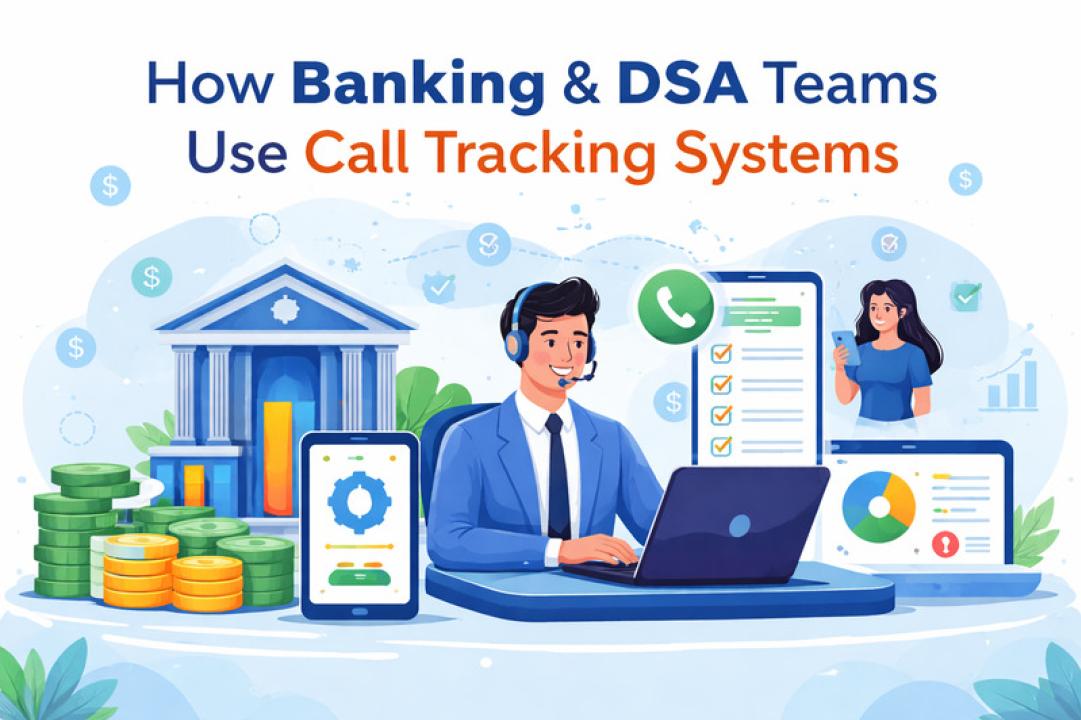
A structured call tracking system for Banking & DSA Teams converts phone conversations into measurable revenue intelligence. When implemented properly, it reshapes how marketing budgets are allocated, how agents are coached, and how pipeline health is evaluated.
Call Tracking as Revenue Infrastructure, Not Reporting Software
Most financial sales teams begin with surface-level metrics:
- Total calls received
- Calls answered vs missed
- Average call duration
These are operational indicators, not strategic ones.
In mature banking setups, call tracking must close the full revenue loop:
- Call initiated
- Lead created
- Application submitted
- Application approved
- Disbursal completed
- Revenue recorded
Without connecting these stages, marketing ROI remains partially blind.
When outcome tagging is integrated into the system, leadership can analyze:
- Cost per funded loan
- Revenue per campaign source
- Conversion rate by traffic channel
- Average ticket size per call origin
A true call tracking system for Banking & DSA Teams shifts reporting discussions from “How many calls did we get?” to “Which calls generated funded revenue?”
That difference changes decision-making at the executive level.
Understanding Financial Buyer Call Behavior
Financial buyers behave differently from retail consumers. They research interest rates, compare lenders, and read reviews before initiating a call. The call itself is often the moment of validation.
On the sales floor, behavioral patterns become clear:
- Callers asking about documentation timelines convert significantly higher than generic rate inquirers.
- Repeat callers within 24 to 48 hours show higher funding probability.
- Longer calls involving eligibility clarification correlate strongly with application submission.
These signals rarely appear in traditional CRM dashboards. They emerge only when call metadata and conversation content are structured and analyzed.
Advanced Banking DSA call tracking implementations classify calls based on intent markers and behavioral signals, allowing better prioritization and routing.
The value lies in segmentation. Rate shoppers, urgent borrowers, documentation-ready prospects, and comparison callers require different handling strategies.
Core Architecture of a Modern Call Tracking Environment
A high-functioning environment includes more than call logging. It involves multiple integrated layers.
Channel-Level Attribution
Dynamic number allocation maps calls to specific channels:
- Organic search
- Paid advertising
- Referral networks
- Branch campaigns
- WhatsApp promotions
- Offline print or outdoor marketing
Without source-level mapping, campaign ROI discussions remain speculative.
CRM Integration and Outcome Feedback
The system should automatically:
- Create leads in CRM
- Tag campaign source
- Attach call duration and timestamps
- Capture agent handling details
- Update final status such as approved or funded
Revenue feedback must flow back into reporting dashboards. Only then can marketing and operations evaluate real contribution.
Conversation Intelligence Layer
Manual call audits do not scale in high-volume DSA operations. AI-powered analytics introduces measurable oversight.
Capabilities typically include:
- Keyword-based intent detection
- Sentiment scoring
- Compliance phrase monitoring
- Automatic call scoring
For example, phrases such as:
- “I can submit documents today.”
- “What is the disbursal timeline?”
- “I need funds urgently.”
These phrases often indicate high purchase intent. Flagging such calls allows priority routing to senior agents.
Strategic Applications in Banking and DSA Operations
When call data is structured properly, it influences multiple operational domains.
Lead Qualification and Prioritization
Instead of relying only on lead forms, teams can build qualification models using:
- Call frequency within defined timeframes
- Mention of documentation readiness
- Objection patterns
- Silence-to-talk ratio
- Escalation requests
Leads can be scored dynamically and routed accordingly. This reduces response time for high-value prospects.
Campaign Reallocation Based on Revenue
In practice, it is common to see channels generating fewer calls but higher funded value. Without revenue-linked call tracking, such insights are invisible.
With structured data, teams can evaluate:
- Revenue per channel
- Cost per approved application
- Disbursal value per traffic source
Marketing budgets can then shift toward higher-yield channels rather than higher-volume ones.
Agent Performance Optimization
Call tracking introduces objective coaching.
Instead of generic feedback, managers can identify:
- Objection mishandling patterns
- Script deviation trends
- Missed disclosure phrases
- Drop-off moments within conversations
Performance discussions become evidence-based rather than perception-driven.
Compliance Oversight
Financial sales are regulated. Disclosure statements and correct product representation are mandatory.
Conversation analytics enables:
- Automated detection of missing compliance phrases
- Audit-ready call storage
- Risk flagging for corrective action
Compliance monitoring becomes proactive rather than reactive.
Operational Execution That Drives Measurable Impact
Structured call tracking improves daily operational efficiency when embedded correctly.
Missed Call Recovery
Missed calls represent direct revenue leakage. Advanced teams implement:
- Automated callback alerts
- Time-to-callback monitoring
- Retry logic tracking
- Conversion measurement post-recovery
Recovered missed calls often convert at higher rates because the initial intent was already established.
Expertise-Based Routing
High-ticket products such as home loans or secured lending should be routed to experienced agents. Intent detection combined with routing rules improves:
- Conversion rate
- Average ticket size
- Customer confidence
Sales Cycle Compression
Urgency signals detected within calls can trigger accelerated workflows. Faster document follow-up and structured reminders shorten the funding cycle.
Shorter cycles improve:
- Working capital flow for DSAs
- Agent productivity
- Customer satisfaction
Metrics That Define High-Performance Teams
Beyond call volume, strategic banking teams monitor:
Revenue-Focused Metrics
- Call-to-application ratio
- Application-to-approval ratio
- Approval-to-disbursal ratio
- Revenue per 100 calls
- Cost per funded deal
Channel Efficiency Metrics
- High-intent call percentage by source
- Average ticket size by campaign
- Revenue concentration across channels
Operational Metrics
- Average callback time
- Missed call percentage
- Queue abandonment rate
- Conversion after missed call recovery
When these metrics are visible in unified dashboards, forecasting improves significantly.
Behavioral Modeling and Predictive Insights
As data accumulates, repeatable patterns emerge.
Teams often observe:
- Specific time windows producing higher conversion rates
- Certain objection clusters predicting drop-off
- Repeat caller behavior correlating with higher approval likelihood
Predictive scoring can prioritize high-probability leads before competitors engage them.
A mature call tracking system for Banking & DSA Teams evolves from a reporting layer into a predictive performance engine. It does not merely record activity. It identifies patterns that influence revenue outcomes.
Implementation Discipline
Technology alone does not deliver results. Structured governance is essential.
Effective implementation includes:
- Defining revenue KPIs before deployment
- Mapping every acquisition channel
- Integrating CRM with outcome tagging
- Embedding compliance monitoring rules
- Establishing weekly performance reviews
- Training agents on insight-driven improvement
Without governance, call tracking becomes another dashboard. With discipline, it becomes operational infrastructure.
Conclusion
In banking and DSA sales ecosystems, phone conversations are primary conversion events. They carry intent signals, compliance risk indicators, and revenue potential in real time.
When structured correctly, a call tracking system for Banking & DSA Teams transforms those conversations into actionable intelligence. It aligns marketing with revenue, strengthens compliance oversight, improves agent coaching, and enhances forecasting accuracy.
In competitive financial markets, visibility into conversation-level performance is no longer a reporting advantage. It is a structural requirement for sustainable growth.