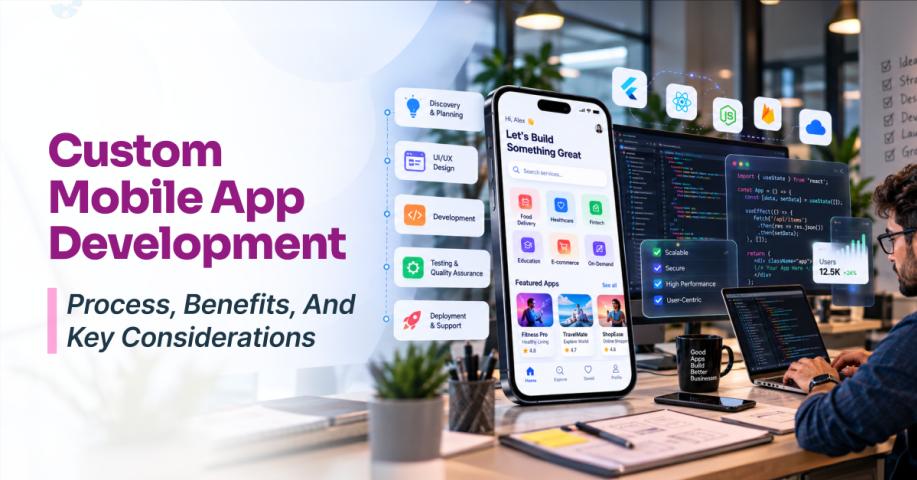
The way businesses engage with customers has fundamentally shifted. Mobile devices now account for over 60% of global web traffic, and consumer expectations have evolved accordingly. If your business strategy still treats mobile as an afterthought, you're not just behind the curve — you're actively leaving revenue on the table.
For founders, CTOs, and enterprise decision-makers, the question is no longer whether to invest in mobile, but how to do it in a way that drives measurable outcomes.
The Real Cost of Ignoring Mobile-First Strategy
Many organizations underestimate the compounding cost of delayed mobile adoption. It's not just about missing app store downloads. It's about friction in the customer journey, weakened brand loyalty, and operational inefficiencies that quietly drain resources.
Consider a mid-sized retail company that relies entirely on a responsive website. While functional, it can't send personalized push notifications, can't leverage device-level features like biometric authentication, and can't deliver the seamless offline experience that modern consumers expect. Each of these gaps translates into abandoned carts, reduced session times, and lower lifetime customer value.
The competitive disadvantage compounds over time. Businesses that invested in dedicated mobile applications three years ago have now built proprietary data ecosystems, refined their UX through thousands of iterations, and created switching costs that keep users engaged. Starting late doesn't mean starting from zero — but it does mean you have a steeper hill to climb.
Android vs. Cross-Platform: Choosing the Right Development Path
One of the first strategic decisions enterprise teams face is platform selection. With Android commanding over 70% of the global smartphone market, particularly dominant across Asia, Africa, and Latin America, it's often the primary target for businesses with broad consumer reach.
However, platform choice isn't purely about market share. It depends on your user demographics, use case complexity, budget constraints, and long-term scalability goals.
When to Prioritize Native Android Development
Native Android development makes sense when your application requires deep hardware integration — think augmented reality features, complex camera functionality, Bluetooth connectivity, or real-time processing. Native apps deliver superior performance in these scenarios because they communicate directly with the operating system without an abstraction layer.
Enterprise applications dealing with sensitive data — healthcare records, financial transactions, identity verification — also benefit from native development. The security frameworks available through native SDKs are more granular and easier to audit, which matters greatly during compliance reviews.
When Cross-Platform Makes More Sense
For businesses targeting both Android and iOS with tighter timelines and budgets, cross-platform frameworks like Flutter and React Native have matured significantly. They now support complex UI patterns, near-native performance, and large plugin ecosystems.
The trade-off is real but manageable. You gain speed-to-market and code reusability at the cost of some platform-specific optimization. For most B2C applications — e-commerce, service marketplaces, content platforms — this trade-off is entirely acceptable.
What Enterprise Decision-Makers Get Wrong About App Development
There's a persistent myth that building an app is primarily a technical exercise. In reality, the most expensive failures in mobile development are strategic, not technical.
Underestimating Discovery and Planning
Skipping or rushing the discovery phase is the single biggest predictor of project failure. This phase — where user personas, core workflows, technical architecture, and integration requirements are mapped out — determines the quality of every subsequent decision.
Organizations that treat discovery as optional often find themselves mid-development when fundamental conflicts emerge. Retrofitting architecture is costly, demoralizing for development teams, and damaging to timelines.
Treating MVP as a Finished Product
A Minimum Viable Product is a learning vehicle, not a market-ready solution. Many businesses launch an MVP, gather lukewarm feedback, and then either over-invest in a flawed foundation or abandon the initiative entirely.
The right approach is to treat your MVP launch as the beginning of a product loop — deploy, measure, learn, iterate. This requires pre-defined success metrics, robust analytics integration from day one, and organizational commitment to post-launch investment.
Ignoring Backend Scalability
Frontend elegance means nothing if your backend can't handle load. This is especially relevant for businesses anticipating rapid user growth or seasonal traffic spikes. Cloud-native architectures, microservices design, and proper API gateway management should be architectural priorities, not afterthoughts.
How to Select the Right Development Partner
Choosing a development partner is arguably more consequential than choosing a technology stack. The wrong partner can deliver technically functional software that completely misses business objectives.
When evaluating vendors, look beyond portfolio aesthetics. Ask for case studies that demonstrate business outcomes — retention rates improved, operational costs reduced, revenue streams created. A strong partner should be able to articulate the "why" behind their technical decisions, not just the "what."
Engagement model flexibility also matters. Businesses working with experienced Android app development services providers, such as InnovationM, often find that the most productive partnerships operate on outcome-oriented models rather than pure time-and-materials arrangements, because they align incentives toward delivery quality rather than billable hours.
Check for domain expertise relevant to your industry. A development team with healthcare app experience understands HIPAA compliance nuances by default. A team experienced in fintech knows how to build secure payment flows that satisfy regulatory auditors. This domain knowledge shortens onboarding time and reduces costly rework.
Red Flags to Watch For
- Vendors who immediately jump to solutions before deeply understanding your problem
- Teams that can't clearly explain their QA and testing methodology
- Partners who discourage phased delivery in favor of large, upfront commitments
- Agencies that don't have dedicated UX/UI designers embedded in the development process
Building for Longevity, Not Just Launch
The most successful enterprise mobile applications share a common characteristic: they were designed for evolution. The technology landscape shifts rapidly. User expectations change. Regulatory requirements evolve. An application architecture that can't adapt becomes a liability within three to five years.
This means investing in clean, well-documented codebases — even when shortcuts seem tempting under deadline pressure. It means establishing CI/CD pipelines early, so future updates can be deployed confidently without regression risk. It means building modular architectures that allow individual components to be updated or replaced without rebuilding from scratch.
Accessibility is another dimension that forward-thinking organizations prioritize from the start rather than retrofitting. Applications that comply with WCAG guidelines reach broader audiences and, increasingly, satisfy legal requirements in multiple markets.
Metrics That Actually Matter Post-Launch
Vanity metrics like download counts and app store ratings are poor proxies for business performance. The metrics that genuinely indicate product-market fit and long-term viability include:
Day 1, Day 7, and Day 30 retention rates — the clearest signal of whether your app delivers recurring value
Session depth and feature adoption rates — indicate whether users are discovering and engaging with core functionality
Crash rate and ANR (Application Not Responding) frequency — directly correlate with uninstall behavior
Customer acquisition cost via mobile — compared against other channels to assess ROI
Net Promoter Score — measures whether your mobile experience drives advocacy