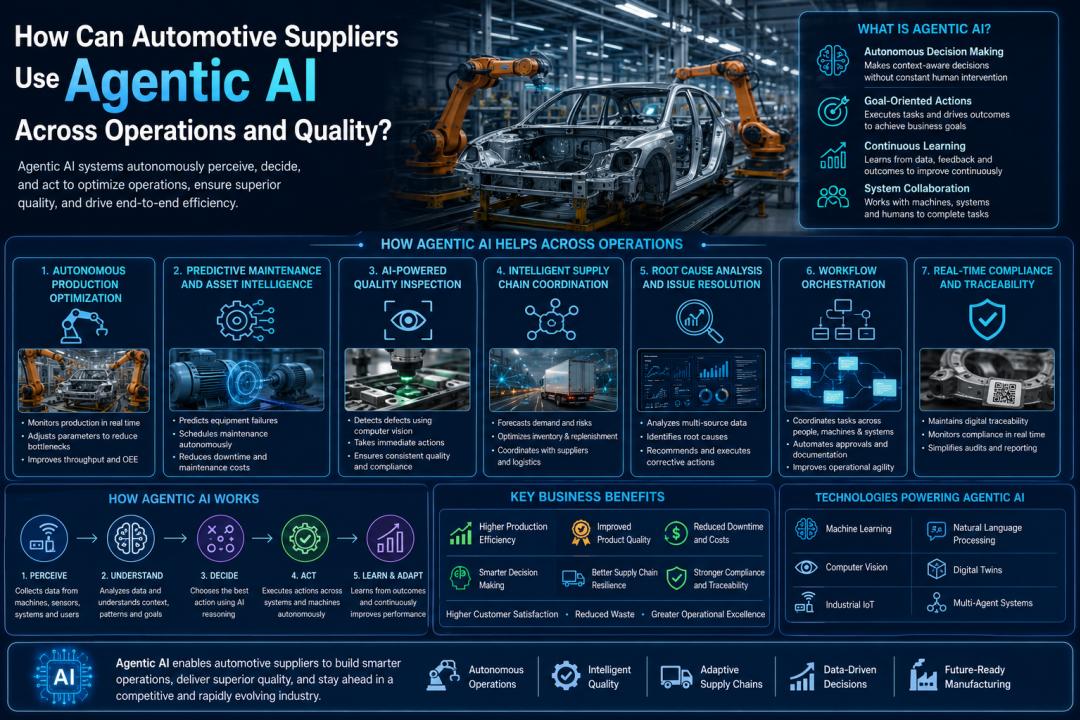
The automotive industry is entering a new phase of intelligent manufacturing driven by automation, connected systems, and real-time decision-making. Automotive suppliers are under increasing pressure to improve production efficiency, reduce defects, optimize supply chains, and maintain strict quality standards while managing rising operational complexity.
Traditional automation systems can handle repetitive workflows, but they often struggle with dynamic production environments, fragmented data, and rapidly changing operational conditions.
Agentic AI is changing this landscape.
Unlike conventional AI systems that only analyze data or provide recommendations, agentic AI systems can autonomously make decisions, coordinate workflows, execute tasks, and continuously optimize operations with minimal human intervention.
For automotive suppliers, agentic AI enables smarter factories, intelligent quality management, predictive operations, and adaptive supply chain systems.
In this blog, we explore how automotive suppliers can use agentic AI across operations and quality management, key use cases, benefits, and future trends.
What is Agentic AI?
Agentic AI refers to AI systems capable of:
- Understanding operational goals
- Making autonomous decisions
- Taking actions independently
- Coordinating with other systems
- Learning continuously from outcomes
These AI agents function like intelligent digital coworkers that can monitor, analyze, plan, and execute operational tasks across manufacturing ecosystems.
In automotive manufacturing environments, agentic AI agents can:
- Monitor production lines
- Detect quality issues
- Coordinate maintenance schedules
- Optimize inventory levels
- Trigger corrective actions
- Communicate with enterprise systems automatically
Why Automotive Suppliers Need Agentic AI
Automotive suppliers operate in highly complex environments involving:
- Multi-tier supply chains
- Just-in-time manufacturing
- Strict quality compliance
- High production volumes
- Multiple product variants
- Frequent engineering changes
Common operational challenges include:
- Production downtime
- Defect detection delays
- Inventory shortages
- Equipment failures
- Manual quality inspections
- Data silos across systems
Agentic AI helps suppliers move from reactive operations to autonomous and predictive manufacturing environments.
How Automotive Suppliers Use Agentic AI Across Operations
1. Autonomous Production Line Optimization
Agentic AI systems continuously monitor production data from:
- Sensors
- PLC systems
- MES platforms
- Robotics
- IoT devices
AI agents analyze:
- Cycle times
- Machine performance
- Production bottlenecks
- Throughput rates
- Downtime patterns
The agents automatically adjust production parameters to improve efficiency.
Example
An AI agent detects a slowdown in robotic welding operations and automatically reallocates workloads across available machines.
Benefits
- Improved throughput
- Reduced downtime
- Better production efficiency
- Faster operational decisions
2. Predictive Maintenance and Asset Intelligence
Unexpected equipment failures can disrupt automotive supply chains and increase operational costs.
Agentic AI enables predictive maintenance by:
- Monitoring equipment health
- Predicting failures
- Scheduling maintenance automatically
- Ordering replacement parts proactively
AI agents analyze:
- Vibration data
- Temperature readings
- Acoustic patterns
- Equipment usage history
Example
An AI agent identifies abnormal vibration patterns in a stamping machine and automatically schedules maintenance before breakdown occurs.
Benefits
- Reduced unplanned downtime
- Lower maintenance costs
- Extended equipment lifespan
- Improved plant reliability
3. AI-Powered Quality Inspection
Quality control is critical in automotive manufacturing because even minor defects can lead to recalls and warranty claims.
Agentic AI combines:
- Computer vision
- Deep learning
- Real-time analytics
- Automated decision-making
to detect manufacturing defects instantly.
AI agents can inspect:
- Weld quality
- Paint defects
- Surface scratches
- Component alignment
- Assembly accuracy
Example
If a defect is detected, the AI agent automatically:
- Stops the production line
- Flags defective parts
- Notifies quality teams
- Updates quality records
- Suggests corrective actions
Benefits
- Faster defect detection
- Reduced scrap and rework
- Higher product quality
- Lower warranty claims
4. Intelligent Supply Chain Coordination
Automotive suppliers rely on tightly connected supply chains.
Agentic AI systems optimize:
- Inventory management
- Supplier coordination
- Demand forecasting
- Logistics planning
- Material replenishment
AI agents analyze:
- Production schedules
- Supplier performance
- Demand fluctuations
- Transportation delays
Example
An AI agent predicts a raw material shortage and automatically adjusts procurement plans while notifying production teams.
Benefits
- Reduced inventory shortages
- Improved supply chain visibility
- Better delivery performance
- Lower operational risks
5. Root Cause Analysis for Manufacturing Defects
Traditional root cause investigations are time-consuming and often reactive.
Agentic AI systems automatically analyze:
- Sensor data
- Production logs
- Machine conditions
- Operator actions
- Environmental variables
to identify the source of defects quickly.
Example
An AI agent identifies that temperature fluctuations during injection molding are causing dimensional inconsistencies.
Benefits
- Faster problem resolution
- Reduced quality issues
- Improved process stability
6. Autonomous Workflow Orchestration
Automotive suppliers manage complex workflows involving multiple departments and systems.
Agentic AI can coordinate:
- Production schedules
- Quality approvals
- Maintenance workflows
- Procurement processes
- Compliance documentation
AI agents interact with:
- ERP systems
- MES platforms
- PLM software
- Warehouse systems
Benefits
- Reduced manual coordination
- Faster workflow execution
- Improved operational agility
7. Real-Time Compliance and Traceability
Automotive suppliers must comply with strict quality and regulatory standards.
Agentic AI helps automate:
- Audit preparation
- Documentation tracking
- Traceability reporting
- Compliance monitoring
AI agents maintain real-time records of:
- Production batches
- Component origins
- Inspection results
- Process changes
Benefits
- Better regulatory compliance
- Faster audits
- Improved traceability
Key Technologies Behind Agentic AI in Automotive Manufacturing
Machine Learning
Enables predictive analytics and operational intelligence.
Computer Vision
Detects manufacturing defects and quality issues.
Industrial IoT
Provides real-time operational data from connected equipment.
Natural Language Processing (NLP)
Enables intelligent reporting and human-AI interaction.
Digital Twins
Simulate manufacturing environments for optimization.
Multi-Agent Systems
Allow multiple AI agents to collaborate across operations.
Real-World Use Cases for Automotive Suppliers
Tier-1 Automotive Suppliers
Use agentic AI for automated defect detection and predictive maintenance.
EV Battery Manufacturers
Deploy AI agents to monitor battery production quality and safety.
Automotive Electronics Suppliers
Use AI-powered inspection systems for PCB and semiconductor quality validation.
Metal Stamping Suppliers
Implement AI agents to optimize machine utilization and reduce downtime.
Business Benefits of Agentic AI for Automotive Suppliers
Automotive suppliers adopting agentic AI gain measurable operational advantages.
Key Benefits Include:
- Increased production efficiency
- Improved product quality
- Reduced downtime
- Lower operational costs
- Faster decision-making
- Better supply chain coordination
- Reduced scrap and rework
- Higher customer satisfaction
- Improved compliance and traceability
Agentic AI enables suppliers to create more autonomous, adaptive, and intelligent manufacturing ecosystems.
Challenges of Implementing Agentic AI
Despite its advantages, implementation comes with challenges.
Common Challenges:
- Legacy system integration
- Data silos
- High implementation complexity
- Cybersecurity risks
- Workforce adoption concerns
- AI governance requirements
Successful deployment requires:
- Strong data infrastructure
- Scalable AI architecture
- Cross-functional collaboration
- Clear operational goals
The Future of Agentic AI in Automotive Manufacturing
The future of automotive manufacturing will increasingly rely on autonomous AI-driven operations.
Emerging trends include:
- Self-optimizing factories
- Autonomous production planning
- AI-driven robotic coordination
- Intelligent supplier ecosystems
- Generative AI engineering assistants
- Fully connected smart manufacturing networks
As Industry 4.0 evolves, agentic AI will become a foundational technology for competitive automotive suppliers.
Conclusion
Agentic AI is transforming how automotive suppliers manage operations, production efficiency, and quality control. By combining autonomous decision-making, predictive analytics, computer vision, and intelligent workflow orchestration, automotive suppliers can improve operational performance while reducing costs and quality risks.
From predictive maintenance and intelligent inspection systems to autonomous supply chain coordination, agentic AI enables suppliers to build smarter, faster, and more resilient manufacturing operations.
Organizations investing in agentic AI today will gain a significant competitive advantage in the future of automotive manufacturing.
Looking to Build Agentic AI Solutions for Automotive Manufacturing?
At Intellectyx we help automotive suppliers develop AI-powered solutions for:
- Intelligent manufacturing
- AI quality inspection
- Predictive maintenance
- Industrial automation
- Supply chain intelligence
- Agentic AI systems
Our experts build scalable AI solutions tailored for modern automotive manufacturing ecosystems.