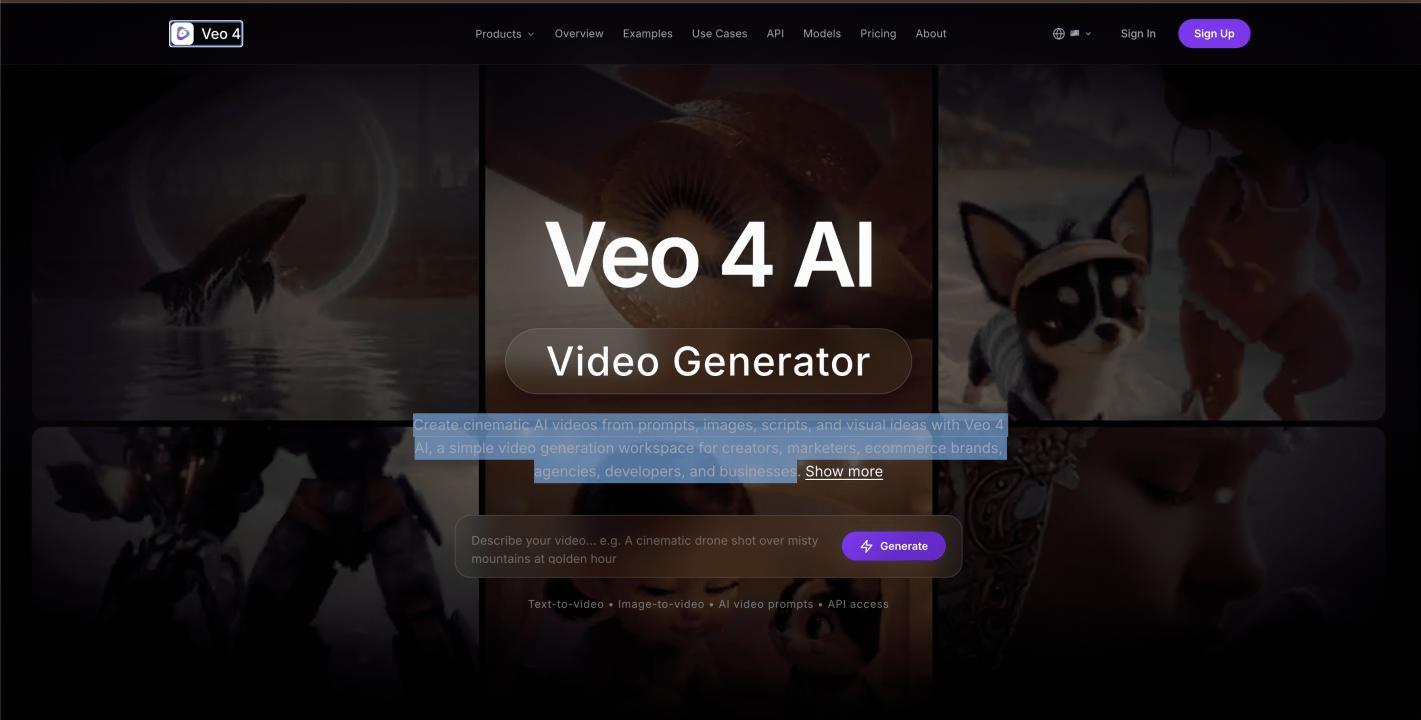
Veo 4’s launch has fundamentally changed the direction of generative media. Previous video models have almost entirely concentrated on the visual layer. Veo 4 is the first video model that adopts a holistic approach to video synthesis, incorporating a native audio-engine directly into the diffusion process. This is not just about putting a soundtrack to a video; it is a synchronized creation where every visual movement is biologically and physically tied to a corresponding sound. And for a digital entrepreneur such , managing professional-grade applications means tools that deliver this level of native synergy to reduce the ‘friction’ of post-production.
The Unified Latent Space: Vision & Audio
The technical innovation of Veo 4 is its joint latent space. A creator makes a video and then uses another AI to make audio, which in standard workflows can feel “desynced.” Veo 4 tackles this by producing both modalities simultaneously. When the AI draws a scene of a glass breaking, the acoustic signature of that particular type of glass – its resonance, its shatter pattern, its impact – is generated as part of the same mathematical probability. The final 1080p output feels alive and immersive thanks to this “Acoustic-Visual Entanglement,” delivering a level of realism that was once the exclusive domain of professional foley artists.
Cinematic Command & Control
Veo 4 is designed for the professional director. It knows complicated movie jargon that goes far beyond simple descriptions. If a user specifies a “long-take tracking shot with low-key lighting and shallow depth of field,” Veo 4 adjusts its virtual camera parameters accordingly. It mimics the physics of a 35 or 50 mm lens, with realistic bokeh and peripheral distortion. This makes it an essential tool for building sophisticated SaaS platforms designed for high-end content creators who want granular control over their visual storytelling.
Extended FAQ The Veo 4 Advantage
What is the longest a Veo 4 generation can last?
Veo 4 is designed to create cinematic compositions that unfold continuously for more than 60 seconds without losing structural coherence or narrative focus.
Does it have local sound effects?
Yes, the native audio engine can recognize sound sources in 3D space relative to the video, producing a binaural or surround-sound experience.
How does it compare for text to video vs image to video?
Veo 4 is multimodal, so it can accept a high res reference image (say, one from Nano Banana 2) and “hallucinate” the motion and sound that would logically follow from that static moment.
Does the sound quality sound professional?
The audio is high fidelity 48kHz and suitable for direct use in commercial advertising and social media content.
Can Veo 4 cut and paste existing videos?
Yes, it has a sophisticated “In-filling” and “Extending” feature that can generate frames and sounds before or after an existing piece of footage.