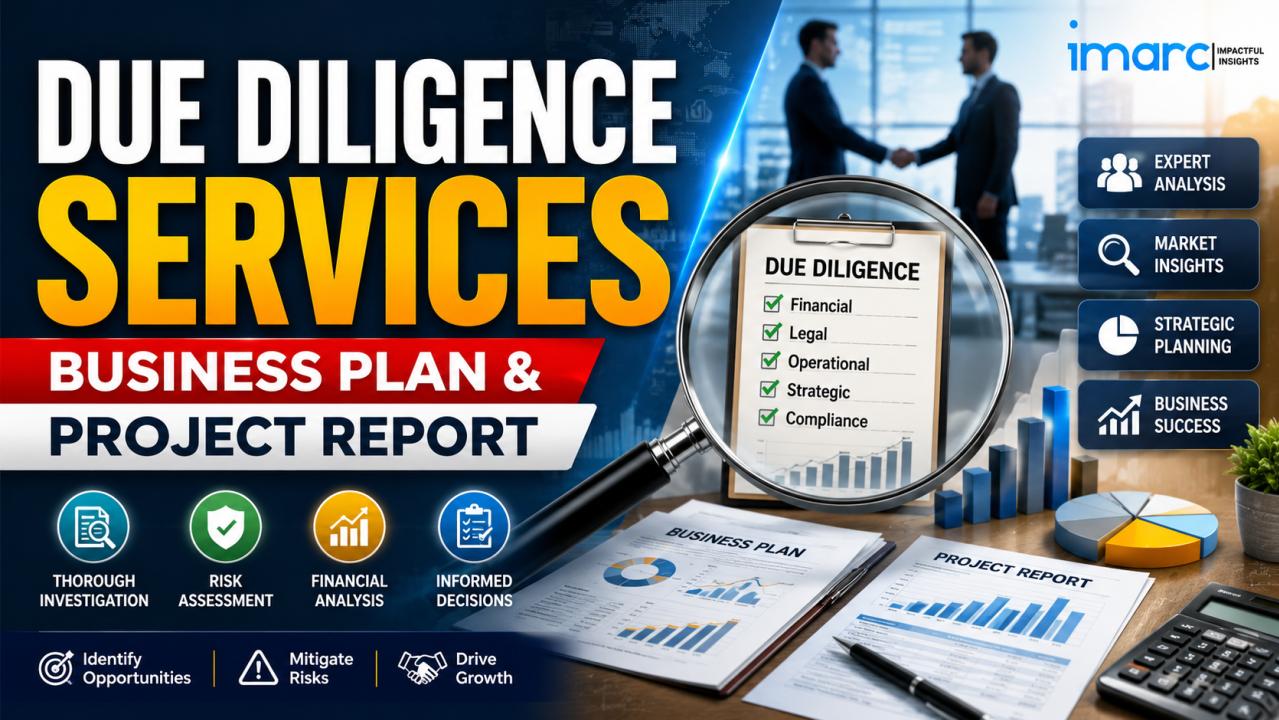
IMARC Group's "Due Diligence Services Business Plan and Project Report 2026" provides a detailed and practical roadmap for launching and managing a successful due diligence service. The report highlights market dynamics, client demand, service formats, investment needs, and profitability forecasts. It serves as a vital resource for entrepreneurs, financial professionals, corporate advisors, and investors. It also offers step-by-step guidance on due diligence services business plan setup, service planning, regulatory requirements, and operational execution.
What are Due Diligence Services?
Due diligence services refer to structured investigative processes that evaluate the credibility, risks, and operational realities of a business, individual, asset, or transaction. These services ensure that decisions related to investments, partnerships, acquisitions, vendor onboarding, or regulatory compliance are based on verified information rather than assumptions. They typically involve financial reviews, legal checks, operational assessments, reputational analysis, and background verification. By providing an independent and comprehensive assessment, due diligence helps organizations minimize exposure to fraud, non-compliance, misrepresentation, and operational risks.
In modern business environments, due diligence plays a central role in strategic decision-making. Organizations rely on these services to validate claims, understand potential liabilities, evaluate governance practices, and assess the long-term stability of a target entity. The process often includes document reviews, data authentication, site inspections, stakeholder interviews, and digital footprint analysis. As companies increasingly operate across borders, due diligence has expanded to include compliance screening, anti-corruption checks, beneficial ownership verification, and reputational intelligence assessment. The objective is to provide stakeholders with a clear and unbiased understanding of the risks and advantages associated with a business decision.
Due Diligence Services Business Market Trends and Growth Drivers:
The trends and drivers of a due diligence services business are shaped by the rising demand for risk-mitigation services, as organizations increasingly prioritize independent verification to reduce exposure to fraud, compliance failures, and governance risks, driving sustained demand for structured due diligence assessments across sectors.
Expansion of Cross-Border Business Activities - Global operations, international partnerships, and multi-country investments require deeper checks on compliance, ownership, and legal standing, encouraging organizations to outsource due diligence to specialized service providers.
Growing Focus on Regulatory Compliance - Stricter corporate governance norms and evolving compliance obligations motivate companies to seek external assessments that ensure their partners, vendors, and acquisition targets meet required standards.
Latest Industry Developments:
- October 2025: S-RM launched Perspecta Diligence, an AI-driven due diligence solution enabling organizations to efficiently assess and triage third-party risk at scale. The platform streamlined screening processes, offered reliable checks on low- and medium-risk partners, and integrated seamlessly with existing third-party risk management programs.
- September 2025: Astek acquired Quantion, a Spanish digital transformation specialist. The deal enhanced Astek's presence in Spain and across Europe, bolstering expertise in customer experience, data and AI, cloud infrastructure, and due diligence services, with strong synergies in the travel and airline sector.
- September 2025: Pinsent Masons launched Portana, a new online platform designed to streamline due diligence services in complex M&A transactions. The platform enabled clients to quickly identify key issues without reviewing lengthy reports and allowed lawyers and clients to collaborate in real-time, enhancing efficiency and transparency throughout the due diligence process.
To meet these demands, operators are investing in domain experts, research capabilities, digital assessment tools, client engagement systems, branding activities, and operational resources to build a credible due diligence practice capable of offering high-quality, insight-driven evaluations. These investments not only enhance the client experience but also strengthen business outcomes by aligning with broader trends in risk management and corporate governance.
Revenue diversification is another critical factor in building financial resilience. In addition to direct consulting and advisory fees, income streams may include specialized investigative services, compliance verification packages, vendor and partner onboarding assessments, and ongoing monitoring and reporting services.
Location and community engagement play a vital role in success. Practices positioned in areas with high concentrations of corporate headquarters, financial institutions, and legal firms benefit from steady client referrals and professional credibility. At the same time, state-of-the-art digital infrastructure, compliance with confidentiality norms and data protection requirements, and adherence to ethical review standards ensure operational excellence and client trust.
How Do You Set Up a Due Diligence Services Business?
The IMARC report serves as a complete guide for setting up a due diligence services business, covering:
- Industry overview and market performance
- Service workflows and offerings
- Facility planning and equipment requirements
- Cost structure (CapEx & OpEx)
- Revenue generation models
- Risk mitigation strategies
- Licensing and regulatory compliance
- Profitability and investment analysis
Request for a Sample Report: https://www.imarcgroup.com/due-diligence-services-business-plan-project-report/requestsample
Key Requirements for Setting Up Due Diligence Services:
1. Business Model & Operations Plan:
- Service Overview: Financial reviews, legal checks, operational assessments, reputational analysis, background verification, compliance screening, anti-corruption checks, beneficial ownership verification
- Service Workflow: Client intake → needs assessment → document collection and review → analysis and investigation → report generation → delivery and client consultation
- Revenue Model: Consultation and advisory fees, specialized investigative services, compliance verification packages, ongoing monitoring and reporting services
- SOPs & Service Standards: Guidelines for client confidentiality, data handling, ethical practices, regulatory awareness, and service quality
2. Technical Feasibility:
- Site Selection Criteria: Proximity to corporate headquarters, financial institutions, legal firms, and business hubs
- Space & Costs: Office spaces, meeting rooms, administrative areas, secure document storage
- Equipment & Suppliers: Digital assessment tools, secure data-handling systems, research databases, collaboration platforms
- Interior Setup & Fixtures: Professional, private setups suited to confidential consultations
- Utility Requirements & Costs: IT infrastructure, high-speed internet, cybersecurity systems, cloud storage
- Human Resources & Wages: Compliance experts, risk evaluators, investigative researchers, financial analysts, legal advisors, project managers, client coordinators
3. Financial Feasibility:
Includes:
- Capital Investments & Operating Costs
- Revenue & Expenditure Projections
- Profit & Loss Analysis
- Taxation & Depreciation
- ROI, NPV & Sensitivity Analysis
Market Analysis & Insights:
Industry Overview:
The report covers:
- Market drivers & challenges
- Demand patterns
- Client preferences
- Segmentation by service type and region
Competitive Landscape:
Profiles of leading due diligence service providers offering:
- Service formats
- Pricing strategies
- Market positioning
- Client engagement models
Capital & Operational Cost Breakdown:
Capital Expenditure (CapEx): Equipment and machinery costs account for the largest portion of the total capital expenditure. The cost of facility development forms another substantial part of the overall capital investment. This allocation ensures a solid foundation for safe and efficient operations.
Operational Expenditure (OpEx): In the first year of operations, the operating cost for the due diligence services is projected to be significant, covering salaries and wages, utilities, overheads, depreciation, taxes, among others. By the fifth year, the total operational cost is expected to increase substantially due to factors such as inflation, market fluctuations, and a potential increase in labor costs.
Projections account for inflation, technology upgrades, and demand fluctuations.
Profitability Projections:
The report outlines a detailed profitability analysis over the first five years of operations, including projections for:
- Total revenue from consultation services, specialized investigations, and compliance packages, expenditure breakdown, gross profit, and net profit
- Profit margins for each revenue stream and year of operation
- Revenue per client projections and market penetration growth estimates
These projections offer a clear picture of the expected financial performance and profitability of the business, allowing for better planning and informed decision-making.
FAQs:
1. Do I need a license to operate a due diligence service?
Yes- the practice must ensure adherence to confidentiality norms, data protection requirements, industry-specific compliance expectations, and ethical review standards that govern how sensitive information is collected, evaluated, and reported during due diligence engagements.
2. What is the ideal target audience for due diligence services?
Investors, enterprises, financial institutions, legal firms, and organizations seeking independent verification for partnerships, acquisitions, vendor onboarding, and regulatory compliance.
3. How do due diligence businesses make money?
Through consultation and advisory fees, specialized investigative services, compliance verification packages, and ongoing monitoring and reporting services.
4. Are due diligence services profitable?
Yes- the business demonstrates strong viability due to increasing demand for independent transaction validation, high-value advisory margins, recurring engagements from investors, and a growing reliance on specialist insights that enhance trust and reduce risks in business decisions.
Why This Report Matters:
Due diligence services combine investigative relevance, risk management expertise, and strong commercial potential. This report equips entrepreneurs with the insights needed to build a successful and scalable due diligence services business from planning and licensing to profitability forecasting.
About Us:
IMARC Group is a leading global market research and management consulting firm. We specialize in helping organizations identify opportunities, mitigate risks, and create impactful business strategies.
Our expertise includes:
- Market Entry and Expansion Strategy
- Feasibility Studies and Business Planning
- Company Incorporation and Advisory Service Setup Support
- Regulatory and Licensing Navigation
- Competitive Analysis and Benchmarking
- Industry Partnership Development
- Branding, Marketing, and Client-Focused Customer Strategy
Contact Us:
IMARC Group
134 N 4th St. Brooklyn, NY 11249, USA
Email: sales@imarcgroup.com
Tel No: (D) +91 120 433 0800
United States: (+1-201-971-6302)