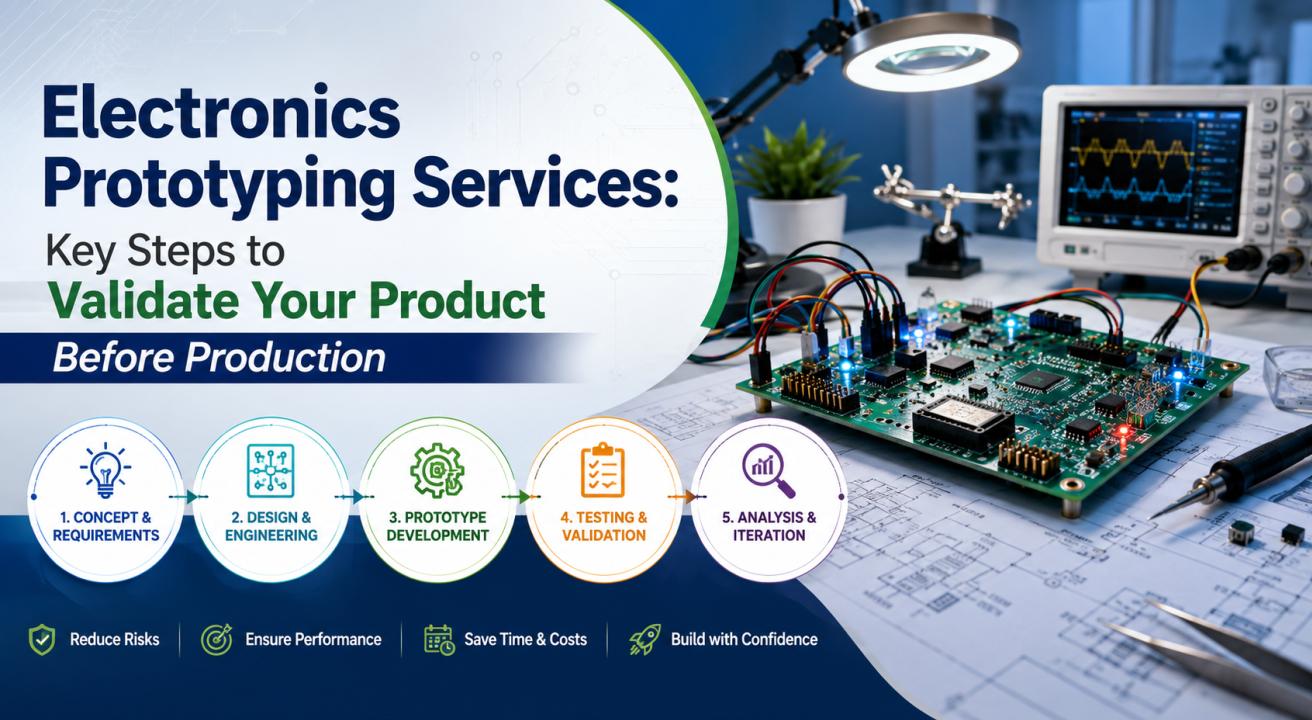
A successful hardware prototype is an essential milestone, but it doesn't mean the device is ready for manufacturing. The true test comes when that same design has to be assembled again, sourced with available components, pass functional testing, and perform reliably outside the engineering lab.
This is where electronics prototyping services can be helpful. They’re used by hardware teams to evaluate designs, uncover manufacturing issues early, and improve hardware and software before full production.
If you are developing an IoT device, industrial controller, or consumer electronics product, a structured validation method can help you avoid costly redesigns, improve production readiness, and build confidence before scaling the operations.
Why Validation Matters More Than Speed
It's tempting to rush toward manufacturing once the first prototype powers on successfully. The reality is that a working prototype only answers one question: Can it function?
Production requires answering several more:
Can the PCB assembly be repeated consistently?
Are critical components readily available?
Is the design easy to manufacture and test?
Will the product perform reliably outside the lab?
Finding these answers early helps reduce engineering revisions, supply chain delays, and quality issues later.
Key Steps Before Moving to Production with Electronics Prototyping Services
1. Validate the Design Under Real Conditions
Bench testing is only the beginning. Hardware should be evaluated in the environments where customers will actually use it.
For example, an embedded system developed for industrial equipment can be subject to vibration and temperature changes that occur in office testing. These tests identify flaws before they result in expensive field failures.
2. Review Manufacturability Early
A few simple design considerations during the DFMA phase will ensure that there are no costly production holdups at later stages.
A manufacturing review typically checks:
PCB layout for efficient assembly
Component placement for easier testing
Solderability and production tolerances
Opportunities for BOM optimization
Making these improvements before tooling begins reduces redesign costs and shortens production timelines.
3. Verify Embedded Software Alongside Hardware
Hardware and software development should go hand in hand. Reliable firmware engineering services ensure sensors, processors, communication modules, and peripherals perform appropriately as hardware improves.
In practice, many problems that seem to be hardware failures are caused by firmware timing, initialization, or communication errors. It’s considerably easier to fix those problems if you find them early in integration testing.
4. Evaluate Component Availability
A prototype built with hard-to-source components may never become a scalable product.
Before committing to production, review:
Component sourcing options
Approved alternative parts
Lead times for critical components
Supply chain visibility across suppliers
This step reduces the risk of redesigns caused by unavailable parts after orders are placed.
5. Build a Small Production Run
Low-volume manufacturing is the intermediate step between engineering samples and production.
Rather than turning out thousands of pieces at a time, many companies may do a small batch to make sure that their assembly lines, quality checks, packing, and functional testing are all working. This strategy often produces process improvements that are hard to see from a single prototype.
Continued firmware engineering services at this level also help to fine-tune performance, resolve edge-case behaviors, and increase product stability before greater production quantities.
Common Mistakes Hardware Teams Should Avoid
Even experienced teams can overlook details that create delays later. Some of the most common include:
Treating a successful prototype as production-ready
Waiting too long to optimize the BOM
Ignoring component lifecycle and sourcing risks
Delaying manufacturing feedback until after design completion
Testing hardware and firmware independently instead of together
What most hardware teams don’t realize is that you don’t get to a successful product by building one perfect prototype. They get better through repeated validation cycles. This fortifies the design as well as the production process.
Why Hardware Teams Choose Elecbits for Product Validation
Getting from concept to production takes a lot more than just making a working board. Elecbits makes it easier for hardware companies to make this transformation by combining engineering expertise and production support in one workflow.
Teams get more insight into all stages of development from rapid prototyping and PCB assembly to sourcing coordination, DFMA evaluations, and firmware engineering services with fewer iterations before going to production.
Summary
With increasing complexity in hardware products, the gap between a fully functional prototype and a manufacturable product widens. By investing in electronics prototyping services, teams can validate their designs, improve manufacturing readiness, and reduce the risk of production problems. Businesses that will invest in validation now are ready for future success in terms of launching a quality product and entering the mass-production stage.